
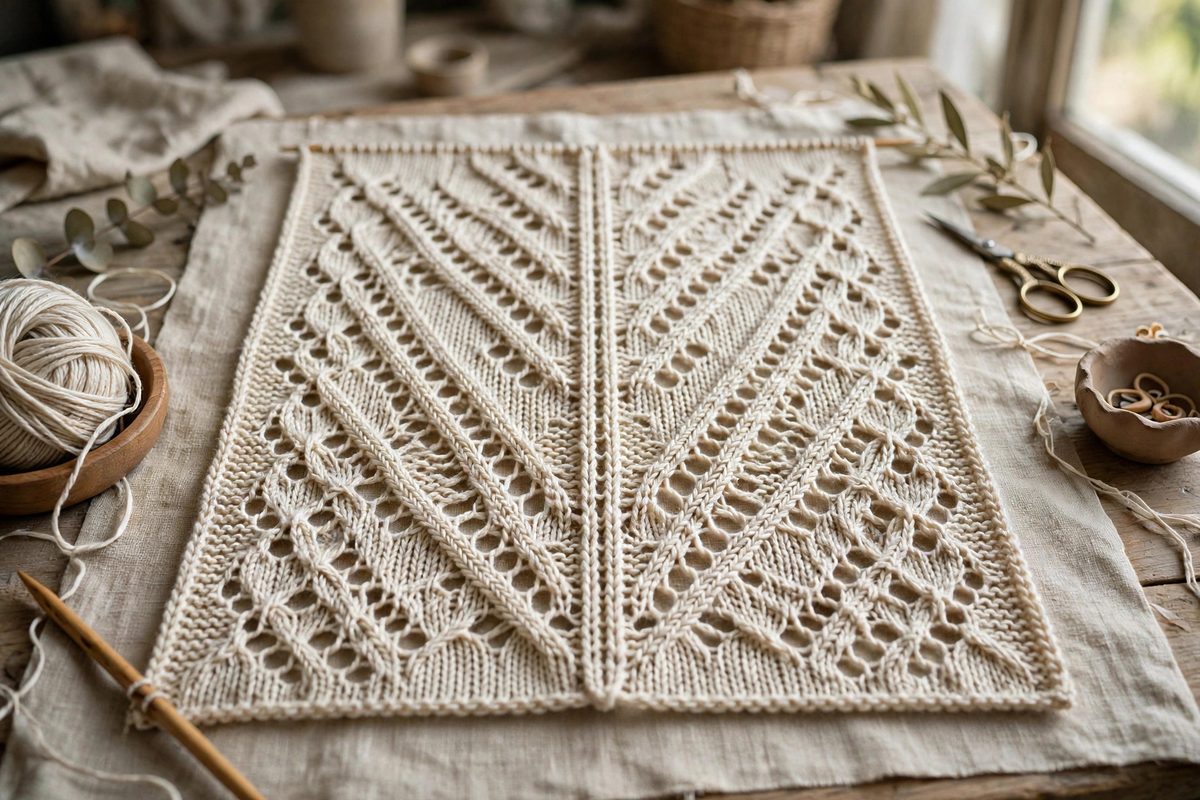
In mirrored lace, the same motif reflects across a center line: decreases lean toward the spine on one side and away on the other, keeping the fabric symmetric. The stitch that holds the whole mirror together is the central double decrease, which removes two stitches at once while keeping a single stitch centered on the axis. Get its geometry right and the lace reads as one continuous design; get it wrong and the center line wobbles, the stitch count drifts, and the mirror breaks.
What the decrease actually does
A central double decrease takes three stitches and turns them into one. The center stitch of the three stays on top and stays centered, while the two flanking stitches disappear behind it, one to each side. Because it consumes two stitches net, it must always be paired with two yarnovers somewhere in the row to keep the stitch count constant. Its defining trait is symmetry: unlike a k3tog, which leans visibly to one side, the central double decrease presents a straight vertical line. That straight line is what the eye follows down the lace, so its neatness determines the whole piece's crispness.
Two ways to work it
The classic method: slip two stitches together knitwise, knit the next stitch, then pass the two slipped stitches over. This produces a centered decrease with the middle stitch on top. The alternative, sometimes called the centered double decrease worked differently, is to slip one, knit two together, pass the slipped stitch over; it is faster but the center stitch does not sit quite as perfectly on top. For mirrored lace where the spine is the visual anchor of the design, the slower slip-two method is worth the extra motion. Whichever method you choose, use it consistently: mixing methods down a center line creates a visible texture change.
Geometry of the mirror
Mirroring means every decrease on the left has a counterpart on the right at the same distance from center. The central double decrease sits exactly on the axis, so it needs no counterpart; it is the hinge the mirror swings on. Around it, pair your single decreases correctly: an ssk on the left mirrors a k2tog on the right (or the reverse, depending on the design's lean convention). The yarnovers that compensate the central decrease should also mirror, one on each side at equal distance from center. When chart-reading, mark the center stitch with a highlighter on every row; it is astonishingly easy to drift one stitch off axis over a long repeat, and the error compounds.
Stitch count discipline
Every row of mirrored lace is an arithmetic check. The central double decrease removes two; count your yarnovers and make sure they add two. Between markers, the stitch count must be identical on every pattern row. Develop the habit of counting each section after completing a pattern row, before moving on. It takes seconds and catches the dropped yarnover or the accidental k2tog that would otherwise surface ten rows later as a visible jog in the spine. Place a removable marker immediately on each side of the center stitch; when the markers are no longer equidistant from the row's edges, you know the drift happened and roughly where.
Tension at the center line
The central decrease is worked over stitches that have just been decreased on previous rows, so the fabric there is dense and the needle can be hard to insert. Work the decrease with slightly relaxed tension and, if needed, a needle tip one size smaller for that stitch only. Avoid yanking the working yarn tight after the decrease; a tight center line puckers the whole spine inward and no amount of blocking fully corrects it. Block lace firmly but do not stretch the center line longer than the surrounding fabric, or the spine will ripple.
The central double decrease is small, three stitches into one, but it carries the symmetry of the entire design. Work it cleanly, count it honestly, and the mirror holds.
Related Guides
- Lifeline Thread Placement in Complex Lace Knitting: Complex lace knitting involves hundreds of stitches per row, yarnovers and decreases in precise relationships, where one missed operation several
- Centering Double Decreases in Openwork Knit Stitches: In lace knitting, yarn overs create the holes and decreases shape the fabric, and the two must balance: every yarn over needs a matching decrease or
- Centering Double Slip Decreases in Openwork Stitches: Lace knitting is architecture in yarn: every decrease shapes the fabric, and every yarn-over opens a window. The centered double decrease, which
- Managing Wrap and Turn Gaps in Complex Shetland Shawls: Shetland shawls are lace knitting at its most demanding: fine yarn, complex patterns, and shaping that relies on short rows. The wrap and turn is the