
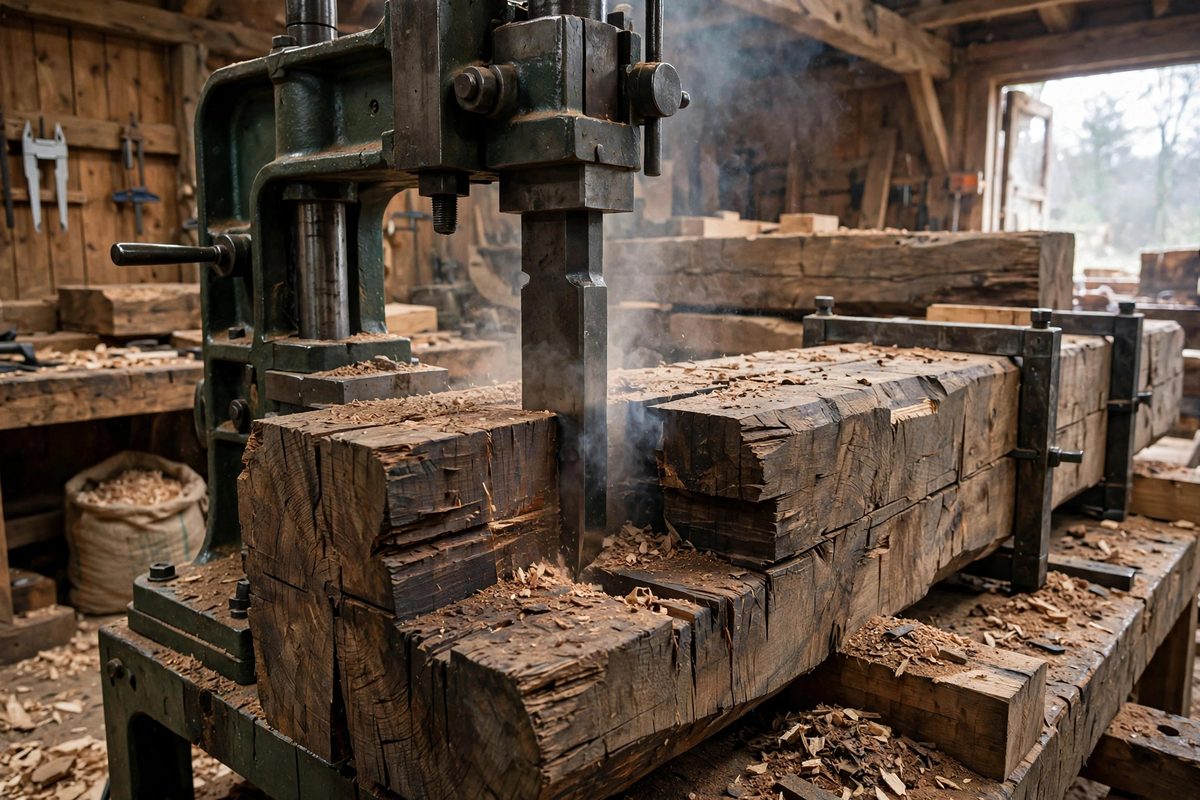
A mortiser cutting heavy timber works harder than one cutting furniture stock: deeper mortises, denser wood, longer cutting time, and far more heat and friction at the chisel. Clearance relief chamfers, small angled cuts relieving the chisel's sides behind the cutting edge, are what keep a heavy timber mortiser cutting freely instead of binding, burning, and wandering. They are a small geometric detail with an outsized effect on cut quality.
Why Mortise Chisels Bind in Deep Cuts
A mortise chisel cuts on its end and clears chips up through its hollow body, but the chisel's sides still rub against the walls of the mortise as it descends. In shallow mortises this friction is minor; in deep timber mortises, with several inches of chisel buried in dense wood, the side friction becomes enormous. The wood also springs back slightly behind the cutting edge, gripping the chisel, and heat from the cut expands both the chisel and the surrounding wood, tightening the grip further. Without relief, the operator fights the chisel on every stroke, the mortise walls get burnished and scorched, and the chisel can deflect off line, which is how mortises end up tapered or out of square.
What Clearance Relief Chamfers Do
A clearance relief chamfer is a small bevel ground or milled along the chisel's sides (and sometimes the corners) just behind the cutting edge, narrowing the chisel slightly so only the cutting edge contacts the wood. The relief creates a tiny gap between the chisel body and the mortise wall, which breaks the friction grip, gives chips room to escape, and lets the chisel descend without the walls squeezing it. The geometry is the same principle as the clearance angle behind any cutting edge: the edge cuts, and everything behind it gets out of the way. On heavy timber work, where the chisel spends a long time buried deep, that clearance is the difference between a smooth plunging cut and a wrestling match.
Sizing the Relief for Timber Work
Relief chamfers on timber mortisers are more generous than on furniture-scale chisels, because the forces and the wood movement are larger. The chamfer needs to be long enough to clear the full depth of cut: relief that only covers the first inch of the chisel does nothing for a four-inch mortise. The angle is a compromise: too shallow and it does not clear; too steep and it weakens the chisel's corners, which take a beating in dense timber. The corners deserve particular attention, since square chisel corners are stress concentrators that can chip; a small corner relief or chamfer protects them while also reducing corner friction. When sharpening or regrinding, preserve the relief geometry rather than grinding it away in pursuit of a sharper-looking edge.
Relief and Chip Evacuation
Deep mortises fail as often from chip packing as from friction. Chips that cannot escape get compressed into the mortise, increasing friction enormously and eventually stalling the cut. Relief chamfers help by giving chips an escape path along the chisel sides, but they work best combined with good technique: clear the chips frequently, withdrawing the chisel partially on deep cuts rather than trying to punch the full depth in one go. On a hollow-chisel mortiser, keep the auger bit sharp and properly adjusted relative to the chisel: the auger should lead the chisel slightly so it clears the waste the chisel is about to cut. A dull auger with perfect chisel relief still packs chips.
Checking and Maintaining the Geometry
Relief chamfers wear with use, especially in abrasive timber like oak or reclaimed stock with embedded grit. Inspect the chisel sides periodically: if the relief has worn flat and the chisel sides are rubbing again, it is time to regrind. When grinding, keep the chisel cool: overheating draws the temper and softens the edge, which then dulls rapidly and makes every problem worse. A light touch with frequent cooling dips preserves the hardness. Also check the chisel for straightness: a bent chisel binds no matter how good the relief, and timber mortising is exactly the kind of heavy work that bends chisels.
Safety on the Heavy Mortiser
Heavy timber mortisers generate serious force, and a binding chisel stores that force as a surprise. Keep hands clear of the chisel path, clamp the timber solidly so it cannot shift and pinch the chisel, and never force a binding cut: back the chisel out, clear the chips, check the relief, and re-enter. Forcing it risks breaking the chisel, and a broken chisel under load sends fragments with real energy. Sharp, relieved, and patient beats strong and hurried every time.
Clearance relief chamfers are the unsung geometry of timber mortising: a small bevel behind the edge that keeps the chisel free, the chips moving, and the mortise true. Grind them generously, maintain them, and let the relief do the hard work of the deep cut.
Related Guides
- Clearance Relief Angles on Deep Mortise Chisels: A mortise chisel driven deep into hardwood lives a hard life: every mallet blow wedges it into the cut, and the chisel's own sides rub the walls of
- Relief Angle Geometry on Scraper Cutting Edges: A card scraper cuts with a tiny hooked burr, not with a beveled edge like a chisel, and the geometry of that hook, its relief angle, determines
- Secondary Micro-Bevel Angles on Heavy Framing Chisels: Heavy framing chisels live a rough life: chopping mortises, paring tenons, and occasionally doing things the manufacturer never intended. The edge
- Primary Bevel Rake Angle Formulas for Spindle Gouges: A spindle gouge's cutting behavior is set by its bevel geometry: the primary bevel angle determines the rake, the angle at which the edge meets the