
A spindle gouge's cutting behavior is set by its bevel geometry: the primary bevel angle determines the rake, the angle at which the edge meets the wood, and the rake determines whether the tool slices cleanly, scrapes, or catches catastrophically. Turners often treat bevel angles as received tradition, grinding to 45 degrees because that is what they were taught, but the geometry relates to the cut through understandable formulas. Knowing the relationships lets you choose bevel angles for the cut you want instead of accepting whatever the last grinding produced.
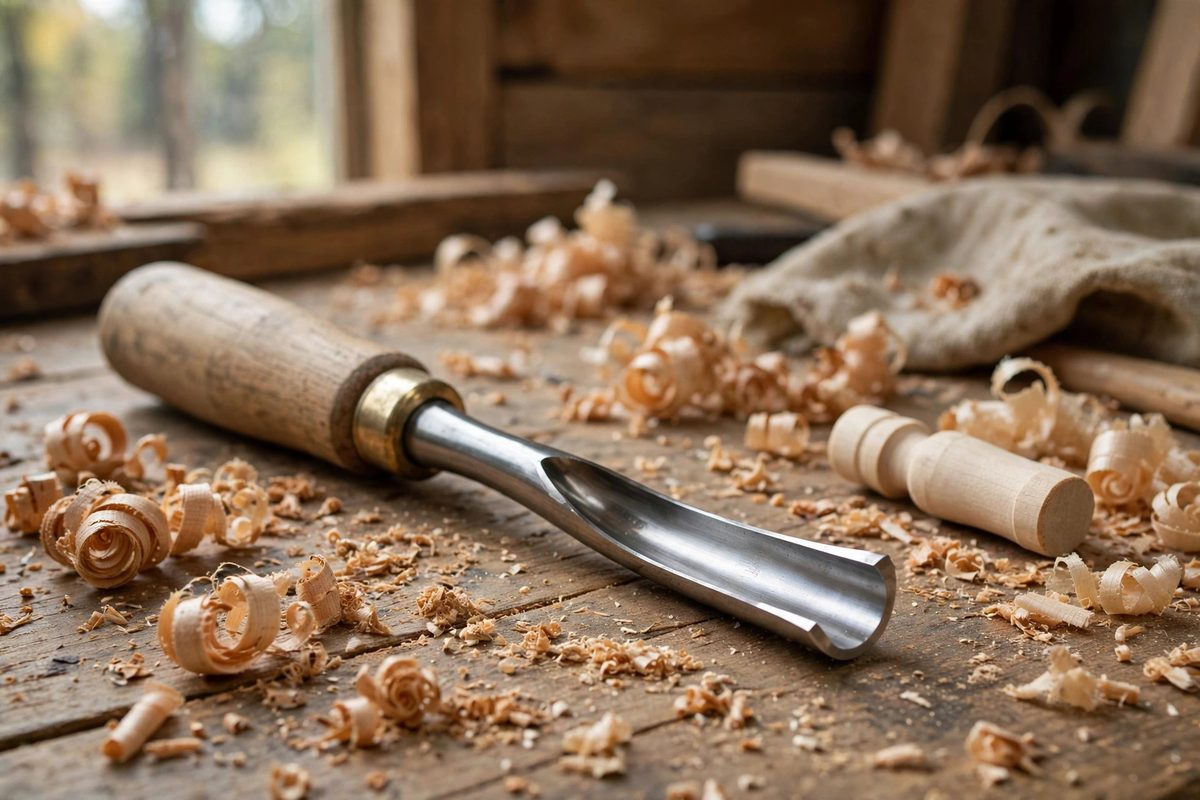
Bevel Angle, Rake Angle, and Clearance
Three angles describe the cutting edge: the bevel angle (between the bevel face and the tool's underside), the rake angle (between the bevel face and the wood surface, measuring how aggressively the edge attacks), and the clearance angle (between the tool's underside and the wood, preventing rubbing). They are linked: for a gouge presented with its bevel rubbing, the rake angle equals 90 degrees minus the bevel angle minus the presentation angle. A 45-degree bevel presented with the bevel flat on the wood gives roughly a 45-degree rake; the same bevel lifted so only the edge contacts gives a higher, more aggressive rake. This is why presentation matters as much as grinding: the grinder sets the bevel angle, but the turner's hands set the working rake. Understanding the formula means understanding that "bevel angle" is only half the geometry; the other half is how you hold the tool.
The Catch Mechanism and Rake Limits
A catch happens when the cutting edge digs below the wood surface and the wood's rotation levers the tool violently: the geometry of a catch is the edge presenting too much rake, biting deeper than the bevel can control. The bevel's job is to limit the cut: riding the bevel keeps the edge at a fixed depth, because the bevel face bears on the wood and prevents the edge from diving. The formulas quantify this: as long as the bevel rubs, the depth of cut is geometrically constrained; the moment the edge leads the bevel, the constraint vanishes and the wood decides the depth. Steeper bevels (larger bevel angle, lower rake) are more catch-resistant because the bevel engages more positively; shallower bevels cut more aggressively but demand precise bevel contact. This is the fundamental tradeoff the formulas describe, not a matter of opinion: aggression versus security, parameterized by angle.
Choosing Bevel Angles by Task
Different spindle operations want different geometries. Roughing, hogging a square blank to round, wants a robust, catch-resistant bevel in the steeper range: the priorities are safety and material removal, not surface quality. Detail work, beads and coves, wants a bevel that balances control with a clean cut, the middle range, because the tool must maneuver in tight curves where bevel contact is intermittent. Fine finishing cuts and shear scraping want shallower effective geometries, but these are achieved more by presentation, lifting the handle to increase the working rake, than by grinding a shallow primary bevel. The practical approach is to grind the primary bevel to a versatile middle angle and vary the presentation for the task: the formulas show that presentation changes the working rake as effectively as regrinding, without the metal loss. Reserve specialized grinds for specialized, frequent operations.
Measuring and Reproducing Angles
Angles you cannot measure you cannot reproduce, and freehand grinding drifts. Use a bevel gauge or a simple angle-setting jig to check the primary bevel after grinding: the investment in measurement pays off in consistent tool behavior. Note that the gouge's flute shape complicates the measurement: the bevel angle varies across the curved edge, steeper at the wings, shallower at the nose, or vice versa depending on the grind. The quoted bevel angle refers to the nose, the working center; the wings follow from the grinding technique. When reproducing a favored grind, record not just the nose angle but the grinding setup: wheel grit, tool rest angle, and the rolling motion used. A formula tells you what angle you want; the setup notes tell you how to get it again.
Secondary Bevels and Micro-Bevels
A micro-bevel, a tiny secondary bevel at a slightly steeper angle right at the edge, refines the geometry without regrinding the whole primary bevel. It strengthens the edge, the steeper micro-bevel supports the cutting edge against the wood's force, and it speeds honing, since only the micro-bevel needs refreshing. The formulas accommodate this: the working rake is set by the micro-bevel angle where it contacts, while the primary bevel provides clearance behind it. Keep micro-bevels truly micro: a wide secondary bevel changes the effective geometry significantly and eventually needs to be ground back into the primary. For spindle gouges, the micro-bevel is honed, not ground, preserving the primary geometry through many sharpenings. This is the economical path: grind rarely, hone often, and the geometry stays where the formulas say it should.
Spindle gouge geometry is applied trigonometry: bevel angle plus presentation sets the rake, the rake sets the aggression, and the bevel's contact sets the safety. Grind a versatile primary bevel, control the working rake with presentation, measure what you grind, and maintain with micro-bevels. The tool will cut the way the angles say it should, which is the whole point of knowing them.
Related Guides
- Secondary Micro-Bevel Angles on Heavy Framing Chisels: Heavy framing chisels live a rough life: chopping mortises, paring tenons, and occasionally doing things the manufacturer never intended. The edge
- Relief Angle Geometry on Scraper Cutting Edges: A card scraper cuts with a tiny hooked burr, not with a beveled edge like a chisel, and the geometry of that hook, its relief angle, determines
- Clearance Relief Angles on Deep Mortise Chisels: A mortise chisel driven deep into hardwood lives a hard life: every mallet blow wedges it into the cut, and the chisel's own sides rub the walls of
- Clearance Relief Chamfers on Heavy Timber Mortisers: A mortiser cutting heavy timber works harder than one cutting furniture stock: deeper mortises, denser wood, longer cutting time, and far more heat