
A card scraper cuts with a tiny hooked burr, not with a beveled edge like a chisel, and the geometry of that hook, its relief angle, determines whether the scraper peels whisper-thin shavings or skates uselessly across the surface. Relief angle is the clearance between the cutting edge and the wood behind it: enough clearance and the edge bites; too little and the edge rubs. Understanding and controlling this angle is the whole science of scraper sharpening.
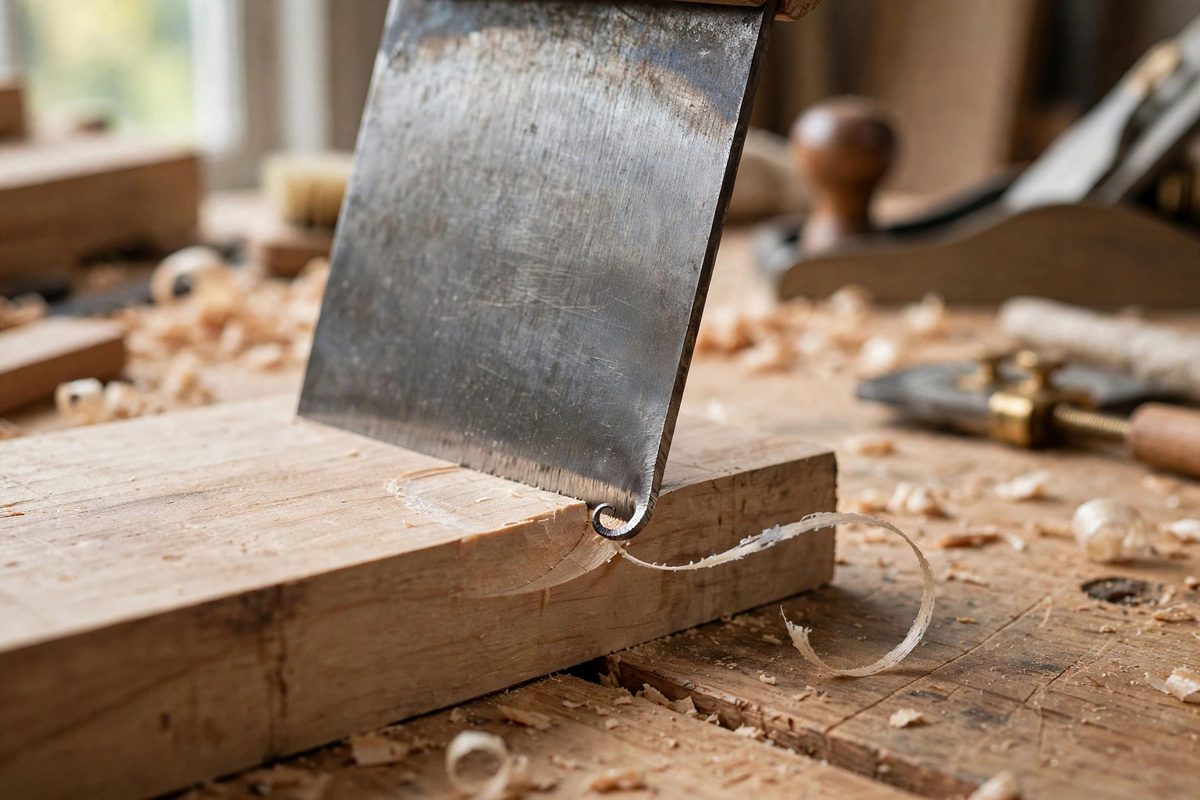
Anatomy of the scraper edge
A prepared scraper edge has three features: the flat face of the card, the square edge filed at 90 degrees, and the hook, the tiny burr turned over by burnishing. The hook's cutting face meets the wood at an angle set by how far the burr is turned. The relief angle is the gap between the back of the hook and the wood surface as the scraper is presented; it must be positive, the back of the edge must clear the wood, or the edge cannot engage.
This is why presentation angle matters as much as sharpening. A perfectly burnished hook presented too flat rubs on its back; presented too steeply it digs. The working range is narrow, and the relief geometry defines it.
Forming the hook: the burnishing sequence
The sequence is file, hone, burnish. File the edge square and straight, removing old hooks and damage; hone the faces flat on a stone to polish the steel the hook will be drawn from; then burnish, drawing a hardened steel rod along the edge at a slight angle to turn the microscopic burr. The burnisher's angle sets the hook's angle: a few degrees of tilt produces a fine hook for finishing, more tilt a aggressive hook for stock removal.
Pressure matters as much as angle. Firm, consistent strokes turn an even hook along the full edge; hesitant light strokes produce a patchy hook that cuts in spots and skates in others. Two or three deliberate passes per side beat a dozen timid ones. The steel must be harder than the scraper, which is why dedicated burnishers or hardened drill shanks work and soft steel rods do not.
Relief angle and cutting behavior
A small hook with minimal turn presents a high relief angle and takes fine shavings: the finishing configuration. A heavily turned hook presents lower relief and a more aggressive cutting geometry: the stock-removal configuration. Match the hook to the task: aggressive hooks on rough surfaces, fine hooks for final smoothing before finish.
When a scraper stops cutting, the hook has usually dulled or folded, losing its relief. Re-burnishing without re-filing sometimes revives it for a while, but a hook turned repeatedly from the same edge work-hardens and crumbles; eventually the edge needs re-filing to fresh steel. Learn to feel the difference between a hook that needs re-turning and an edge that needs re-filing; it saves time and steel.
Troubleshooting the edge
Skating without cutting usually means no hook, insufficient turn, or presentation too flat. Increase the burnishing angle slightly and present the scraper a touch steeper. Digging and chattering usually means too aggressive a hook or presentation too steep; soften the hook or flatten the presentation. Dust instead of shavings means the hook is cutting but the geometry is marginal: re-burnish with attention to consistency.
Edge straightness matters enormously. A wavy edge, from uneven filing, contacts the wood only at the high spots, producing patchy cutting no hook geometry fixes. File the edge straight first, checking against a straightedge, before any burnishing. Geometry built on a crooked foundation stays crooked.
Scraper planes and holder geometry
Scraper planes and scraping holders fix the presentation angle mechanically, removing the variable of hand angle. Their bedding angle sets the relief geometry by design; choose or set it for the work, steeper bedding for finer work. The advantage is consistency across long surfaces; the trade is losing the hand scraper's ability to adjust angle stroke by stroke for figured grain.
Maintain holder blades with the same file-hone-burnish sequence, and keep the holder's sole flat so the blade presents evenly. A holder with a bellied sole rocks and cuts unevenly regardless of edge quality.
Scraper geometry is relief angle management: square the edge, hone it flat, turn the hook to suit the task, present it in the working range, and rebuild from fresh steel when the hook gives up. The shavings, fine and continuous, are the proof the angles are right.
Related Guides
- Clearance Relief Angles on Deep Mortise Chisels: A mortise chisel driven deep into hardwood lives a hard life: every mallet blow wedges it into the cut, and the chisel's own sides rub the walls of
- Clearance Relief Chamfers on Heavy Timber Mortisers: A mortiser cutting heavy timber works harder than one cutting furniture stock: deeper mortises, denser wood, longer cutting time, and far more heat
- Primary Bevel Rake Angle Formulas for Spindle Gouges: A spindle gouge's cutting behavior is set by its bevel geometry: the primary bevel angle determines the rake, the angle at which the edge meets the
- Secondary Micro-Bevel Angles on Heavy Framing Chisels: Heavy framing chisels live a rough life: chopping mortises, paring tenons, and occasionally doing things the manufacturer never intended. The edge