
Heavy framing chisels live a rough life: chopping mortises, paring tenons, and occasionally doing things the manufacturer never intended. The edge geometry determines how long the chisel survives that life. A secondary micro-bevel, a tiny second angle at the very edge, is the simplest way to toughen the cutting edge without sacrificing how the chisel cuts.
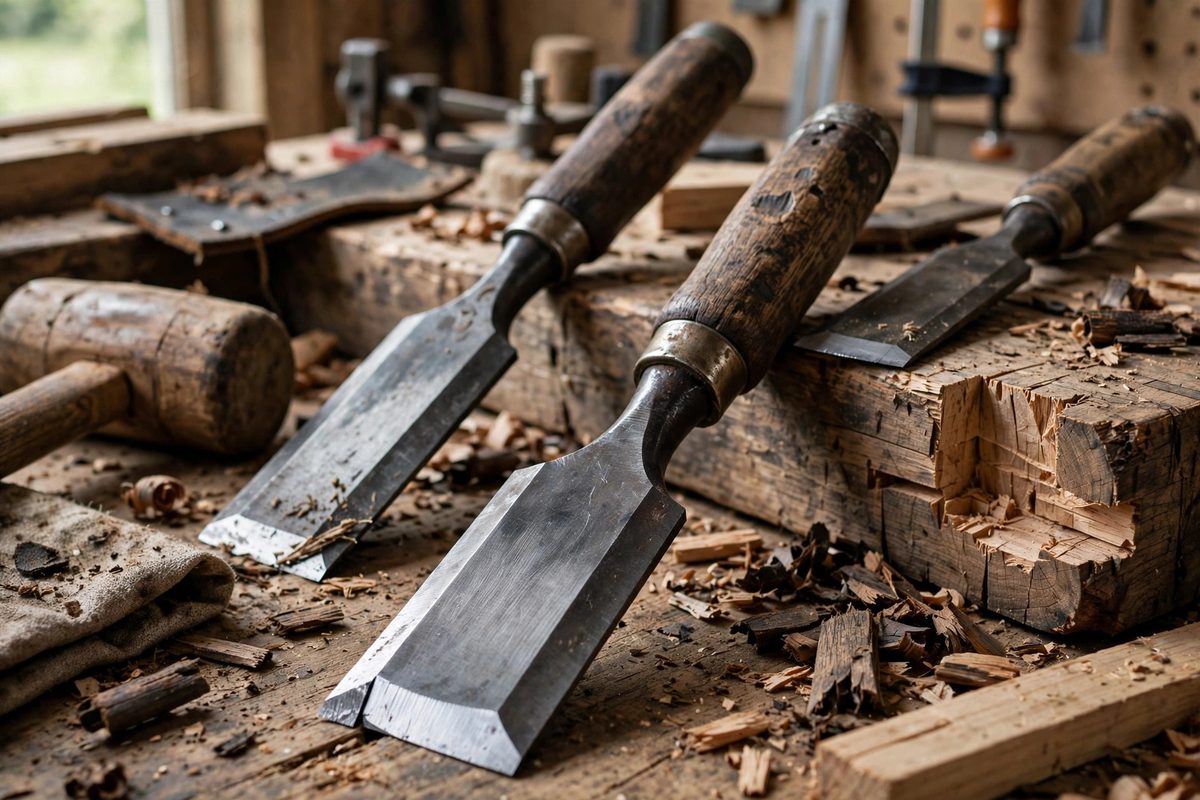
Primary bevel versus micro-bevel
The primary bevel is the main ground angle of the chisel, typically around 25 degrees on a framing chisel, which sets the overall wedge shape. The micro-bevel is a narrow band at the cutting edge ground a few degrees steeper, around 30 degrees. The steeper micro-bevel thickens the steel right behind the edge, which is where chipping starts. Because the micro-bevel is only a millimeter or two wide, it barely changes how the chisel enters the wood, but it significantly changes how the edge resists damage. It is a small change with an outsized effect.
Why framing chisels need the extra support
Framing chisels take impacts that paring chisels never see: mallet blows, levering out waste, chopping across grain. A 25-degree edge under those loads is thin enough to chip or roll, especially in hardwoods or around knots. The micro-bevel adds the steel where the abuse lands. This is the same logic as the thicker edge on an axe versus a carving knife; the tool's job determines the edge's robustness. A framing chisel sharpened like a paring chisel will cut beautifully for about ten minutes.
Grinding the micro-bevel
Grind the primary bevel first, establishing the flat 25-degree face and removing any damage. Then raise the honing angle slightly and work the edge on stones or a strop until a narrow, even band appears along the full width. The band should be uniform; a micro-bevel that is wide in the middle and absent at the corners means uneven pressure. On a grinder, a light touch with the tool rest set a couple degrees higher does the job, but keep the steel cool. Overheating the edge draws the temper and undoes the hardness the geometry is trying to protect.
Honing and maintaining the edge
The micro-bevel makes maintenance faster, which is its hidden benefit. Touching up the edge means honing only the narrow micro-bevel band, not regrinding the whole primary bevel. A few strokes on a medium stone followed by a strop restores the edge in under a minute at the job site. When the micro-bevel grows wide from repeated honing, it is time to regrind the primary bevel and start fresh. This cycle, hone the micro-bevel often, regrind the primary occasionally, keeps the chisel working with minimal downtime.
Matching the angle to the work
The standard 25-plus-30 combination suits general framing work, but adjust to the task. Chopping mortises in oak or working around knots justifies a steeper micro-bevel for more support; cleaner paring work in softwood can run a shallower one for easier cutting. The chisel does not know the textbook angle; it knows the wood it is in. Experienced framers often carry chisels with slightly different edges for different jobs, and the micro-bevel is what makes those differences cheap to maintain.
Safety with a truly sharp chisel
A sharp chisel is safer than a dull one because it goes where you push it instead of skating, but it still demands respect. Always push the edge away from your body, keep both hands behind the cutting edge, and never catch a falling chisel. A micro-beveled framing chisel holds its edge longer, which means it stays dangerously sharp longer; treat it accordingly. Sharp is a condition to manage, not a virtue to admire carelessly.
Grind the primary bevel for the cut, add the micro-bevel for the abuse, and hone the small band often. The framing chisel that holds its edge through the job is the one whose geometry matches its work.
Related Guides
- Clearance Relief Angles on Deep Mortise Chisels: A mortise chisel driven deep into hardwood lives a hard life: every mallet blow wedges it into the cut, and the chisel's own sides rub the walls of
- Primary Bevel Rake Angle Formulas for Spindle Gouges: A spindle gouge's cutting behavior is set by its bevel geometry: the primary bevel angle determines the rake, the angle at which the edge meets the
- Clearance Relief Chamfers on Heavy Timber Mortisers: A mortiser cutting heavy timber works harder than one cutting furniture stock: deeper mortises, denser wood, longer cutting time, and far more heat
- Relief Angle Geometry on Scraper Cutting Edges: A card scraper cuts with a tiny hooked burr, not with a beveled edge like a chisel, and the geometry of that hook, its relief angle, determines