
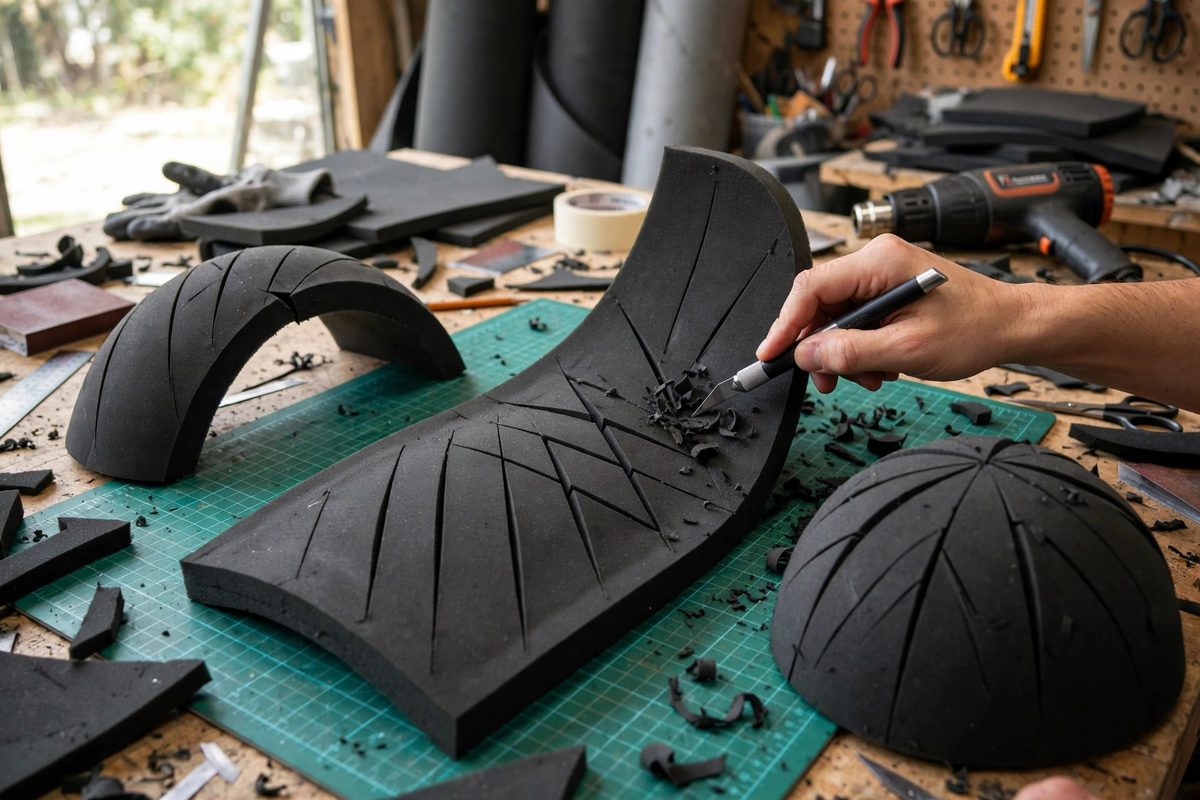
High-density EVA foam bends beautifully over simple curves but fights compound curves, the kind that bend in two directions at once like a shoulder pauldron or a helmet crown. Scoring the back of the foam, cutting angled channels that close up as the foam bends, is the technique that tames those shapes. The angle of each score decides how tightly the foam turns and how clean the finished surface stays.
How Scoring Creates the Curve
A score is a V-shaped channel cut into the back face of the foam. When you bend the foam so the channel closes, the front face stretches smoothly around the curve while the back face takes up the slack in the closed Vs. Deeper scores allow tighter curves because more material is removed from the inside of the bend. Wider scores close more gradually and give a smoother bend over a larger area. The front face stays uncut and continuous, which is why a scored bend looks clean from the outside while doing all its work on the hidden side.
Choosing the Score Angle
The score angle, the V of the channel, sets the bend per cut. A narrow V, roughly thirty degrees, closes a little and suits gentle curves with several scores working together. A wide V, around sixty to ninety degrees, closes a lot and suits tighter turns with fewer cuts. For compound curves, the angles vary across the piece: the direction bending tighter gets wider scores or closer spacing, and the gentle direction gets narrower scores spread wider. Cut a test grid of angles on scrap foam first; foam is cheap and a test grid teaches the relationship between angle, depth, and resulting curve faster than any explanation.
Depth Control
Score depth should reach roughly half to two thirds of the foam thickness. Too shallow and the foam resists the bend, springing back and stressing the glue. Too deep and the score cuts through to the front face, leaving a visible line or a weak spot that tears. A consistent depth across all scores in a curve gives an even bend; one deep score in a row of shallow ones becomes a hinge that kinks. Mark the blade or use a depth stop so every score matches, and keep the blade sharp because a dragging blade tears the foam instead of cutting it.
Spacing Scores for Smooth Curves
Closer scores make smoother curves because each score contributes a smaller angle and the bend distributes evenly. Wide spacing gives a faceted, segmented look that suits some armor styles but reads as crude on organic shapes. For a smooth compound curve, space scores roughly one to two times the foam thickness apart, then adjust by eye. On a pauldron that curves over the shoulder and around the arm simultaneously, the score pattern becomes a fan: closer together where the curve is tightest, spreading where it relaxes.
Locking the Bend
Foam wants to spring back, so the bend must be locked while the adhesive cures. Contact cement on the closed score faces bonds the bend permanently once pressed together. For complex shapes, tape or clamp the piece over a form, a bowl, a ball, or a custom buck, until the cement fully sets. Heat-forming with a heat gun before gluing relaxes the foam's memory and reduces springback dramatically; warm the foam evenly until it just starts to relax, shape it, and let it cool in position. The combination of heat setting and glued scores produces armor pieces that hold their compound curves through a full day of wear.
Compound curves in foam are a scoring problem: the right V angle, the right depth, the right spacing, locked with heat and glue. Test on scrap, cut with a sharp blade and a steady hand, and the foam will do exactly what you tell it to.
Related Guides
- Bevel Cutting Angles for High Density Foam Seams: Cosplay armor built from high-density EVA foam gets its crisp edges and smooth curves from beveled seams: two foam edges cut at complementary angles
- High-Density EVA Foam Heat Contouring for Armor: EVA foam is the cosplay armor builder's miracle material: light, cheap, carvable with a knife, and thermoformable with nothing more than a heat gun
- Bevel Edge Angle Consistency for Curved Foam Plates: Foam armor reads as metal, leather, or stone only if its edges look intentional. A beveled edge on a curved foam plate catches light like a forged
- Contact Adhesive Drying Thresholds for Plasti-Dip Armor: Plasti-Dip coated foam armor holds together only as well as the glue underneath it, and contact adhesive is the standard bond for EVA foam builds