
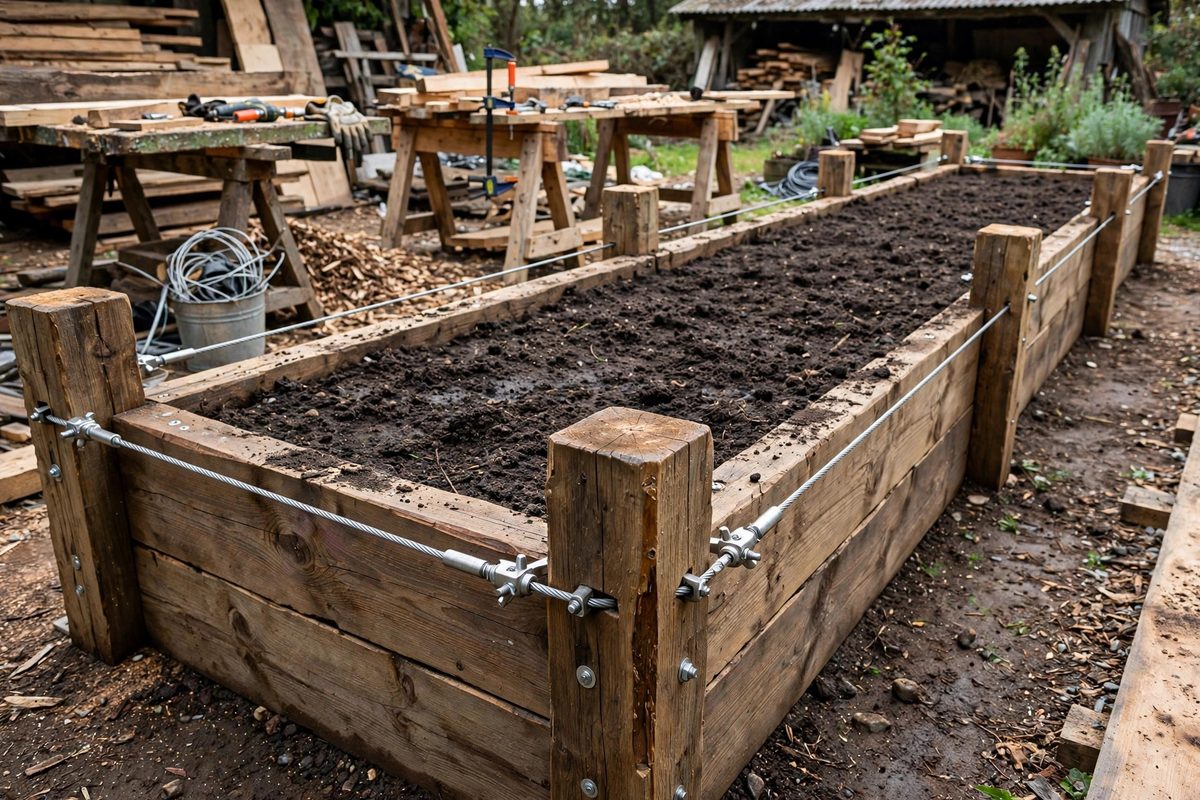
A long raised bed built from timbers looks indestructible on day one, but soil is heavy and patient: a cubic yard of wet garden soil weighs over a ton, and it pushes outward on the bed walls every hour of every day. On beds longer than about eight feet, the long sides bow outward over time unless they are tied together. A cable run between corner posts, properly tensioned, is the clean, strong fix. Here is how to size and tension it.
Why long beds bow
Soil pressure on a retaining wall increases with depth, pushing hardest near the bottom of the bed. On a short bed, the corner joints carry this load easily. On a long bed, the middle of each long side is far from any corner support, and the timbers act as beams spanning between the ends. Wood creeps under sustained load, so the bow develops slowly: straight in spring, visibly bellied by fall, worse every year. Tie rods or cables connecting the two long sides convert the bending load into pure tension, which cable handles beautifully.
Cable versus rod
Threaded rod is the traditional tie, but cable has advantages in a garden: it is cheaper, easier to thread through timbers, and naturally flexible during installation. Use galvanized or stainless cable; plain steel rusts away in the damp soil environment within a few seasons. A 3/16-inch galvanized cable is ample for typical raised beds up to about 18 inches tall; taller beds or very long spans justify 1/4-inch. Pair the cable with proper hardware: thimbles at any bend, cable clamps (at least two per connection, spaced correctly), and large washers or plates where the cable bears against the timber.
Placement and corner posts
Run the ties at the points of maximum bow, which is the middle of the span for a simple long bed; beds over twelve feet long benefit from ties at the third points. Position each tie about two-thirds of the way down from the top of the bed, near where the soil pressure peaks but accessible for adjustment. The corner posts themselves should be substantial, 4x4 minimum, set deep enough to resist the inward pull: the cable tension tries to drag the posts toward each other, and a shallow post will lean. Set posts at least as deep as the bed is tall, in compacted soil or concrete for tall beds.
Tensioning technique
Tension the cable with a turnbuckle, which allows precise adjustment and re-tightening as the timbers season and shrink. Tighten until the long sides pull straight, then add a small additional turn; the cable will relax slightly as everything seats. Do not over-tension: the goal is straight walls, not bowed inward. Check the tension seasonally, since wood shrinks across the grain as it dries and the cable will loosen. A turnbuckle left accessible (not buried behind soil) makes this a two-minute maintenance task. If a turnbuckle is not available, tension with cable clamps and a come-along, then clamp off, but leave a way to re-tighten later.
Protecting the cable and the garden
Where the cable passes through soil, sleeve it or accept that it is a consumable; even galvanized cable eventually corrodes in constant soil contact. Keep cable runs below the root zone of what you are growing where possible, or accept that deep-rooted plants will find it. Cap or cover any exposed cable ends and turnbuckles; a protruding cable end at shin height is a genuine hazard. Inspect annually for rust, fraying, and loose clamps.
Tie the long sides together at the bow point, tension to straight with a turnbuckle, and check it yearly. The bed will stay rectangular for as long as the timbers last.
Related Guides
- Build a 4x8 Raised Garden Bed: Start Growing Your Own Food! A raised garden bed is one of the best weekend projects you can tackle. It gives you better soil drainage, easier weed
- Cross-Tie Tension Rod Spacing for Tall Timber Planters: A tall timber planter is a box full of wet soil, and wet soil pushes outward with surprising force. The long sides bow, the corners strain, and
- Corrugated Galvanized Wall Bracing for Raised Beds: Corrugated galvanized steel makes beautiful raised beds: crisp lines, excellent longevity, and a modern look that wood cannot match. But a tall bed
- Internal Tie Rod Anchor Sizing for Multi-Tier Beds: Soil pushes outward. Every raised bed, and especially every tier stacked on another, carries lateral pressure that wants to bow the walls outward and
- Threaded Tension Rod Spacing for Multi-Tier Planters: A multi-tier planter is a stack of growing beds held apart by structure, and wet soil is heavy: a single tier of damp growing medium can weigh