
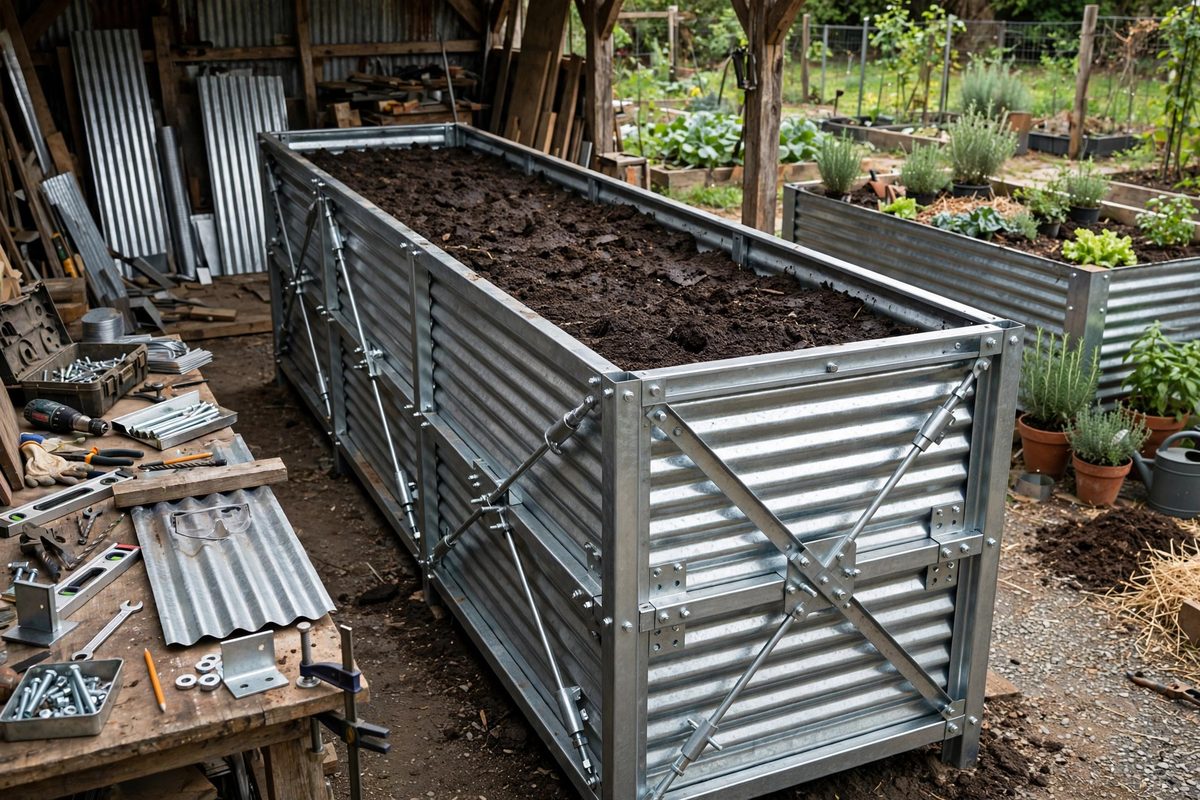
Corrugated galvanized steel makes beautiful raised beds: crisp lines, excellent longevity, and a modern look that wood cannot match. But a tall bed full of wet soil is a structural problem wearing a garden's clothes. Soil pushes outward with surprising force, and corrugated panels, strong as they are along their corrugations, will bow, buckle, or burst their fasteners if that force is not managed. Bracing is not optional trim on a metal raised bed; it is the structure that keeps the rectangle a rectangle.
Why soil pushes and how hard
Soil behaves like a heavy fluid pressing against the walls, and the pressure grows with depth: the bottom of a deep bed carries far more lateral load than the top. Wet soil is dramatically worse than dry, because water fills the pore spaces and adds its full weight to the push while lubricating the soil particles so they slide against each other more freely. A bed that looks fine in a dry spring can bow alarmingly after the first soaking rain. Corrugation gives the panel stiffness against bending along the corrugation direction, but the panel spans between its supports, and spanning is where it fails. The longer the unsupported span and the deeper the bed, the more bracing the wall needs. This is why short beds rarely cause trouble and long, deep beds always do.
Tie rods: the primary defense
The most effective bracing for a rectangular metal bed is the tie rod: a rod or cable spanning the bed's width, connecting the two long walls and holding them against the outward push. Tie rods work in tension, which is exactly what the walls need, and they are simple to install: drill through both walls, pass the rod through, and secure it with washers and nuts on the outside. Use galvanized or stainless hardware to match the panels' corrosion resistance; plain steel rods will rust, stain, and eventually fail. Place tie rods at the vertical midpoint of deep beds or slightly below, where the pressure is greatest, and space them along the length so no span between rods exceeds a few feet. For beds longer than about six feet, two or more tie rods per wall pair are normal. The rods will be buried in soil, which is fine, but sleeve them in pipe or use solid rod rather than cable if you want them to survive shovel strikes during bed renovation.
Top-edge bracing and corner structure
Tie rods handle the middle of the wall; the top edge needs its own treatment. A cap rail or rim of wood or metal angle along the top edge ties the wall panels together, stiffens the free edge, and gives you a comfortable place to lean while working. Corners deserve solid posts: the corner is where two walls meet and where fasteners concentrate, so anchor each corner to a sturdy post driven into the ground or to a well-built corner bracket. Internal vertical stakes, driven into the ground inside the bed and fastened to the wall panels, break long walls into shorter spans and are especially useful on very long beds where tie rods alone would need to be closely spaced. Combine methods freely: corner posts plus tie rods plus a cap rail is a belt-and-suspenders assembly that will hold its shape for decades.
Fasteners, galvanization, and longevity
Every fastener in the bracing system should be compatible with galvanized steel. Mixing metals invites galvanic corrosion: stainless fasteners with galvanized panels are generally acceptable, but plain steel or copper hardware against galvanized steel will corrode at the contact point. Use fender washers or large washers under bolt heads and nuts to spread the load on the thin panel; without them, the hardware pulls through the corrugation under soil pressure. Self-drilling screws are convenient for attaching cap rails and stakes, but through-bolts with washers carry the real structural loads at tie rods and corners. When drilling the panels, touch up the bare edges with cold galvanizing spray to restore corrosion protection where the drill removed it.
Checking and maintaining the bracing
Inspect braced beds annually, ideally before the growing season. Look for bowing between tie rods, loose nuts on the rods, rust streaks at fasteners, and any wall section that has drifted out of plumb. Tighten what has loosened, replace what has corroded, and add a tie rod if a span is bowing that was fine when the bed was new; soil settles and compacts over the years, and loads change. A bed that is holding its shape after five years will likely hold it for twenty, because the initial settling is done. The maintenance burden is small, but only if the bracing was built right in the first place.
Brace for wet soil at full depth, use compatible galvanized hardware with real washers, and tie the walls together so they cannot leave. A corrugated bed built this way is a permanent garden fixture, not a seasonal experiment.
Related Guides
- Build a 4x8 Raised Garden Bed: Start Growing Your Own Food! A raised garden bed is one of the best weekend projects you can tackle. It gives you better soil drainage, easier weed
- Corner Post Cable Tension in Long Timber Garden Beds: A long raised bed built from timbers looks indestructible on day one, but soil is heavy and patient: a cubic yard of wet garden soil weighs over a
- Internal Tie Rod Anchor Sizing for Multi-Tier Beds: Soil pushes outward. Every raised bed, and especially every tier stacked on another, carries lateral pressure that wants to bow the walls outward and
- Cross-Tie Tension Rod Spacing for Tall Timber Planters: A tall timber planter is a box full of wet soil, and wet soil pushes outward with surprising force. The long sides bow, the corners strain, and
- Threaded Tension Rod Spacing for Multi-Tier Planters: A multi-tier planter is a stack of growing beds held apart by structure, and wet soil is heavy: a single tier of damp growing medium can weigh