
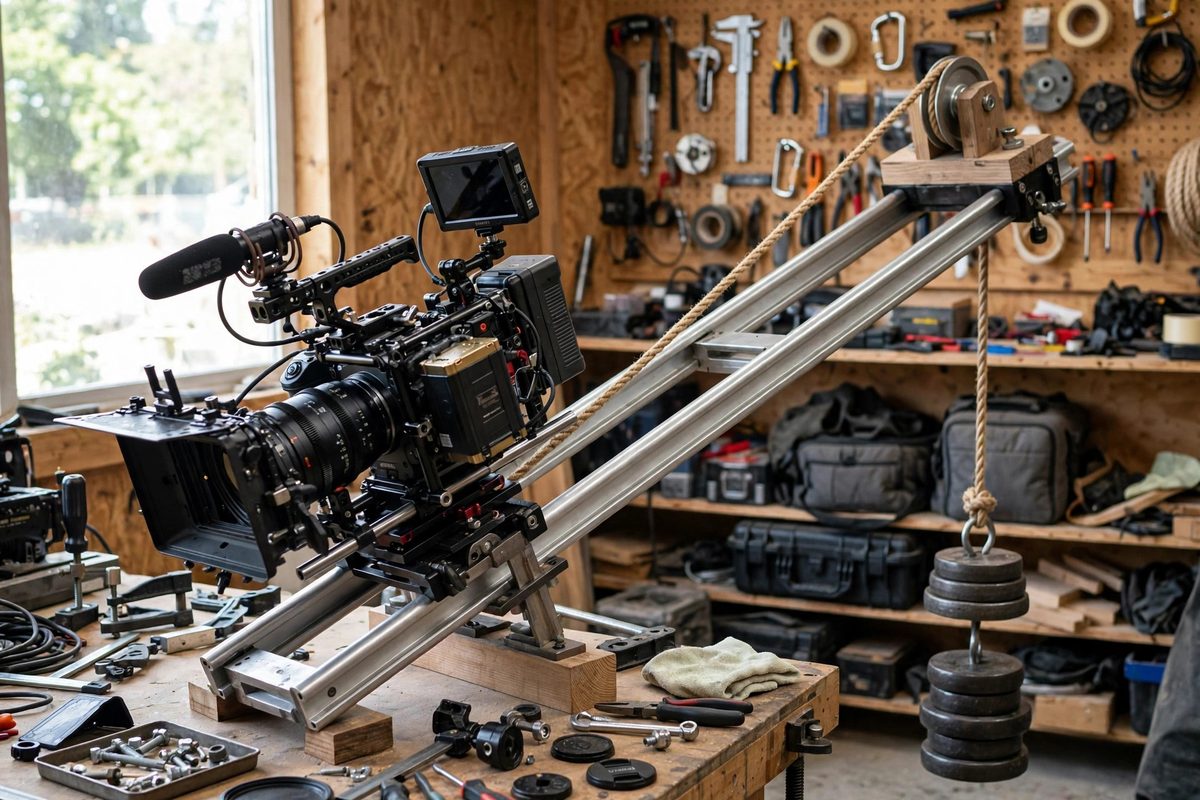
A camera slider with a heavy cinema rig on it is a physics problem on rails: several kilograms of camera, lens, and accessories riding a carriage that must glide smoothly, often at an angle or vertically, driven by a motor or by hand. Without balancing, the motor strains, the motion stutters, and angled moves become a fight against gravity. Counterweight balancing, hanging weight on the far side of a pulley to offset the carriage, transforms the slider from a struggle into a precision instrument. It is the same principle as an elevator counterweight, applied to camera movement.
Why unbalanced sliders misbehave
On a level slider, gravity acts straight down through the carriage into the rails, and the main problem is friction and inertia: the motor must overcome the carriage's reluctance to start and stop. Tilt the slider, and gravity gains a component along the rails, pulling the carriage downhill. The motor must then hold the carriage against that pull at rest and fight it during uphill moves, while downhill moves run away unless braked. The result is uneven speed, strained motors, overheated drivers, and moves that look different going up versus down. A counterweight equal to the downhill component of the carriage's weight cancels that component: the motor then sees the same load in both directions, which is a load it was designed for. The move becomes symmetric, smooth, and repeatable.
Sizing the counterweight
The counterweight needs to balance the component of the carriage weight acting along the rails, which depends on the tilt angle. On a level slider, no counterweight is needed for gravity (though some builders add a small one to smooth inertia). As the angle increases, the required counterweight grows with the sine of the angle: at 30 degrees of tilt, roughly half the carriage weight; at 45 degrees, roughly seventy percent; vertical, the full weight. In practice, you do not need trigonometry on set: hang weight on the pulley and adjust until the carriage stays put when released at any point along the rails. That neutral balance point is correct by definition. Use proper counterweights, not improvised junk: purpose-made weights with secure attachment, or sandbags with reliable rigging. The counterweight hangs off the end of the slider, often at head height or above, so its attachment must be beyond question.
Pulley, cable, and attachment
The counterweight hangs from a cable or belt running over a pulley at the downhill end of the slider, attached to the carriage. The pulley must be smooth and free-running; a gritty pulley adds the very friction you are trying to eliminate, and it shows up as stutter in the move. The cable attachment to the carriage should be centered and secure, pulling along the rail axis rather than at an angle that would bind the carriage. Keep the cable path clear of the camera, the lens, and the operator's hands throughout the full travel. For motorized sliders, the counterweight cable and the drive belt are separate systems; do not try to combine them. And protect the drop zone below the counterweight: if anything fails, the weight falls, so keep feet, cables, and expensive gear out from under it.
Balancing procedure on set
Balance with the full shooting rig mounted, lens and all, because the weight that matters is the total moving mass. Set the slider at the intended angle, attach the counterweight cable, and add weight incrementally until the carriage holds position when released mid-travel. Then test the full move: run the carriage end to end by hand, feeling for tight spots or unevenness that indicate rail or alignment issues the counterweight cannot fix. Power the motor and run the programmed move, watching for smooth acceleration and consistent speed in both directions. Rebalance whenever the rig changes: swapping a lens changes the weight, and a balance set for one configuration is wrong for another. This takes minutes and it is the difference between a professional move and a wobbly one.
Safety around hanging weight
A counterweight is stored energy waiting for a failure. Secure it with a secondary safety: a backup cable or a catch that prevents a free fall if the primary attachment fails. Never stand under the counterweight, and brief everyone on set about where it hangs. Inspect the cable, pulley, and attachments before each use; frayed cable gets replaced, not nursed. When breaking down the rig, remove the counterweight before detaching the carriage cable, controlling the weight by hand so it does not drop when the tension releases. Treat the counterweight with the same respect you give any overhead load, because that is what it is.
Balance until the carriage floats, secure everything twice, and recheck when the rig changes. A counterweighted slider moves like the camera is weightless, which is exactly what the shot needs.
Related Guides
- Linear Bearing Damping for Heavy Motion Sliders: A camera slider carrying a heavy cinema rig has a physics problem: mass plus motion equals momentum, and momentum at the end of a slide becomes a
- Damped Linear Bearing Selection for Heavy Camera Sleds: A camera slider carrying a heavy cinema rig lives or dies by its linear bearings. The sled must glide with constant resistance, no stick-slip, no
- Dual Steel Linear Rail Spacing on Heavy Camera Mounts: A camera slider is only as smooth as its rails, and heavy camera packages punish undersized or poorly spaced rails mercilessly. Dual steel linear
- Stepper Pulley Tooth Profiles for Low Vibration: A motorized camera slider lives or dies by smoothness: any vibration in the drive becomes visible jitter in the footage. The pulley and belt that