
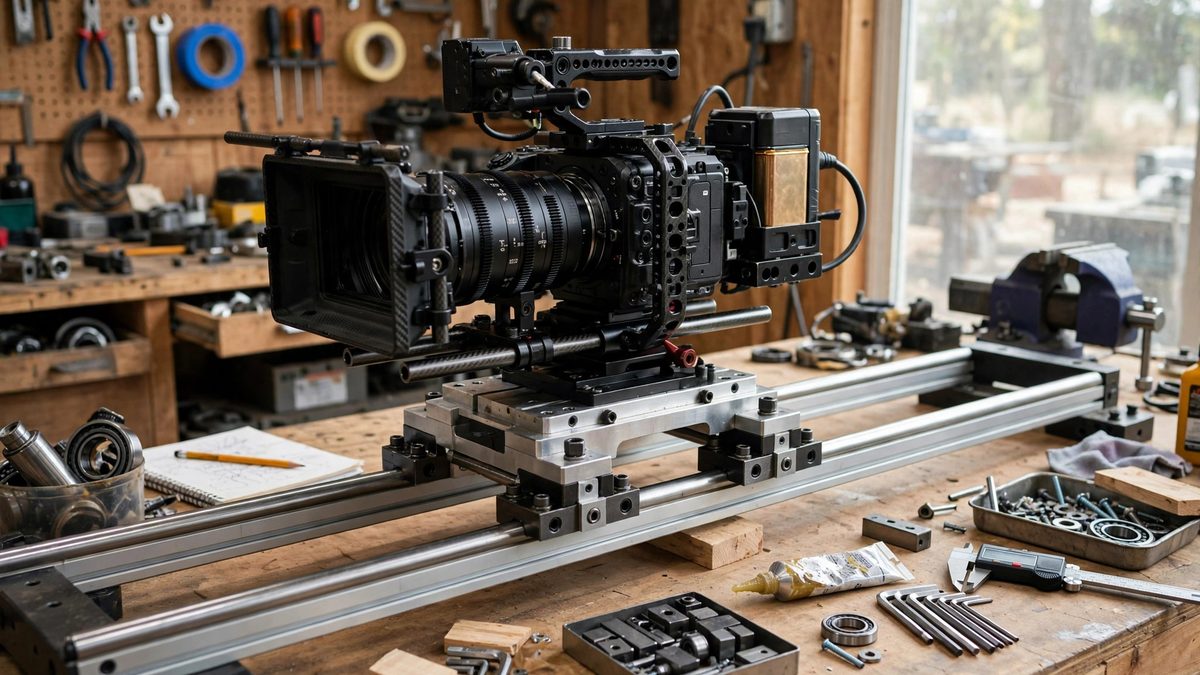
A camera slider carrying a heavy cinema rig lives or dies by its linear bearings. The sled must glide with constant resistance, no stick-slip, no rumble, and no sag, while supporting a load that may be several times the weight of the slider itself. Selecting bearings with the right damping and load capacity is a mechanical decision that shows up directly in the footage.
Load Capacity and the Real Working Load
Bearing catalogs list static and dynamic load ratings, and the temptation is to pick a bearing whose rating just covers the camera weight. Resist it. The working load includes the camera, lens, matte box, follow focus, monitor, and any counterweights, plus the dynamic forces of starting and stopping the move. A slider that is level in the studio may be used at an angle on location, which shifts the load onto fewer bearing elements. Size the bearings so the rated dynamic load comfortably exceeds the fully dressed rig weight, with margin for angled use. Undersized bearings brinell, developing flat spots on the races that translate into a once-per-revolution rumble in the footage. That rumble is nearly impossible to remove in post.
Why Damping Matters
An undamped sled on low-friction bearings keeps gliding after you stop pushing; it overshoots, oscillates, and makes precise framing moves frustrating. Damping, whether from the bearing seals, a friction adjustment, or a dedicated damper, gives the sled a consistent drag that the operator can feel and control. The right amount of damping lets you push the sled and have it stop when you stop, without fighting you on the push. Too much damping and the move becomes jerky as the operator's hand force varies; too little and the sled drifts. Some builders add damping with adjustable friction pads bearing on the rail, which lets the feel be tuned for the weight of the rig. Heavier rigs generally want slightly more damping, since their momentum is what causes overshoot.
Bearing Types for Slider Duty
Recirculating ball bushings on round shafts are the classic slider bearing: smooth, high load capacity, and tolerant of long rails. Their weakness is that they transmit every rail imperfection, so the shafts must be straight, supported, and clean. Profile rail guides (the rectangular linear guides) are stiffer and handle moment loads better, which matters when a heavy rig sits high above the rail and tries to tip the sled. Polymer plain bearings run quietly and need no lubrication, but they have higher friction and wear faster under heavy loads. For a heavy cinema sled, recirculating ball or profile rail types are the usual choice; choose seals that keep dust out without adding lumpy drag, and keep the rails wiped clean, because a single grit particle in a ball bushing becomes a click in the move.
Stiffness, Sag, and Rail Support
The bearings are only as good as the rails they ride on. A long rail supported only at the ends sags under a heavy sled, and the sled then rolls downhill toward the middle, ruining the move. Support long rails at intervals, or choose a rail section stiff enough for the span; the deflection under the working load should be a small fraction of what would be visible as a tilt in the shot. Mount the bearing blocks with a wide stance on the sled plate to resist tipping moments, and make the sled plate itself rigid, because a flexing plate lets the bearings fight each other. Tighten bearing block fasteners evenly and check that the sled moves freely by hand before loading the camera; binding unloaded means the alignment is off.
Maintenance and Field Habits
Sliders live in dusty locations, and dust is the enemy of smooth motion. Wipe the rails before every shoot and keep the slider covered in transit. Lubricate according to the bearing type: ball bushings want a light oil or the manufacturer's specified lubricant, while some polymer bearings must stay dry. Listen to the sled: new noises mean contamination or wear, and catching it early is a cleaning job instead of a bearing replacement. Carry the slider with the sled locked or removed so transport shocks do not brinell the races. A well-chosen, well-maintained bearing set gives years of silent moves; a neglected one gives you rumble, stick-slip, and reshoots.
Size the bearings for the fully dressed rig plus margin, tune the damping so the sled stops when you do, support the rails against sag, and keep everything clean. The audience should feel the move, never the mechanism.
Related Guides
- Linear Bearing Damping for Heavy Motion Sliders: A camera slider carrying a heavy cinema rig has a physics problem: mass plus motion equals momentum, and momentum at the end of a slide becomes a
- Dual Steel Linear Rail Spacing on Heavy Camera Mounts: A camera slider is only as smooth as its rails, and heavy camera packages punish undersized or poorly spaced rails mercilessly. Dual steel linear
- Counterweight Balancing on Heavy Camera Sliders: A camera slider with a heavy cinema rig on it is a physics problem on rails: several kilograms of camera, lens, and accessories riding a carriage
- Stepper Pulley Tooth Profiles for Low Vibration: A motorized camera slider lives or dies by smoothness: any vibration in the drive becomes visible jitter in the footage. The pulley and belt that