
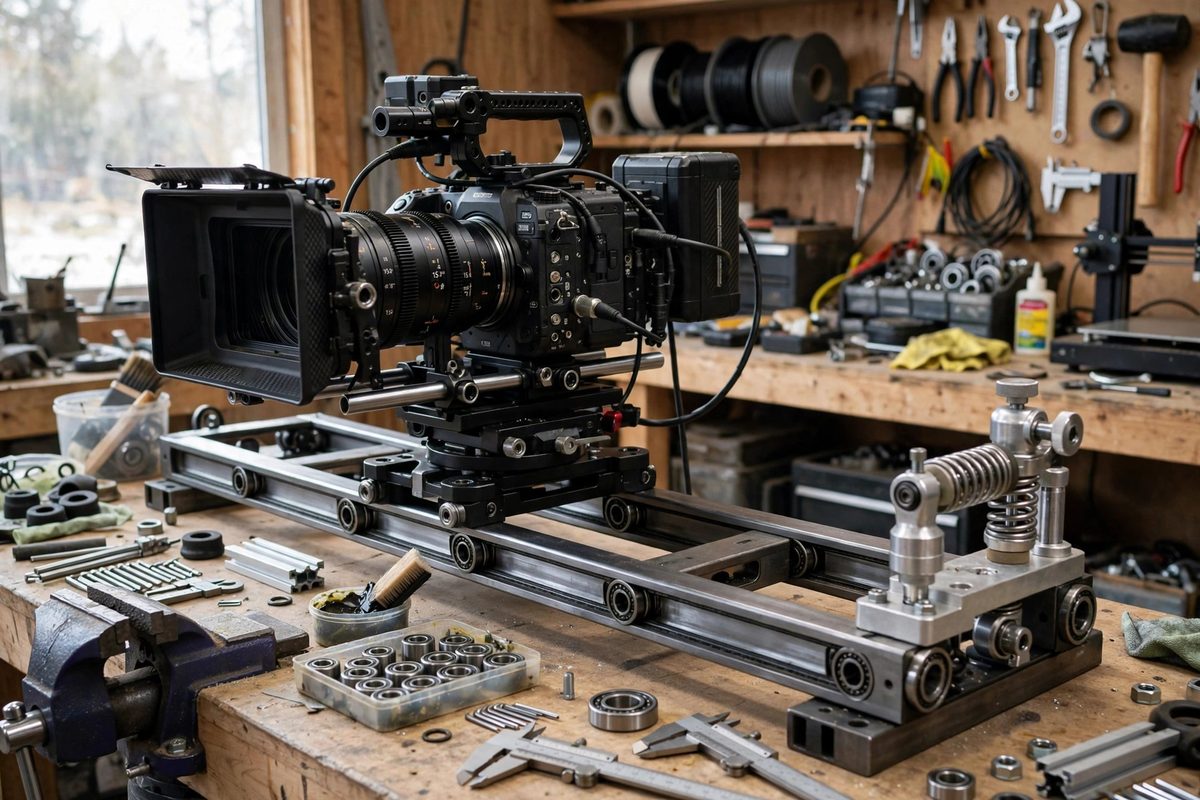
A camera slider carrying a heavy cinema rig has a physics problem: mass plus motion equals momentum, and momentum at the end of a slide becomes a jolt. Linear bearings give the smooth travel, but smooth travel with a heavy payload needs damping: controlled resistance that lets the operator start and stop moves gracefully instead of fighting inertia. Without it, every move ends with a bounce, and every bounce ruins the shot.
Why Heavy Sliders Need Damping
A light mirrorless camera on a slider stops when you stop pushing; a fifteen-pound cinema package keeps going. The operator's hand must absorb that momentum, which means the end of every move is a negotiation between hand pressure and inertia. Damping adds a consistent, speed-dependent resistance that assists the operator: it smooths the start (no jerky breakaway), steadies the middle (constant drag irons out hand tremor), and cushions the stop (the carriage decelerates instead of slamming the end). The result looks like the move was made by a machine, which is the point.
Types of Damping for Sliders
Friction damping (adjustable drag pads or brake shoes pressing on the rail) is the simplest: a knob sets the drag, and it works at any speed. Its weakness is stiction, the difference between starting friction and moving friction, which can make move starts jerky if set too tight. Viscous damping (a rotary damper or a fluid-filled dashpot linked to the carriage) resists proportionally to speed: gentle at creep speeds, firm at fast moves, with no stiction at all. Viscous is smoother but more complex to build and harder to adjust in the field. Many good DIY sliders combine light friction drag for steadiness with end-stop bumpers for the stops.
Bearing Choice Sets the Baseline
The damping system can only refine what the bearings deliver. Recirculating ball linear bearings on supported round shafts are the DIY standard: smooth, affordable, and available in long lengths. Keep the shafts supported along their full length (supported rail, not end-supported) for heavy payloads, because an end-supported shaft flexes under load and no damper fixes a flexing rail. Clean and lightly lubricate the bearings; a gritty bearing introduces exactly the stick-slip motion that damping is supposed to eliminate. Two bearing blocks per shaft, spaced widely on the carriage, resist the rocking that a single centered block allows.
Building Adjustable Drag
An adjustable friction damper can be as simple as a felt or UHMW pad on a thumbscrew pressing against the rail or against a dedicated drag bar. The pad material matters: felt gives smooth, quiet drag; UHMW is more durable but can chatter if the pressure is uneven. Mount the damper so its pressure is symmetric (two pads opposing, or one pad against a backed rail) to avoid pushing the carriage sideways. Provide enough adjustment range that the same slider works for a light DSLR (minimal drag) and a heavy rig (firm drag); a damper with only one useful setting is a damper you will remove.
End Stops That Actually Stop
Every slider needs end stops, and on a heavy slider they need to absorb energy. Hard stops (bolts, clamps) transmit the impact straight into the rig; damped stops (polyurethane bumpers, spring plungers, or small hydraulic shock absorbers) decelerate the carriage over a fraction of an inch. Position the stops so the carriage cannot reach the bearing blocks' travel limits; slamming a bearing block into its end is how bearings get brinelled. For motorized sliders, the stops are also the failsafe: if the controller glitches, the mechanical stop is what saves the camera.
Maintenance for Lasting Smoothness
Wipe the rails before every shoot; dust on the rail becomes grinding paste in the bearings. Check damper pads for wear and replace them before they glaze or crumble. Verify that the carriage still moves with uniform resistance across the full travel; a tight spot means a bent shaft, a damaged bearing, or debris, and it will show up in the footage as a hesitation mid-move. A slider is a precision instrument wearing work clothes; treat it like one and it will deliver machine-smooth moves for years.
Damping is what separates a heavy slider that fights you from one that feels like an extension of your hand. Choose honest bearings on supported rails, add adjustable drag you can tune to the payload, cushion the ends, and keep it clean; the footage will show the difference in every single move.
Related Guides
- Damped Linear Bearing Selection for Heavy Camera Sleds: A camera slider carrying a heavy cinema rig lives or dies by its linear bearings. The sled must glide with constant resistance, no stick-slip, no
- Counterweight Balancing on Heavy Camera Sliders: A camera slider with a heavy cinema rig on it is a physics problem on rails: several kilograms of camera, lens, and accessories riding a carriage
- Dual Steel Linear Rail Spacing on Heavy Camera Mounts: A camera slider is only as smooth as its rails, and heavy camera packages punish undersized or poorly spaced rails mercilessly. Dual steel linear
- Stepper Pulley Tooth Profiles for Low Vibration: A motorized camera slider lives or dies by smoothness: any vibration in the drive becomes visible jitter in the footage. The pulley and belt that