
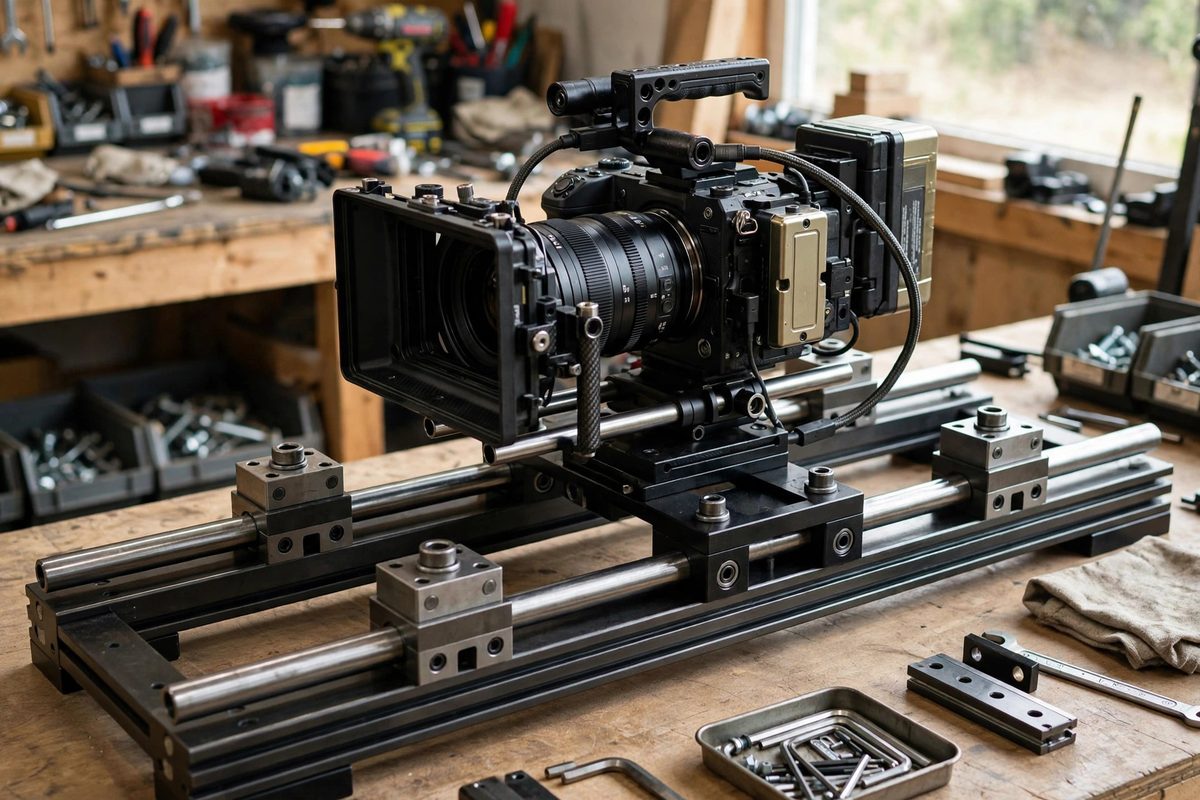
A camera slider is only as smooth as its rails, and heavy camera packages punish undersized or poorly spaced rails mercilessly. Dual steel linear rails spread the load across four bearing blocks and resist the twisting that makes single-rail sliders bind. The spacing between the two rails is the design decision that determines whether the carriage glides or chatters.
Why Two Rails
A single rail resists motion along its length but offers little resistance to rotation around it. A heavy camera mounted high above the rail creates a lever arm, and any imbalance twists the carriage on the single rail, binding the bearings. Two parallel rails separated by a sensible distance turn that twisting force into a simple push-pull between the rails, which linear bearings handle easily. The wider the rail spacing, the less force each bearing sees from a given twisting moment, which is why spacing is a structural decision, not just a packaging one.
Setting the Rail Spacing
Space the rails as widely as the carriage design allows, because stiffness against twist grows fast with spacing. A practical rule: the rail spacing should be at least as wide as the carriage is long, and wider is better up to the point where the carriage plate itself starts flexing between the rails. For heavy cinema packages, rails spaced roughly six to ten inches apart on a carriage of similar length produce a stable platform. Narrow spacing, rails nearly touching, gains almost nothing over a single rail and wastes the second rail's potential. Let the camera's footprint guide the maximum: the carriage should support the camera's mounting points without the rails hanging far outside them.
Rail Straightness and Parallelism
Two rails only work as a system if they are straight and parallel. A rail with a bow forces the carriage bearings to climb and descend as it travels, which shows up as vertical bounce in the footage. Rails that converge or diverge along their length bind the carriage progressively, smooth at one end and stuck at the other. Mount the rails to a rigid base, a thick aluminum plate or a machined beam, and check parallelism with a dial indicator or a careful straightedge before final tightening. Tighten the rail mounting bolts in sequence from the center outward so the tightening itself does not bow the rail.
Bearing Block Arrangement
Use two bearing blocks per rail, spaced along the carriage, for four contact points total. The block spacing along the rail resists pitching (nose-up, nose-down rocking) while the rail spacing resists rolling (side-to-side twist). Longer block spacing gives more pitch stability but lengthens the carriage; balance the two spacings so the carriage resists both motions comparably. Preloaded bearing blocks, with no perceptible play, are worth the cost on a heavy slider because any slop in the bearings becomes visible wobble at long focal lengths.
Keeping It Smooth in the Field
Steel rails and recirculating bearings need clean, lightly lubricated running surfaces. Wipe the rails before every shoot; dust and grit embedded in the bearing tracks destroy smoothness fast. A thin film of appropriate lubricant keeps the bearings quiet and consistent, but excess oil attracts dirt, so apply sparingly. Protect the rails in transit with covers or a case, because a dented rail is a permanently bumpy slider. When the carriage starts feeling gritty, clean first and suspect the bearings second; most slider problems are contamination, not wear.
Dual steel rails spaced wide, mounted straight and parallel on a rigid base, with four preloaded bearing blocks, carry heavy cameras smoothly. Space them generously, align them carefully, keep them clean, and the slider disappears from the footage the way it should.
Related Guides
- Damped Linear Bearing Selection for Heavy Camera Sleds: A camera slider carrying a heavy cinema rig lives or dies by its linear bearings. The sled must glide with constant resistance, no stick-slip, no
- Counterweight Balancing on Heavy Camera Sliders: A camera slider with a heavy cinema rig on it is a physics problem on rails: several kilograms of camera, lens, and accessories riding a carriage
- Linear Bearing Damping for Heavy Motion Sliders: A camera slider carrying a heavy cinema rig has a physics problem: mass plus motion equals momentum, and momentum at the end of a slide becomes a
- Stepper Pulley Tooth Profiles for Low Vibration: A motorized camera slider lives or dies by smoothness: any vibration in the drive becomes visible jitter in the footage. The pulley and belt that