
High-carbon tool steels earn their hardness in the quench, but a conventional quench leaves unfinished business: a percentage of the steel's austenite never transforms to martensite at room temperature, sitting in the blade as retained austenite that softens the steel and can shift dimensions over time. A cryogenic step (cooling the quenched blade well below freezing) converts that retained austenite, squeezing out the last of the steel's potential hardness and stability. It is an extra step, but for a working knife it is the step that separates good from excellent.
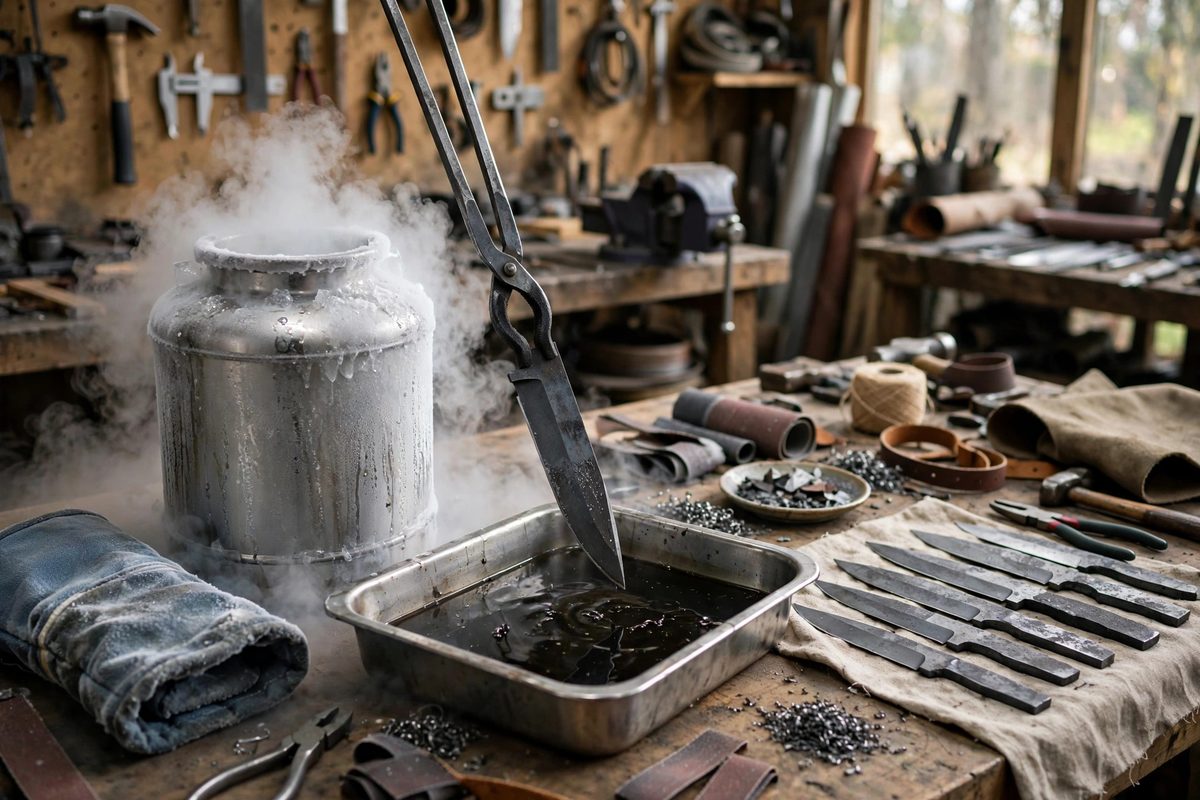
What Cryo Does to the Steel
When high-carbon steel quenches, most of the austenite transforms to hard martensite, but the transformation finishes below room temperature for many tool steels, leaving 10 to 20 percent or more as soft retained austenite. Cooling to cryogenic temperatures (dry ice at about -109 F, or liquid nitrogen colder still) drives the transformation to completion. The payoff is measurable: a point or two of additional Rockwell hardness, better wear resistance, and dimensional stability, because retained austenite that transforms months later (it does, slowly) changes the blade's dimensions and can loosen handles and warp edges.
Where Cryo Fits in the Schedule
The sequence is: austenitize, quench, cryo, then temper. Cryo goes immediately after the quench, before any tempering, because tempering stabilizes the retained austenite and makes it resistant to later conversion. In practice, let the quenched blade cool to room temperature (or just to where you can handle it with gloves), then move it into the cryo medium. Do not delay: a blade left sitting for days between quench and cryo lets some austenite stabilize, and you lose part of the benefit.
Dry Ice vs. Liquid Nitrogen
Dry ice in an insulated cooler (often with a splash of alcohol or kerosene to improve thermal contact) reaches about -109 F and converts most of the retained austenite in common high-carbon steels. It is cheap, available, and safe to handle with gloves and ventilation. Liquid nitrogen goes colder (around -320 F) and converts essentially all of it, but it demands a dewar, careful handling to avoid asphyxiation and cold burns, and respect for the fact that it boils off continuously. For most shop knife work, dry ice delivers the meaningful gains; liquid nitrogen is for chasing the last fraction of performance.
Soak Times
Transformation at cryogenic temperature is fast once the steel reaches temperature, but thick blades take time to cool through. Soak a typical knife blade at cryo temperature for at least a couple of hours; thick tooling or large blades benefit from overnight soaks. There is no harm in longer soaks with dry ice, since the temperature cannot drop below the medium's limit. After the soak, let the blade warm to room temperature slowly in still air; do not quench it in water to warm it faster, because thermal shock on freshly transformed, untempered martensite can crack the blade.
Tempering After Cryo
Temper immediately after the blade reaches room temperature. The freshly converted martensite is highly stressed and brittle, and tempering relieves that stress while setting the final hardness-toughness balance. Many makers run a double or triple temper on cryo-treated blades, since the extra cycles help stabilize the fully transformed structure. Expect the blade to temper to its target hardness normally; cryo does not change the tempering temperatures, it just gives the temper a better starting structure to work with.
Safety Notes
Cryogenic work demands plain precautions. Ventilate the area: both dry ice and liquid nitrogen displace oxygen, and an unventilated shop can become dangerous silently. Wear cryo gloves and eye protection; a splash of liquid nitrogen or prolonged contact with dry ice causes cold burns instantly. Store dry ice in a vented cooler, never a sealed container, because sublimating gas builds pressure. And handle quenched, untempered blades with care throughout, since they are at their most brittle exactly when you are moving them between stations.
Cryogenic treatment is not magic; it is the completion of a transformation the quench started. Quench, cool, cryo-soak, warm slowly, and temper promptly, and your high-carbon blades will hold the hardness and stability that the steel was designed to deliver.
Related Guides
- Cryogenic Quenching Protocols for Tool Steels: After the conventional quench, many tool steels retain a percentage of austenite, the high-temperature crystal phase, that never converted to hard
- Sub-Zero Quench Protocols for Cryogenic High Carbon D2: D2 tool steel holds an edge well but leaves retained austenite behind after a standard quench, and retained austenite is soft, unstable, and prone to
- Heat Treating Ten Ninety-Five High Carbon Steel Knives: 1095 is the classic American knife steel: simple, honest high-carbon steel with about 0.95 percent carbon, no fancy alloying, and a well-earned
- Differential Tempering on O1 Tool Steel Scandi Grinds: A Scandi grind, the single flat bevel beloved of bushcraft knives, puts a wide, thin edge on the blade. That edge needs to be hard enough to cut and