
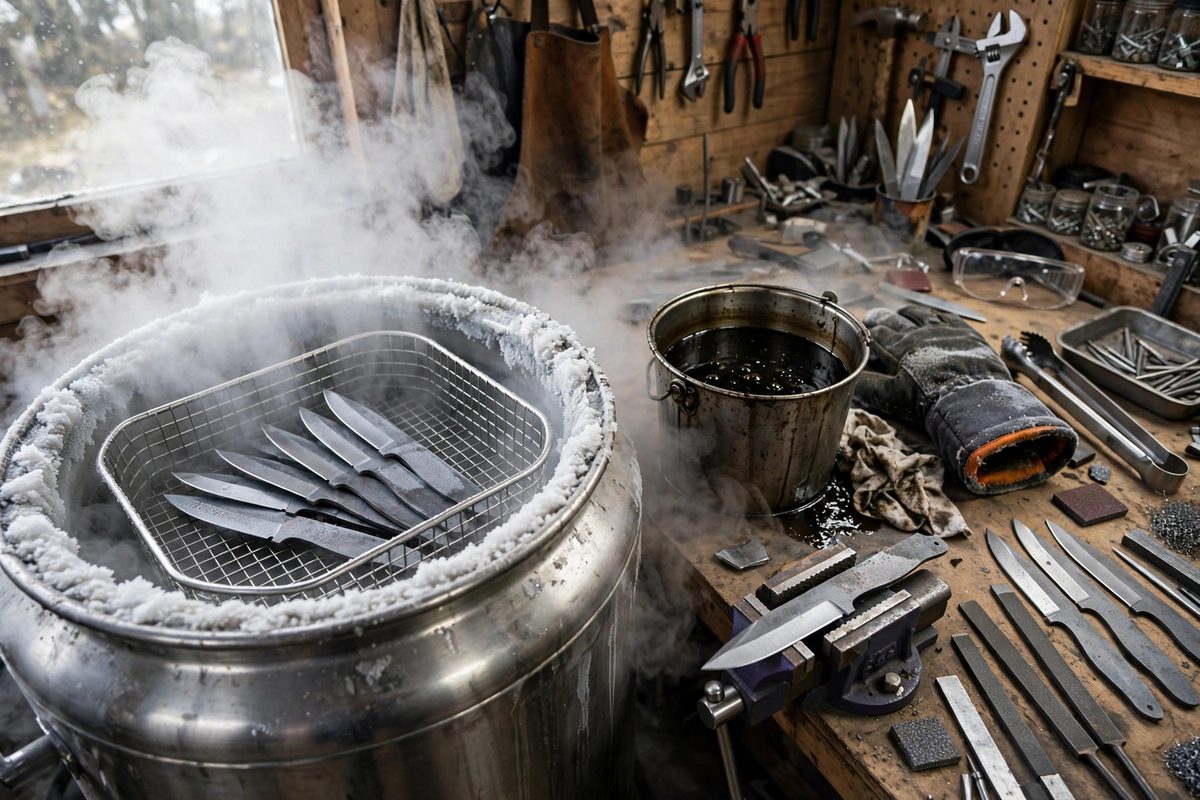
After the conventional quench, many tool steels retain a percentage of austenite, the high-temperature crystal phase, that never converted to hard martensite. That retained austenite is soft, dimensionally unstable, and reduces wear resistance. Cryogenic treatment, cooling the steel to around -300°F after quenching, converts the retained austenite and completes the hardening. For a maker chasing maximum performance from a knife or tool, it is the final step that finishes what the quench started.
Why retained austenite survives the quench
In high-alloy tool steels, the martensite finish temperature (Mf) sits below room temperature: the quench simply cannot get cold enough to finish the transformation. Steels like D2, A2, and many stainless knife steels can retain 10 to 20 percent austenite after a room-temperature quench. This retained phase hurts in three ways: it is softer than martensite, so it lowers overall hardness; it can convert to untempered martensite later in service, causing dimensional growth and brittleness; and it reduces wear resistance. Cryogenic cooling takes the steel below its Mf and completes the conversion.
The basic protocol
Cryo treatment happens after the quench and before tempering, or sometimes between tempering cycles depending on the steel's recommended schedule; check the steel manufacturer's heat-treat guidance. Cool the parts slowly and uniformly to cryogenic temperature: plunging room-temperature steel directly into liquid nitrogen causes thermal shock that can crack precision parts. The standard practice is a controlled ramp down over several hours, a soak at temperature (typically 8 to 24 hours for full effect, though shorter soaks still help), and a controlled ramp back up. Temper immediately after the parts return to room temperature; freshly converted martensite is brittle and stressed.
Equipment approaches for small shops
Full cryogenic treatment at -300°F requires liquid nitrogen and a suitable container or chamber, which puts it out of reach for many home shops. The practical middle ground is sub-zero treatment using dry ice and a solvent bath (acetone or alcohol), which reaches about -100°F: this converts a meaningful portion of retained austenite in many steels, though not as completely as full cryo. Whatever the method, the parts must be at uniform temperature before the soak clock starts, and temperature changes must be gradual. Insulated coolers work for dry-ice treatments; liquid nitrogen demands proper dewars and handling equipment.
Safety is non-negotiable
Cryogenic materials cause instant, severe cold burns: wear cryo-rated gloves, face protection, and handle everything with tools, not fingers. Work in ventilated areas, since evaporating nitrogen displaces oxygen in enclosed spaces; asphyxiation from nitrogen is odorless and silent. Never seal cryogenic liquid in a closed container; the pressure buildup will rupture it explosively. Dry ice plus solvent baths give off CO2 and solvent vapor, so ventilate those too. These are industrial hazards in a home shop, and they deserve industrial respect.
What cryo actually gains you
Expect a modest hardness increase, typically one to three Rockwell points, plus improved wear resistance and dimensional stability. It will not rescue a bad quench or poor temperature control earlier in the process; cryo finishes a good heat treat, it does not fix a bad one. For simple carbon steels like 1084, where Mf is above room temperature and retained austenite is minimal, cryo gains little. Its value concentrates in the high-alloy steels where retained austenite is a real problem. Match the treatment to the steel, and the edge will hold the difference.
Quench well, cool gradually to cryo, soak, warm gradually, temper promptly. The last few percent of austenite becomes the first few percent of performance.
Related Guides
- Cryogenic Quench Schedules for High-Carbon Tool Steels: High-carbon tool steels earn their hardness in the quench, but a conventional quench leaves unfinished business: a percentage of the steel's
- Sub-Zero Quench Protocols for Cryogenic High Carbon D2: D2 tool steel holds an edge well but leaves retained austenite behind after a standard quench, and retained austenite is soft, unstable, and prone to
- Differential Tempering on O1 Tool Steel Scandi Grinds: A Scandi grind, the single flat bevel beloved of bushcraft knives, puts a wide, thin edge on the blade. That edge needs to be hard enough to cut and
- Heat Treating Ten Ninety-Five High Carbon Steel Knives: 1095 is the classic American knife steel: simple, honest high-carbon steel with about 0.95 percent carbon, no fancy alloying, and a well-earned