
D2 tool steel holds an edge well but leaves retained austenite behind after a standard quench, and retained austenite is soft, unstable, and prone to moving around after the blade is finished. A sub-zero or cryogenic treatment converts that leftover austenite into hard martensite, raising hardness and stabilizing the blade. The protocol is straightforward, but the details matter because D2 is not forgiving of sloppy heat treatment.
Why D2 Needs the Cold Treatment
D2 is a high-carbon, high-chromium steel that hardens deeply but finishes its martensite transformation below room temperature. After a normal quench to room temperature, a meaningful fraction of the structure remains as retained austenite, which later converts on its own, slowly and unpredictably, causing dimensional change and soft spots. Cooling the steel well below freezing forces that transformation to complete now, under your control. The result is higher, more uniform hardness and a blade that will not grow or warp in the drawer over the next year.
Getting to the Cryo Stage Correctly
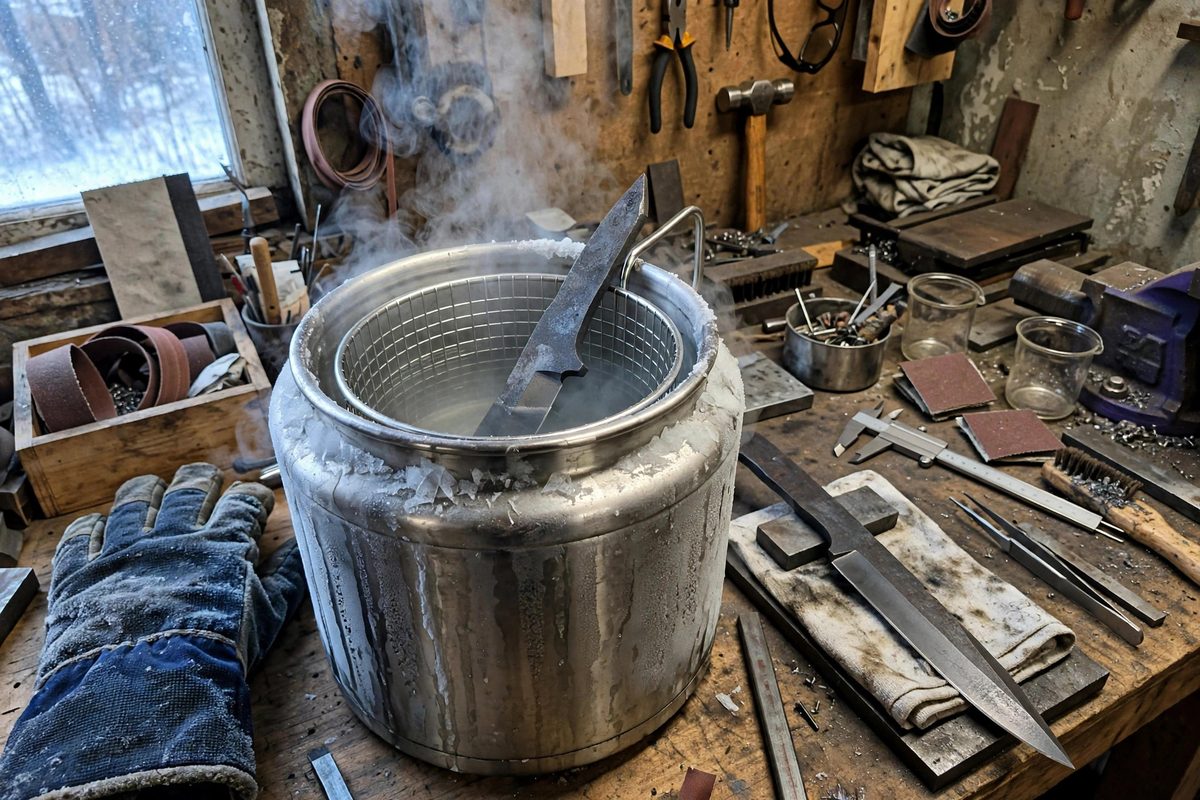
Cryo treatment happens after the quench and before tempering. Quench the blade from the austenitizing temperature per the steel's requirements, let it reach room temperature, and move it into the cold treatment promptly, ideally within the hour. Delaying lets retained austenite stabilize, making it harder to convert later. The blade should be clean and dry; frost forming on the surface is normal during the cold soak but surface contamination can mark the steel. Handle the cold blade with gloves, because skin sticks to sub-zero steel and thermal shock to your hands is no joke.
Sub-Zero Versus Deep Cryo
A household freezer or dry-ice bath reaches around minus one hundred degrees Fahrenheit and converts a good share of retained austenite, which is a real improvement for a shop without specialized gear. A liquid nitrogen soak at roughly minus three hundred twenty degrees drives the conversion essentially to completion and is the standard for maximum performance. Both work on the same principle; the difference is how much austenite remains afterward. For a working knife, dry ice treatment delivers most of the practical benefit. For a blade where every point of hardness counts, liquid nitrogen is the full measure.
Soak Time and Thermal Cycling
Once the blade reaches the target temperature, it needs to stay there long enough for the transformation to finish throughout the cross-section. Thick blades need longer soaks than thin ones; the core of a thick spine lags behind the surface by a wide margin. A soak of several hours at temperature is typical, with overnight soaks doing no harm. Bring the blade back to room temperature slowly rather than shocking it, because a brittle freshly-quenched blade is at its most crack-sensitive during thermal transitions. Never skip tempering after cryo: the newly formed martensite is hard and stressed, and tempering relieves that stress into usable toughness.
Safety Around Cryogenic Materials
Liquid nitrogen and dry ice demand respect. Both displace oxygen in enclosed spaces, so work with ventilation and never seal cryogenic materials in an airtight container; pressure builds fast enough to rupture vessels. Wear a face shield and insulated gloves when handling liquid nitrogen, and treat dry ice with the same care since it causes frostbite on contact. Keep a clear path and a plan for spills before you start, not after.
Cryo treatment turns D2's leftover softness into hardness and its future instability into a finished blade. Quench, chill promptly, soak long enough for the core, warm slowly, and temper. The blade that results holds its edge and its dimensions because the steel finished becoming what it was supposed to be.
Related Guides
- Cryogenic Quench Schedules for High-Carbon Tool Steels: High-carbon tool steels earn their hardness in the quench, but a conventional quench leaves unfinished business: a percentage of the steel's
- Cryogenic Quenching Protocols for Tool Steels: After the conventional quench, many tool steels retain a percentage of austenite, the high-temperature crystal phase, that never converted to hard
- Heat Treating Ten Ninety-Five High Carbon Steel Knives: 1095 is the classic American knife steel: simple, honest high-carbon steel with about 0.95 percent carbon, no fancy alloying, and a well-earned
- Differential Tempering on O1 Tool Steel Scandi Grinds: A Scandi grind, the single flat bevel beloved of bushcraft knives, puts a wide, thin edge on the blade. That edge needs to be hard enough to cut and