
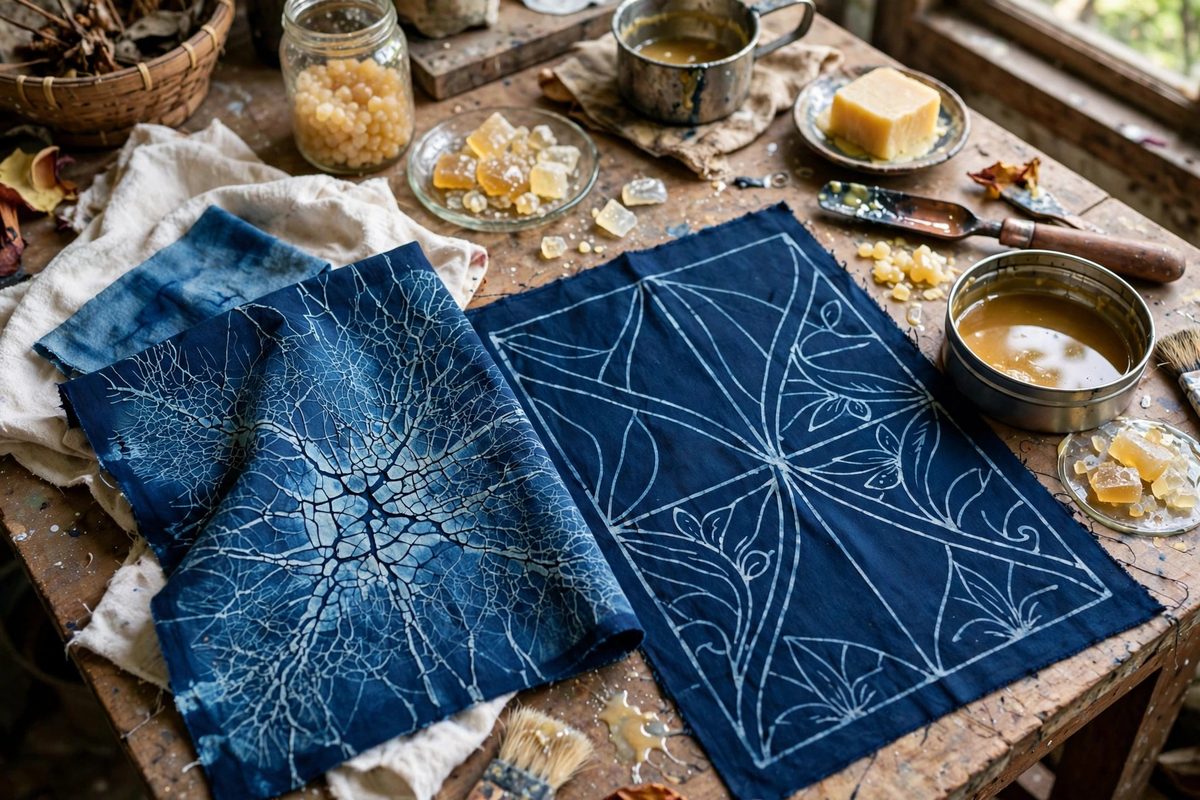
Batik's signature crackle, the fine web of dye lines that veining across the fabric, comes from wax that cracks deliberately. But not every batik wants crackle; sometimes the design needs wax lines that stay intact through multiple dye baths, flexing with the fabric instead of fracturing. Damar resin, added to the traditional beeswax and paraffin resist, is what gives wax its elasticity and controls the crackle. The ratio of damar to wax is the maker's dial between a resist that shatters into fine veins and one that holds its lines through the whole process. Understanding the ratios turns crackle from an accident into a choice.
What damar resin does in the wax
Damar is a natural tree resin that dissolves into molten wax and changes its mechanical character. Pure paraffin is brittle: it cracks at the slightest flex, producing heavy, uncontrolled crackle. Beeswax is flexible and sticky but soft, with a low melting point that risks lifting in warm dye baths. Damar added to the blend increases the wax's toughness and elasticity, letting it bend with the fabric instead of fracturing, while also raising the melting point slightly and improving adhesion to the cloth. The resin does not eliminate crackle; it makes crackle controllable, shifting it from the wax's default shattering to a crackle that appears only where and when the maker induces it by flexing the cooled wax deliberately.
The ratio spectrum and its effects
Wax formulas are usefully described by the proportion of damar in the blend. At the low end, a small fraction of damar in a paraffin-heavy mix, the wax remains quite brittle: it cracks readily with handling, giving the bold, all-over crackle characteristic of traditional high-contrast batik. In the middle range, with beeswax balancing the paraffin and a moderate damar addition, the wax flexes through normal handling and cracks only when deliberately creased, offering selective crackle. At the high end, damar-rich blends become notably elastic and tenacious, holding fine lines and large waxed areas intact through repeated dyeing; this is the formula for precise, crackle-free designs. There is no universally correct ratio, only the ratio that serves the design: choose brittleness for crackle effects, elasticity for line fidelity.
Mixing and melting discipline
Resin and wax must be fully combined for the ratio to mean anything. Melt the waxes first, then add the damar resin gradually, stirring until it dissolves completely; undissolved resin granules create hard spots that resist the tjanting tool and print as blobs. Keep the melting temperature moderate and steady. Overheating darkens the blend, degrades the beeswax component, and drives off the volatile character that makes damar effective; a double-boiler or an electric wax pot with temperature control beats an open flame for consistency. Prepare more than the job needs, since topping up mid-session with a differently-ratioed batch changes the working properties halfway through the design. Label each batch with its ratio; wax pots all look identical once melted.
Application and the crackle decision
Apply the wax at the temperature where it flows smoothly from the tjanting tool or stamp without smoking; too cool and it sits on the surface without penetrating, too hot and it spreads uncontrollably and scorches. The wax must penetrate the fibers to resist dye, which you verify by checking the back of the cloth for full saturation. Once the waxed design cools, the crackle decision is made by handling: leave the piece undisturbed for minimal crackle, or flex, crumple, and crease it deliberately to fracture the wax where veins are wanted. The damar ratio set the threshold; your hands decide whether the threshold is crossed. For multi-color work, subsequent wax applications over dyed areas need the same ratio discipline, since each layer's crackle behavior should be intentional.
Dye bath behavior and wax removal
In the dye bath, the wax's job is to stay put. Damar-toughened wax resists the warm bath better than soft blends, but keep bath temperatures moderate regardless; excessive heat softens even good wax and lets dye creep under the lines. After dyeing, remove the wax by boiling out or ironing between absorbent paper, and expect damar-rich blends to need slightly more thorough removal since the resin makes the wax more tenacious. Residual resin in the cloth is usually invisible but can affect the hand of the fabric; a final hot wash with detergent clears it. The crackle veins, where dye penetrated the deliberate fractures, remain as the permanent record of the ratio choice and the maker's hands.
Safety with hot wax and resin
Molten wax and resin demand the same respect as any hot, flammable liquid. Work ventilated; overheated wax and resin produce fumes that irritate lungs, and damar in particular should never be scorched. Keep the melting setup away from open dye pots and water, since water dropped into hot wax erupts violently. Have a lid or a fire blanket ready for the wax pot, and never leave melting wax unattended. Burns from wax are serious because the wax clings to skin; keep a bowl of cool water nearby and know that the correct response to a wax burn is cooling, not peeling.
Damar resin is the elasticity dial in batik wax: low ratios for bold crackle, middle ratios for selective veining, high ratios for tenacious crackle-free lines. Melt and mix thoroughly, label the batch, apply with full penetration, decide the crackle by handling, and respect the hot wax. The crackle in the finished cloth will show exactly the choice you made.
Related Guides
- Wax Resist Viscosity Formulas for Intricate Batik: Batik's fine lines and crisp detail depend on wax that flows exactly as intended: fluid enough to penetrate the cloth and leave a clean line, viscous
- Wax-to-Resin Ratios for Fine Detail Crackle Batik: Crackle is the signature texture of batik: fine veins of dye that seep through deliberate cracks in the wax resist, creating the webbed, aged look
- Rosin Ratios for Brittle Crackle Lines in Rice Batik: Rice batik crackle is the network of fine dye lines that appears when a solid resist layer is intentionally fractured and the dye seeps into the
- Controlling Crazing Patterns in Cold-Water Crackle Dyes: Crackle dyeing produces the web of fine lines that makes batik-like fabric so compelling: dye seeps into tiny cracks in a resist layer, drawing a