
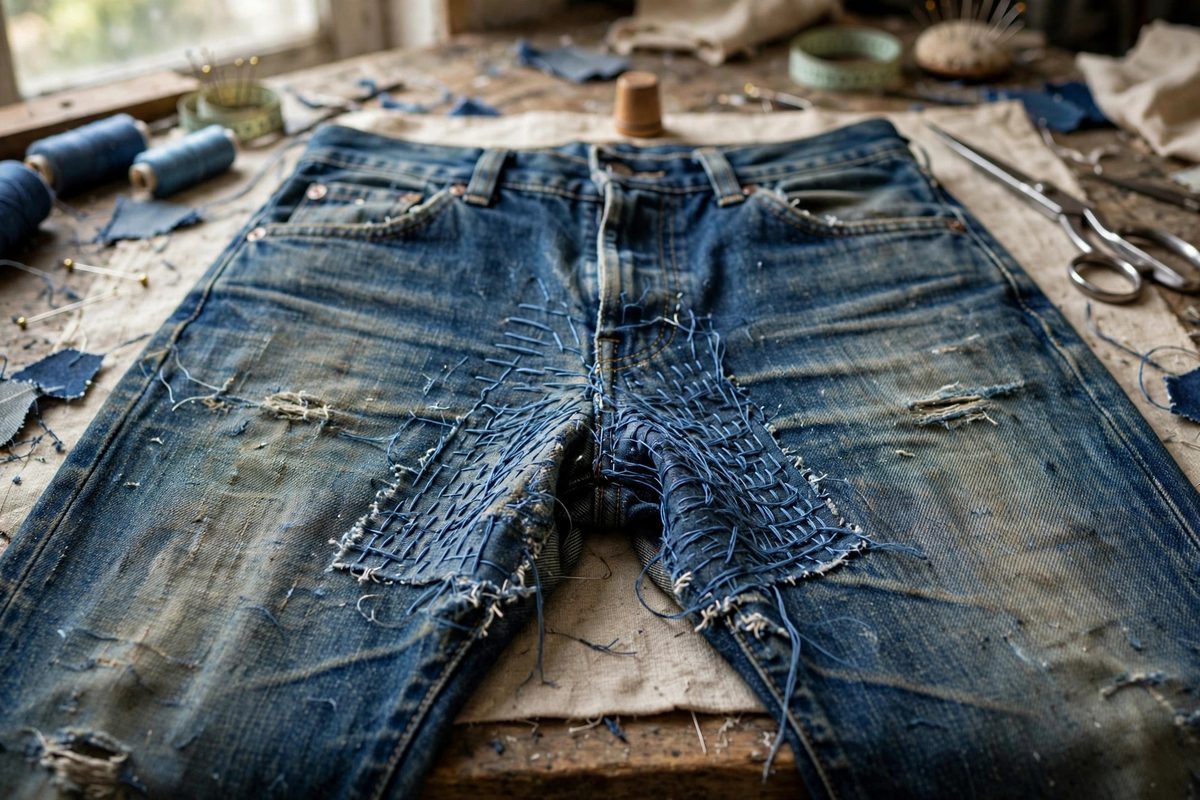
The crotch of a well-loved pair of jeans takes more punishment than any other spot in a garment: constant flexing, friction between the thighs, and stress every time you sit, stand, or climb stairs. When the fabric finally gives out, the result is the classic blowout, a worn hole surrounded by thinning denim. Free-motion darning rebuilds that area with thread, essentially reweaving the fabric where the cotton gave up. Done well, the repair is strong, flexible, and nearly invisible from a few feet away.
Why blowouts happen where they do
Denim fails at the crotch for two compounding reasons. First, the inseam area concentrates mechanical stress: the curved seam and the inner thigh form a point where the fabric is pulled in multiple directions at once with every step. Second, thigh friction abrades the surface yarns constantly, thinning the fabric right where the stress is highest. The weave typically fails along the weft first, leaving long warp threads bridging a gap, then those go too. Understanding this matters because a repair that only covers the hole ignores the thinned fabric around it, and the blowout simply migrates outward. Any durable darn must extend well past the visible damage into fabric that still has body, rebuilding the whole weakened zone rather than just bridging the gap.
Preparing the area and the patch
Start by trimming away the loose, frayed threads around the hole so they cannot tangle in the darning, but do not cut into sound fabric; the goal is a clean edge, not a bigger hole. Turn the jeans inside out and fuse or baste a patch of denim or sturdy cotton behind the damaged area, extending at least an inch past the thinning in every direction. A lightweight fusible interfacing between the patch and the jeans adds body without stiffness. The patch is doing real structural work: it carries the load while your darning stitches lock everything together. Choose a patch fabric close to the jeans' weight. Too heavy and the repair becomes a stiff board in a flexible zone; too light and it contributes nothing. Baste the patch rather than relying on fusible alone if the area is large, since fusing can shift under the pressure of darning.
Machine setup for free-motion darning
Drop or cover the feed dogs, attach a darning or free-motion foot, and set a straight stitch. You move the fabric; the machine only makes stitches. Thread the top with a strong thread in a close color match: a 40-weight polyester or a topstitch thread works well, and a slightly darker shade blends better than a lighter one because the repair sits in shadow inside the leg. Use a regular bobbin thread in a matching tone. A jeans or denim needle in an appropriate size pierces the layered patch area cleanly. Lower the top tension slightly if the bobbin thread pulls to the surface, but make most adjustments by feel on a test sandwich of denim scraps layered like the repair. Hoop the area if your hoop fits inside the leg; if not, stabilize by hand, keeping the fabric flat and taut without stretching it out of shape.
The darning pattern that actually holds
Darn in rows, not circles. Start about an inch beyond the damage in solid fabric and stitch straight rows back and forth across the weakened area, following the direction of the warp threads. Keep the rows close together, nearly touching, so the new threads form a woven mat over the old fabric. When you reach the far side, turn and darn back across at a slight angle, building a second layer that crosses the first. This crosshatching mimics woven cloth, which is exactly what you are recreating: new warp and new weft. Work slowly and let the machine speed stay constant while your hands control the spacing. Overlap each pass slightly past the damage into sound fabric, because the transition zone between darned and undarned denim is where the next failure will start if you skimp. Two to three layers of crosshatched stitching usually rebuilds full strength; more than that adds stiffness without much gain.
Finishing and living with the repair
When the darning is complete, trim any patch edges that extend awkwardly, press the repair flat from the wrong side, and turn the jeans right side out. The darn will look like a slightly textured patch of stitching, which reads as intentional mending rather than damage. Expect the repair to soften and blend further with washing and wear. Wash the jeans inside out to protect the darning, and skip the dryer heat that accelerates fiber breakdown if you want maximum life. A well-darned crotch routinely outlasts the rest of the jeans, because the rebuilt area is now the strongest fabric in the garment. That is the quiet satisfaction of this repair: the blowout becomes the part you never think about again.
Free-motion darning looks intimidating until the second row, when the rhythm takes over and the hole starts disappearing under your hands. It is one of the most genuinely useful machine skills a maker can own, and jeans are the perfect training ground.
Related Guides
- Free-Motion Darning Over High-Wear Denim Interfacing: Denim wears out in predictable places: knees, inner thighs, pocket corners, the spots that take friction and stress every day. Free-motion darning
- Whipstitch Seam Rebuilding on Heavy Canvas Workwear: Heavy canvas workwear, chore coats, duck overalls, tool aprons, earns its repairs honestly: seams blow out at stress points after years of hard use
- Ladder Stitch Seam Tension for Invisible Repairs: The ladder stitch, also called the slip stitch, is the repair stitch that disappears. Used to close a split seam in a jacket lining, reattach a
- Sashiko Grid Reinforcement for Worn Duck Canvas Workwear: Duck canvas workwear earns its wear honestly: knees thin, elbows fray, pockets pull. When the fabric is worn but not done, sashiko, the Japanese