
The ladder stitch, also called the slip stitch, is the repair stitch that disappears. Used to close a split seam in a jacket lining, reattach a stuffed toy's stuffing opening, or mend a cushion cover, it buries the thread inside the seam so the finished repair shows almost nothing. The invisibility depends almost entirely on one thing: tension. Too tight and the seam puckers into a gathered scar; too loose and the thread bridges visibly across the opening.
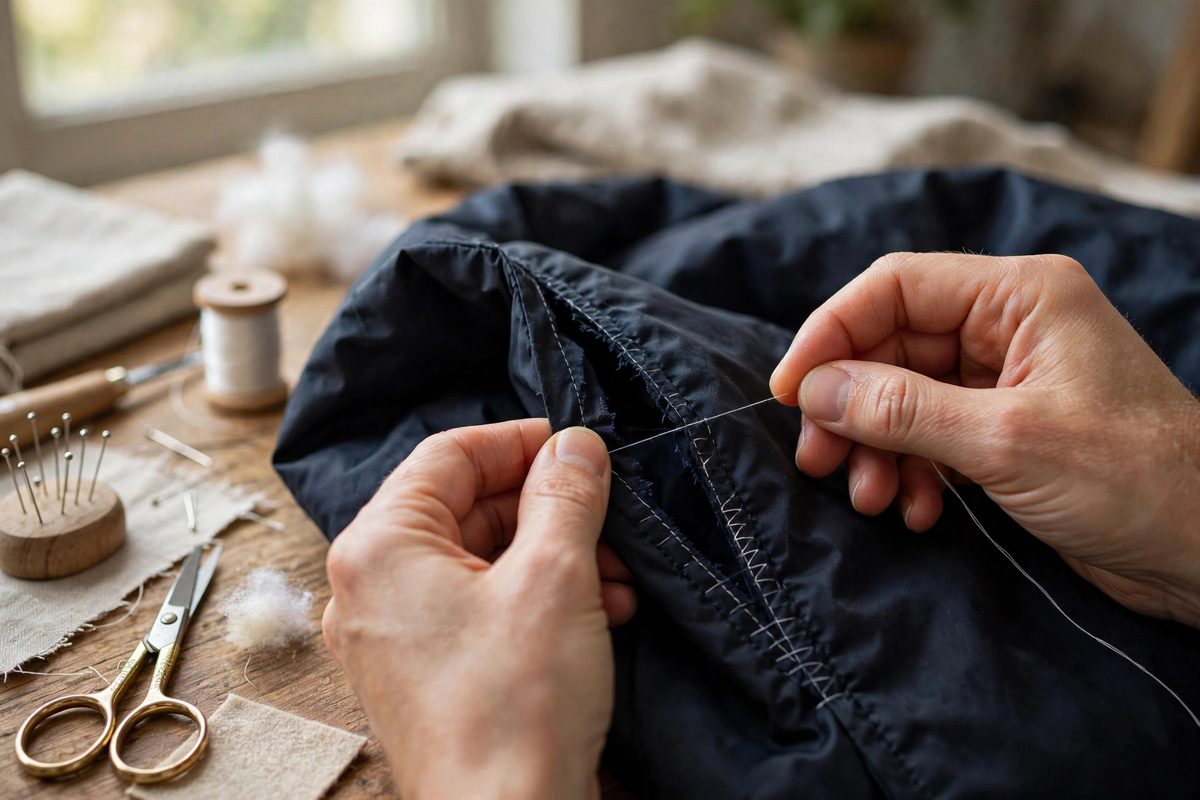
How the stitch hides the thread
The ladder stitch works by taking small bites alternately in the two folded seam allowances, directly opposite each other. The thread travels back and forth across the gap like the rungs of a ladder, but each bite dives into the fold, so the visible thread runs inside the seam channel. When the seam is finally pulled closed, the rungs sink into the folds and vanish. This geometry only works if the folded edges actually meet: the stitch cannot hide thread across a gap that stays open, which is why tension control, not stitch size, is the skill.
Setting the tension stitch by stitch
Take each bite about an eighth to a quarter inch long, directly across from the previous bite, keeping the rungs perpendicular to the seam. After every three or four rungs, pull the working thread gently to draw the seam closed, then let it relax slightly before continuing. The correct final tension is the one where the two folded edges just kiss: no gap, no overlap, no pucker. If the seam puckers, you pulled too hard; ease the thread back a fraction before the next bite. If thread shows between the edges, the rungs are too long or the tension too loose; shorten the bites.
Preparing the repair
Press or finger-press the seam allowances under along the original fold lines before you start; the stitch cannot create a fold that is not there. Match your thread to the fabric, not the original seam thread, since the repair sits on the visible surface. For linings and lightweight fabrics, a single strand of all-purpose thread is right; for upholstery or outerwear, consider a heavier thread or two strands. Knot the thread and bury the knot inside the seam at the start, and plan your bites so the final thread end also buries inside the fold.
Curves, corners, and stuffing openings
On curves, shorten the bites so the rungs can follow the arc without bridging across it. At corners, take one tiny bite right at the pivot to anchor the turn. For stuffed items, close the opening most of the way, add any final stuffing through the remaining gap, then finish the last inch with extra care: this is the visible part, and rushing it shows. Keep the stuffing pushed back from the seam line as you work so it does not get caught in the stitches.
Knowing when it is not the right stitch
The ladder stitch repairs seams; it does not patch holes or reinforce worn fabric. If the fabric itself is shredded along the seam line, stitching the shreds together just moves the failure a quarter inch over. In that case, patch or reinforce first, then close with the ladder stitch. And on high-stress seams, like a child's toy that will be yanked daily, back the repair with a line of machine stitching inside where it will not show.
Small bites, opposite each other, tension just to the kiss. Done right, the repair is something you know is there and nobody else can find.
Related Guides
- Whipstitch Seam Rebuilding on Heavy Canvas Workwear: Heavy canvas workwear, chore coats, duck overalls, tool aprons, earns its repairs honestly: seams blow out at stress points after years of hard use
- Darning Heavy Denim Crotch Blowouts With Free Motion: The crotch of a well-loved pair of jeans takes more punishment than any other spot in a garment: constant flexing, friction between the thighs, and
- Sashiko Grid Reinforcement for Worn Duck Canvas Workwear: Duck canvas workwear earns its wear honestly: knees thin, elbows fray, pockets pull. When the fabric is worn but not done, sashiko, the Japanese
- Free-Motion Darning Over High-Wear Denim Interfacing: Denim wears out in predictable places: knees, inner thighs, pocket corners, the spots that take friction and stress every day. Free-motion darning