
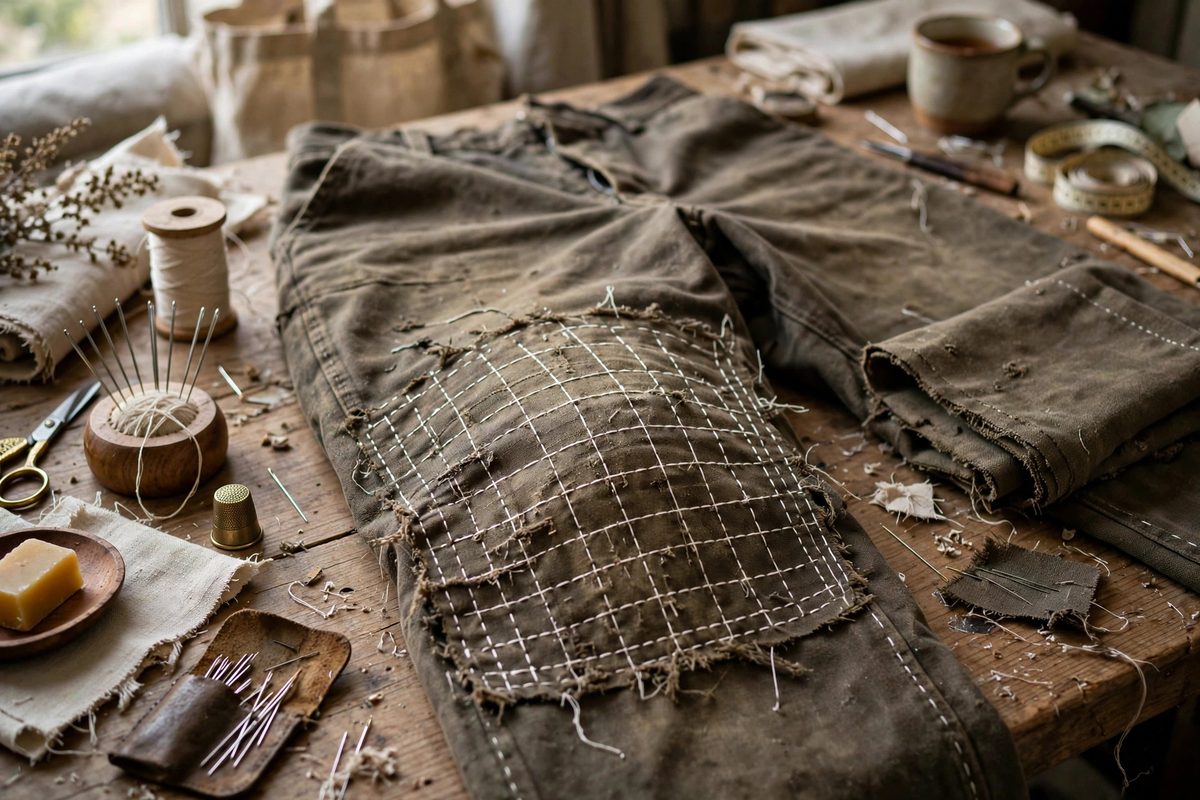
Duck canvas workwear earns its wear honestly: knees thin, elbows fray, pockets pull. When the fabric is worn but not done, sashiko, the Japanese tradition of running-stitch reinforcement, rebuilds the cloth's strength while looking intentional. A sashiko grid over worn duck canvas is a repair that adds years.
Why sashiko suits workwear repair
Sashiko was born from necessity: reinforcing worn cloth with stitching. The running stitch grid distributes stress across the worn area instead of letting it concentrate at the thin spot, and the layered thread effectively adds a second skin to the fabric. On duck canvas, which is already a dense weave, the sashiko layer bonds with the ground fabric to make something tougher than either alone. It is also honest repair; the stitching shows, declaring that the garment was worth saving.
Assessing the worn area
Before stitching, assess what you are working with. Fabric worn thin but intact takes sashiko beautifully; fabric with actual holes needs a patch underneath first, with the sashiko worked over both. Check the surrounding fabric too: if the whole knee is thin, the reinforcement area should extend well beyond the worst spot, because the stress that wore the center is working on the edges too. Clean the garment first; stitching through ground-in grime is unpleasant and weakens the thread's grip.
Marking the grid
The sashiko grid is marked on the fabric before stitching. Traditional patterns use geometric grids, squares, diamonds, or waves, but for workwear reinforcement a simple even grid is the functional choice. Mark with a fabric marker or chalk that will wash out, spacing the lines evenly; the grid's regularity is what distributes the stress. Extend the grid past the worn area onto sound fabric, so the reinforcement anchors to strength. An unmarked freehand grid will drift, and a drifting grid looks accidental rather than intentional.
Stitching technique
Sashiko is a running stitch, worked with a long needle and sturdy thread, traditionally white cotton on indigo but any strong thread on duck canvas. Load several stitches on the needle before pulling through; this keeps the stitch length even and the rhythm smooth. Keep the stitches uniform in length and the spacing even; the grid's strength comes from its regularity. Do not pull the thread tight; sashiko should lie on the fabric's surface, and tight stitching puckers the canvas. The stitching is meditative work, and the evenness shows the care.
Layering for serious wear
For badly worn areas, stitch a patch of new duck canvas behind the worn spot first, then work the sashiko grid over both layers. The patch carries the load, the sashiko locks the patch in place and reinforces the transition zone where patch meets old fabric. That transition is the critical area: a patch edge is a stress concentration, and the sashiko grid spreading across it is what prevents the tear from simply moving to the patch's border. Think of it as engineering, because it is.
Thread and longevity
Use thread that matches the job's demands: strong, abrasion-resistant, and colorfast. Cotton sashiko thread is traditional and pleasant to work; polyester-core thread lasts longer in hard use. The repaired garment will be washed and worn hard, so the thread must survive that life. When the sashiko itself eventually wears, it can be stitched over again; the repair is renewable, which is part of its philosophy. A garment that has been sashikoed twice is a garment with a history.
Mark the grid past the worn area, stitch it evenly without pulling tight, patch underneath when the fabric is truly gone, and use thread built for the work. The duck canvas gets its years back, and the repair looks like it belongs there, because it does.
Related Guides
- Whipstitch Seam Rebuilding on Heavy Canvas Workwear: Heavy canvas workwear, chore coats, duck overalls, tool aprons, earns its repairs honestly: seams blow out at stress points after years of hard use
- Darning Heavy Denim Crotch Blowouts With Free Motion: The crotch of a well-loved pair of jeans takes more punishment than any other spot in a garment: constant flexing, friction between the thighs, and
- Ladder Stitch Seam Tension for Invisible Repairs: The ladder stitch, also called the slip stitch, is the repair stitch that disappears. Used to close a split seam in a jacket lining, reattach a
- Free-Motion Darning Over High-Wear Denim Interfacing: Denim wears out in predictable places: knees, inner thighs, pocket corners, the spots that take friction and stress every day. Free-motion darning