
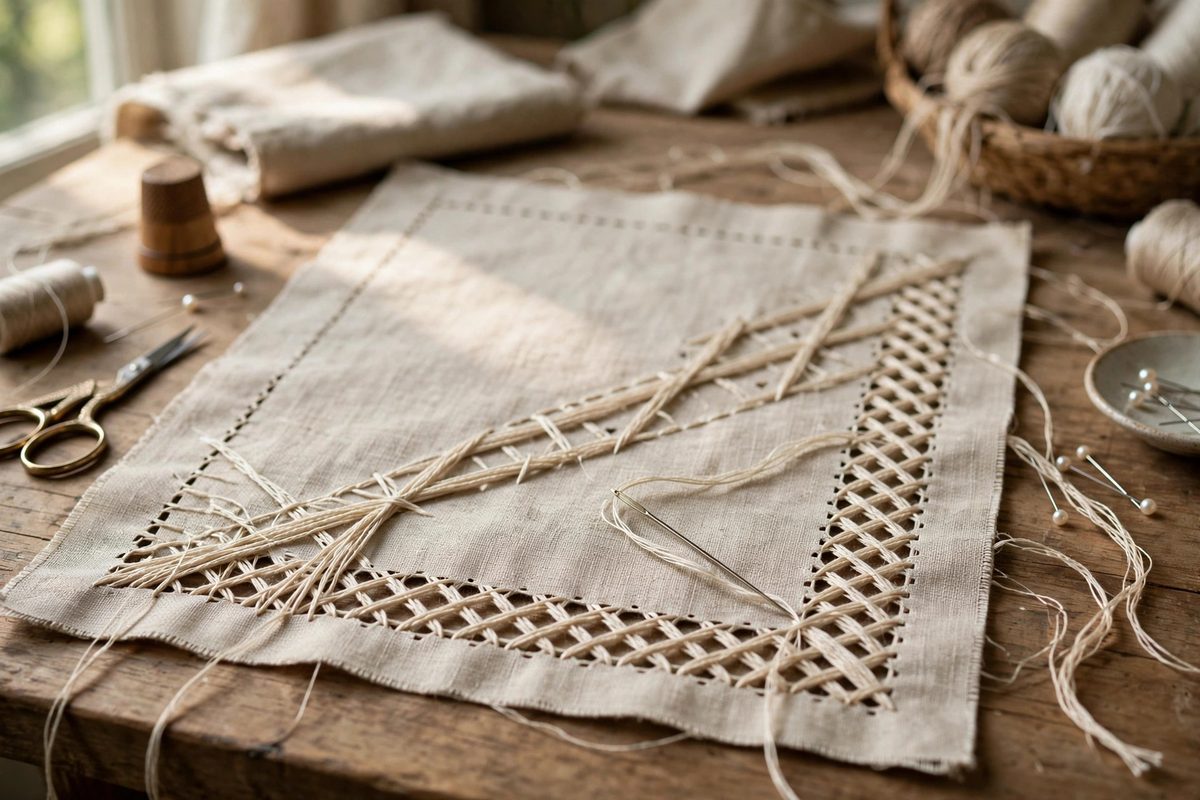
Hemstitching turns a plain hem into an openwork border: threads withdrawn from the fabric leave a lattice, and the remaining threads are grouped and secured with decorative stitches. The diagonal drawn thread variation arranges the lattice on the bias, creating a diamond-patterned openwork that catches light beautifully and elevates household linens into heirlooms. It is counted-thread work, which means every step follows the fabric's weave, and precision in the counting is what makes the lattice regular. This guide walks through the sequence from fabric preparation to the finished edge.
Fabric selection and preparation
Drawn thread work needs an even-weave fabric with threads that withdraw cleanly: linen and linen-like even-weaves are the traditional choices, with a thread count open enough to withdraw but tight enough to hold the remaining structure. Very fine or very tight weaves fight the withdrawal; very coarse weaves leave a lattice too sparse to be elegant. Prepare the fabric by pressing it true, verifying the weave is square, and marking the hemstitch zone: the band where threads will be drawn, typically a half inch to an inch wide, positioned where the hem's structure supports it. The band's edges must follow single fabric threads exactly, since every subsequent step counts from these lines. Mark with a removable method and double-check the count before cutting anything; a band that wanders off-grain produces a lattice that leans.
Withdrawing the threads
Cut and withdraw the crosswise threads within the band, leaving the lengthwise threads standing as the lattice's verticals. Work carefully: nick one lengthwise thread and the lattice has a permanent flaw. Withdraw an even number of threads so the remaining groups divide evenly, and keep the withdrawn count consistent along the whole band; a band that is twelve threads wide at one end and fourteen at the other cannot form a regular lattice. For the diagonal effect, the withdrawal pattern may step: withdrawing threads in a staggered sequence across the band's width creates the bias structure that the hemstitching then secures. Count and recount. This is the foundation, and every later step assumes it is correct.
Grouping the remaining threads
The standing threads are now grouped, typically in bundles of three or four, and each bundle is secured where it meets the fabric's solid edge. The grouping stitch, often a simple overcast or a needle-weaving stitch, wraps each bundle tightly at the band's edge, defining the lattice's verticals. Keep the bundles uniform in thread count and the wrapping tension even; irregular bundles make an irregular lattice, and uneven tension puckers the band. Work the entire edge's grouping before moving to the decorative crossings, since the grouped verticals are the lattice's skeleton. Step back periodically and sight along the band: the verticals should stand parallel and evenly spaced, the visual rhythm that the diagonal work will play against.
Forming the diagonal lattice
The diagonal character comes from drawing the grouped verticals together in bias pairs: each stitch catches half of one bundle and half of its neighbor, pulling them together at the band's middle to form the diamond crossings. Worked in sequence across the band, these crossings create the characteristic zigzag lattice. The stitch used for the crossings varies by tradition, from simple twisted bars to more elaborate needle-weaving, but the geometry is consistent: pairs drawn together on the diagonal, evenly spaced, with uniform tension. The diamonds should be regular and the crossings centered; a crossing that sits high or low breaks the rhythm visibly. This is slow, meditative work, and the regularity comes from counting, not from eyeballing.
Securing the hem and finishing
With the lattice complete, the hem itself is secured: the fabric is folded to its finished hem depth and the hemstitching's edge stitches anchor it, often with the same thread continuing into a hem stitch along the fold. The openwork band thus serves as both decoration and the hem's structural attachment, which is the traditional elegance of the technique. Finish the fabric's raw edges within the hem so nothing ravels, and press the finished piece carefully, easing the lattice flat without crushing its texture. Inspect the whole band under good light: missed groupings, uneven diamonds, and tension puckers are all correctable now and permanent later.
Design variations and applications
Once the basic diagonal lattice is mastered, variations multiply: multiple drawn bands separated by solid stripes, contrasting thread colors in the grouping stitches, beads caught in the diamond crossings, or the lattice worked as a border around a monogram or motif. The technique suits table linens, handkerchiefs, garment hems, and any project where an heirloom edge is wanted. Scale the band width and bundle size to the project: a handkerchief wants a delicate narrow lattice, a tablecloth can carry a bold wide one. The counted-thread discipline transfers directly to other openwork techniques, making hemstitching an excellent foundation for the broader family of drawn and pulled thread embroidery.
Diagonal drawn thread hemstitching is counting made beautiful: prepare an even-weave band on grain, withdraw evenly, group uniformly, cross on the diagonal with regular tension, and secure the hem through the openwork. Precision in the early steps becomes elegance in the finished lattice.
Related Guides
- Tension Control in Open Work Drawn Thread Borders: Drawn thread work removes fabric threads to create open, lacy borders, and the remaining threads are then stitched into decorative patterns. The open
- Even Weft Tension in Drawn Thread Open Border Work: Drawn thread work creates open, lacy borders by removing threads from the fabric and embellishing what remains: the remaining threads are grouped
- Thread Twist Tension Balance in Blackwork Diaper Patterns: Blackwork's diaper patterns, the repeating geometric fills that give the style its woven texture, are built from hundreds of identical small
- Surface Coverage Tension on Hardanger Needle Wefts: Hardanger embroidery is built on a tension paradox: the satin stitch blocks (kloster blocks) must lie flat and smooth, while the needle-woven bars