
Drawn thread work creates open, lacy borders by removing threads from the fabric and embellishing what remains: the remaining threads are grouped, wrapped, and woven into patterns that look like lace but are structurally part of the cloth. The weft, the horizontal threads worked through the remaining warp, must be tensioned with exceptional evenness: too tight and the border puckers and draws in, too loose and the openwork sags and looks sloppy. In drawn thread borders, weft tension is the visible difference between crisp lace and a wavy mess.
What Drawn Thread Borders Demand
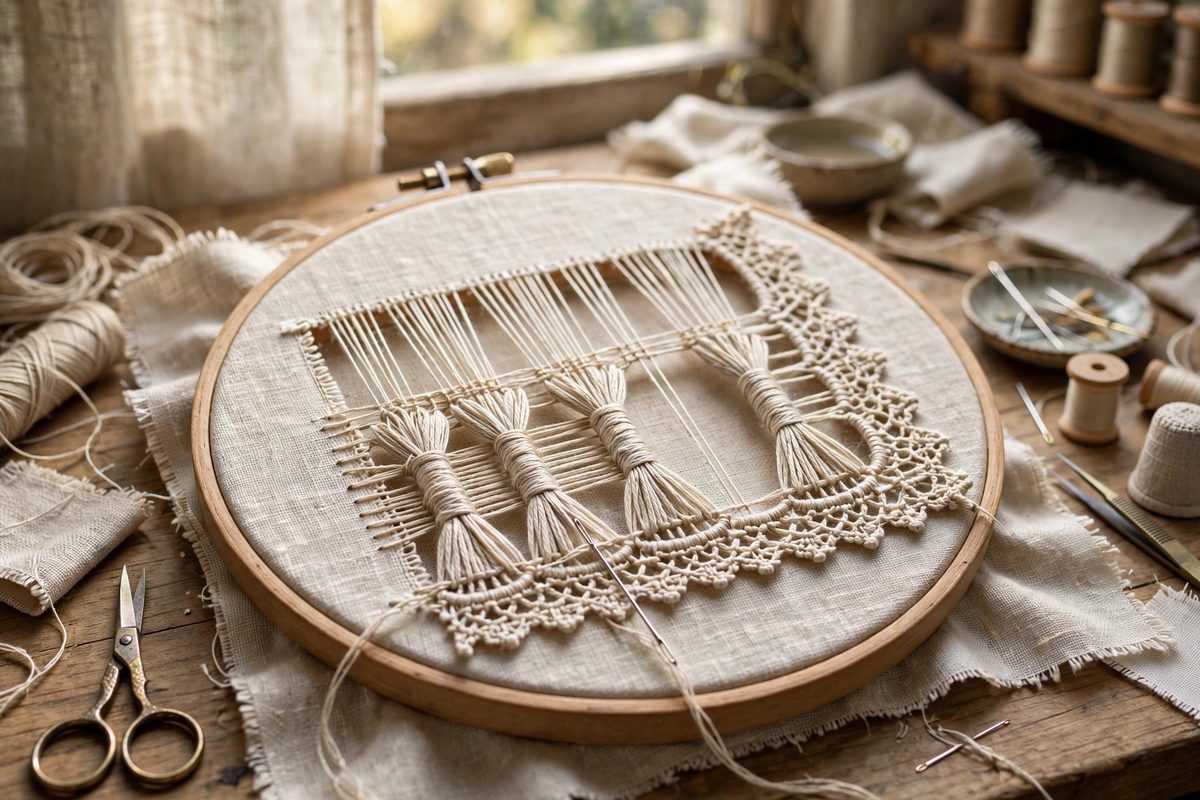
A drawn thread border is a study in structural honesty: with threads removed, every remaining thread and every stitch is visible, and there is no background fabric to hide inconsistencies. The border typically consists of warp threads left standing after weft threads are withdrawn (or vice versa), grouped into bundles and secured with stitches like hemstitching, and then embellished with needle-woven patterns worked on the remaining grid. The weft in this context is the thread you weave through the standing warp to create the decorative patterns: bars, wheels, and woven bands. Because the work is open, the weft's tension directly determines the geometry: tight weft pulls the warp bundles together, loose weft lets them drift apart.
Why Evenness Matters More Here
In solid embroidery, minor tension variations disappear into the surrounding stitches. In openwork, each stitch is silhouetted against empty space, and the eye compares every stitch to its neighbors with ruthless precision. A single weft pass pulled tighter than the rest creates a visible pinch in the border; a loose one creates a sag. Worse, uneven tension accumulates: if each weft pass is slightly tighter than the last, the border progressively draws in, curving the edge of the piece. The standard for drawn thread work is metronomic consistency: every pass tensioned like every other pass, which is a discipline more than a technique.
Developing Even Weft Tension
Several practices build the consistency. Work with the fabric properly tensioned in a hoop or frame: a slack ground fabric makes even weft tension nearly impossible because the foundation moves under your hands. Pull each weft pass with the same motion and the same force: develop a physical rhythm, and resist the urge to snug "just this one" tighter. Leave the weft slightly relaxed rather than slightly tight: in openwork, a touch of ease is far less visible than a touch of tightness, because tight weft distorts the geometry while slightly loose weft merely softens it. Check your work frequently by holding it up and sighting along the border: the warp bundles should be parallel and evenly spaced, the woven bars uniform. Correct drift immediately rather than hoping the next stitches compensate.
Counting and Structure as Tension Aids
Drawn thread work is counted thread work: the patterns are built by counting threads, and that counting is itself a tension aid. When each woven bar spans a counted number of warp threads and each stitch lands in a counted position, the structure enforces regularity: the counting tells your hands where to go, and consistent placement produces consistent tension almost automatically. Do not fudge the counts: skipping a thread here or adding one there to "make it fit" introduces the irregularities that uneven tension then amplifies. If the counts do not work out, the border design needs adjusting, not the stitching.
Thread Choice and Preparation
Use a weft thread appropriate to the scale: too thick and it overwhelms the delicate warp bundles, too thin and it lacks the body to hold the structure crisp. The weft thread should be smooth and consistent in thickness: slubby or uneven thread produces uneven tension no matter how carefully you work. Cut working lengths that are manageable: excessively long threads wear, tangle, and change tension as they shorten, while very short threads mean constant joins. And keep the thread untwisted as you work: built-up twist kinks the weft and creates tension variations along its length.
Finishing and Pressing
When the border is complete, finishing sets the work. Weave in ends invisibly within the woven structures, never across open spaces. Press the finished piece carefully: use a press cloth and press from the wrong side, or pin the border straight and steam it lightly. Pressing will not fix bad tension, but it settles good tension into its final crisp geometry. Inspect the finished border critically: hold it to the light and check that the openwork is even, the bundles parallel, the edges straight. That is the standard, and even tension is how you reach it.
Drawn thread borders show everything, which is exactly their beauty. Count carefully, tension evenly, keep the fabric taut, and let the structure do the talking. The lace-like border that results is worth every counted thread.
Related Guides
- Tension Control in Open Work Drawn Thread Borders: Drawn thread work removes fabric threads to create open, lacy borders, and the remaining threads are then stitched into decorative patterns. The open
- Diagonal Drawn Thread Lattice Hemstitching Steps: Hemstitching turns a plain hem into an openwork border: threads withdrawn from the fabric leave a lattice, and the remaining threads are grouped and
- Thread Twist Tension Balance in Blackwork Diaper Patterns: Blackwork's diaper patterns, the repeating geometric fills that give the style its woven texture, are built from hundreds of identical small
- Surface Coverage Tension on Hardanger Needle Wefts: Hardanger embroidery is built on a tension paradox: the satin stitch blocks (kloster blocks) must lie flat and smooth, while the needle-woven bars