
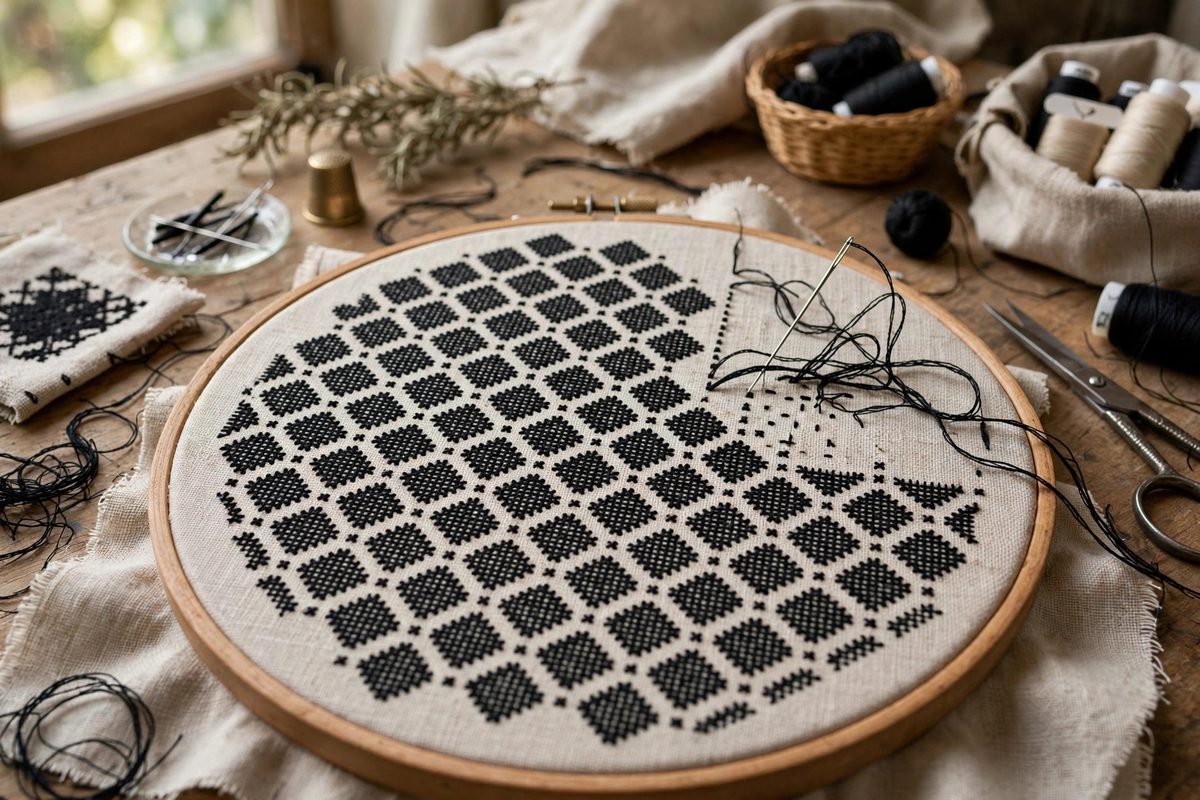
Blackwork's diaper patterns, the repeating geometric fills that give the style its woven texture, are built from hundreds of identical small stitches, usually double running stitch worked in two passes. Their beauty depends on absolute uniformity: every stitch the same length, the same tension, the same relationship to the fabric threads. Thread twist, the natural spiraling of the working thread, is the quiet saboteur of that uniformity, and managing it is a core blackwork skill.
How twist affects the stitch
Every stitch you take adds or removes twist from the working thread, depending on your stitching direction and hand motion. Accumulated twist makes the thread kink, loop, and resist lying flat; it also changes the thread's effective thickness and sheen as the plies tighten or loosen. In a diaper pattern where each stitch sits beside its identical neighbor, twist variation shows as subtle inconsistency in stitch appearance, enough to break the pattern's hypnotic regularity.
Over-twisted thread also fights tension control: it springs and coils instead of seating smoothly, so stitches that should match end up at slightly different tensions. The pattern's geometry is perfect on the chart; twist is what makes the stitched version waver.
Managing twist as you stitch
Let the needle dangle periodically to let the thread untwist naturally; this takes seconds and should become habit every dozen stitches or so. Watch the thread as you work: when it starts to kink or loop back on itself, it is telling you the twist has accumulated too far. Some stitchers roll the needle between their fingers with each stitch to counteract the twist their motion adds; find whether your natural motion adds or removes twist and compensate accordingly.
Work with reasonable thread lengths. Long threads accumulate more twist per threading and degrade in quality as they pass through the fabric repeatedly; the classic recommendation of around 18 inches exists largely for twist and wear reasons. Re-thread cheerfully rather than nursing a tired length through another motif.
Tension balance across the pattern
Diaper patterns demand even tension above all: each stitch should sit on the fabric with the same gentle firmness, neither pulling the weave nor lying loose. The double running stitch's second pass, which completes the pattern by filling the gaps of the first, must match the first pass's tension exactly, or the two passes read as different weights. Stitch the second pass with conscious attention to matching, not just to completing.
Check your work from the back periodically. The reverse side of blackwork should show a clean, even pattern of its own; uneven tension reveals itself there first, as stitches of visibly different tightness. The back is the tension diagnostic the front hides.
Thread and fabric pairing
Choose a thread that suits the fabric count: the stitch should cover the ground threads it crosses without drowning them, and one strand on fine fabric versus two on coarser ground changes the pattern's whole character. Silk and fine cotton threads show twist effects more visibly than matte wools; if twist management is a struggle, a slightly less lustrous thread forgives more.
Keep the fabric taut in the hoop or frame. Slack fabric lets stitches sink unevenly and makes consistent tension impossible; re-tighten regularly. The ground fabric's own regularity matters too: an even-weave fabric with consistent thread spacing is what makes counted patterns countable, and irregular ground fights every stitch.
Reading and correcting the pattern
Count carefully and verify each motif against the chart before moving on; diaper patterns propagate errors geometrically, and a miscount early in a fill corrupts everything after it. When something looks wrong, the fault is almost always counting or tension, not the chart. Unpick to the last correct point rather than fudging forward; blackwork's precision punishes fudging visibly.
Step back regularly to view the whole pattern. Diaper patterns are designed to be seen at arm's length, where the geometric texture emerges; close-up perfectionism can miss the forest for the stitches. The pattern is right when it reads as a continuous woven texture from across the room.
Blackwork diaper patterns are twist management plus tension discipline on an even ground: dangle the needle, match the passes, keep the fabric taut, count honestly, and correct early. The result is the style's signature effect, geometry so regular it looks printed, made entirely by hand.
Related Guides
- Tension Control in Open Work Drawn Thread Borders: Drawn thread work removes fabric threads to create open, lacy borders, and the remaining threads are then stitched into decorative patterns. The open
- Even Weft Tension in Drawn Thread Open Border Work: Drawn thread work creates open, lacy borders by removing threads from the fabric and embellishing what remains: the remaining threads are grouped
- Diagonal Drawn Thread Lattice Hemstitching Steps: Hemstitching turns a plain hem into an openwork border: threads withdrawn from the fabric leave a lattice, and the remaining threads are grouped and
- Surface Coverage Tension on Hardanger Needle Wefts: Hardanger embroidery is built on a tension paradox: the satin stitch blocks (kloster blocks) must lie flat and smooth, while the needle-woven bars