
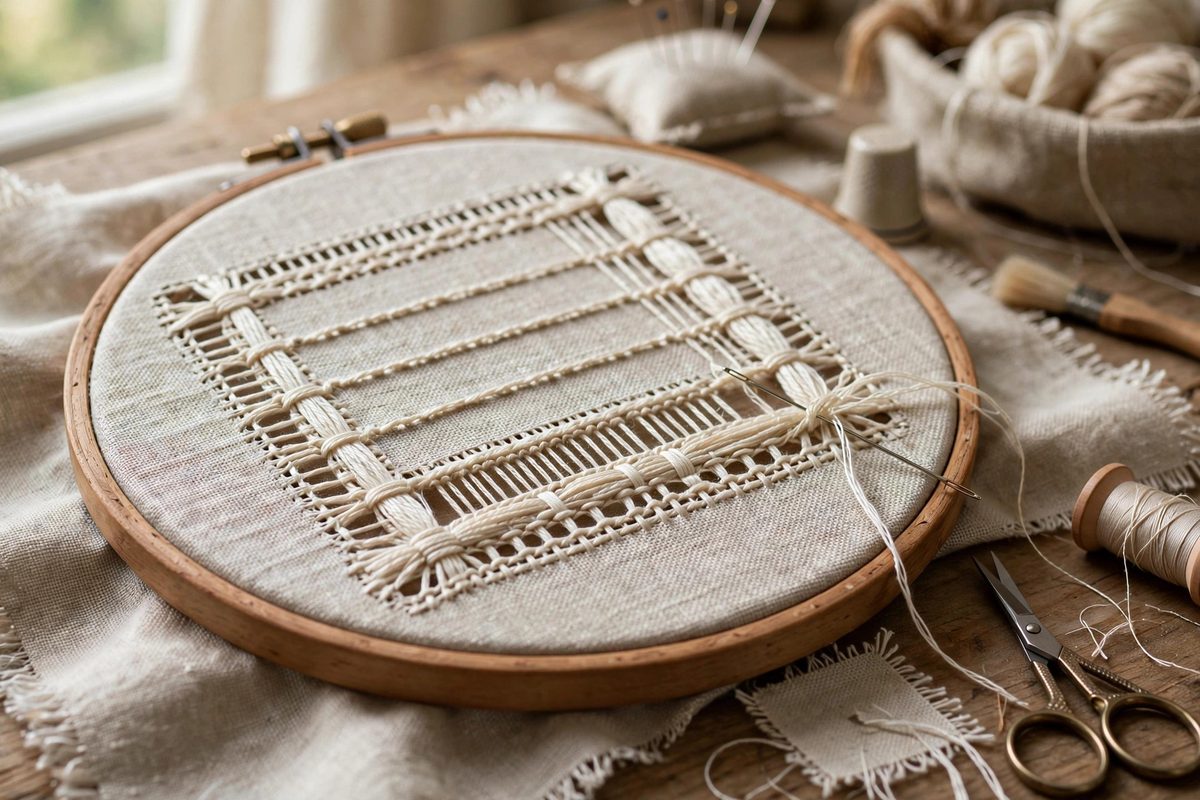
Drawn thread work removes fabric threads to create open, lacy borders, and the remaining threads are then stitched into decorative patterns. The open structure is beautiful and structurally honest: every remaining thread is doing real work. Tension control is what keeps that open work crisp instead of saggy.
Why tension matters more in open work
In solid embroidery, the fabric supports the stitches. In drawn thread work, the stitches support each other across open space, and the withdrawn threads leave the remaining ones carrying more load. Uneven tension shows immediately: a tight stitch puckers the open grid, a loose one sags. There is no fabric behind to hide the inconsistency. The border's geometric precision, which is its whole aesthetic, depends on every stitch pulling exactly its share.
Preparing the fabric
Tension control starts before the first stitch. Choose an even-weave fabric with threads that withdraw cleanly; a fabric whose threads break or fray when pulled will fight you from the start. Mark the border area accurately and withdraw the threads carefully, keeping the remaining threads undistorted. Work on the fabric in a hoop or frame that holds it taut but not stretched; a distorted ground fabric guarantees a distorted border. The preparation is fussy, and it is the foundation of everything that follows.
Stitching the withdrawn grid
The first stitches over the open grid establish the tension for the whole border. Work them with a light, even hand, letting the thread lie naturally rather than pulling it tight. The goal is to define the grid squares without deforming them: each stitch should sit in place, not yank its neighbors. Check the work frequently against the light; holding it up reveals puckers and sags that are invisible flat on the table. Correct tension errors immediately, because later stitches build on the distorted foundation.
Decorative stitches over the grid
Once the grid is established, the decorative stitches, woven bars, knotted fillings, wrapped threads, add the pattern. Each decorative technique has its own tension character: woven bars want to be firm but not tight, knots want to be snug and uniform, wrapped threads want even spacing. Learn each technique's feel on a sample before working it into the border. A border that mixes techniques needs each one tensioned to match the others; a tight knot next to a loose bar looks like a mistake even when both are technically correct.
Edges and corners
Borders turn corners, and corners concentrate tension problems. The stitches at a corner pull in two directions, and the open structure has less to resist with. Work corners deliberately, adjusting the stitch placement to keep the grid square through the turn. Some patterns use a specific corner treatment, a motif or a mitered arrangement, that handles the geometry; follow it rather than improvising. A border with clean corners looks professional; one with pinched or flared corners looks troubled.
Finishing without distortion
When the border is complete, it needs gentle finishing. Press lightly from the back on a padded surface, never crushing the open work. If the border needs blocking, pin it to its true measurements and let it dry; the open structure responds well to blocking because there is room for the threads to move. Frame or mount the finished piece so the border is supported, not stretched. The open work should look effortless, which is the reward for all that careful tension.
Prepare the fabric carefully, stitch the grid with a light even hand, match tensions across techniques, and handle the corners deliberately. The drawn thread border will hold its geometry, and the open work will look as precise as it is.
Related Guides
- Even Weft Tension in Drawn Thread Open Border Work: Drawn thread work creates open, lacy borders by removing threads from the fabric and embellishing what remains: the remaining threads are grouped
- Diagonal Drawn Thread Lattice Hemstitching Steps: Hemstitching turns a plain hem into an openwork border: threads withdrawn from the fabric leave a lattice, and the remaining threads are grouped and
- Thread Twist Tension Balance in Blackwork Diaper Patterns: Blackwork's diaper patterns, the repeating geometric fills that give the style its woven texture, are built from hundreds of identical small
- Surface Coverage Tension on Hardanger Needle Wefts: Hardanger embroidery is built on a tension paradox: the satin stitch blocks (kloster blocks) must lie flat and smooth, while the needle-woven bars