
Card scrapers and cabinet scrapers live on their edges: a scraper with a truly flat, square, burr-free face and a crisp hook shaves wood like a plane, while a scraper with a rounded or scratched face just burnishes and chatters. Diamond lapping plates are the modern way to true those faces: they stay flat (unlike waterstones, which dish), cut fast, and work dry or with a splash of water. The grit progression you follow on the plates determines the edge you get.
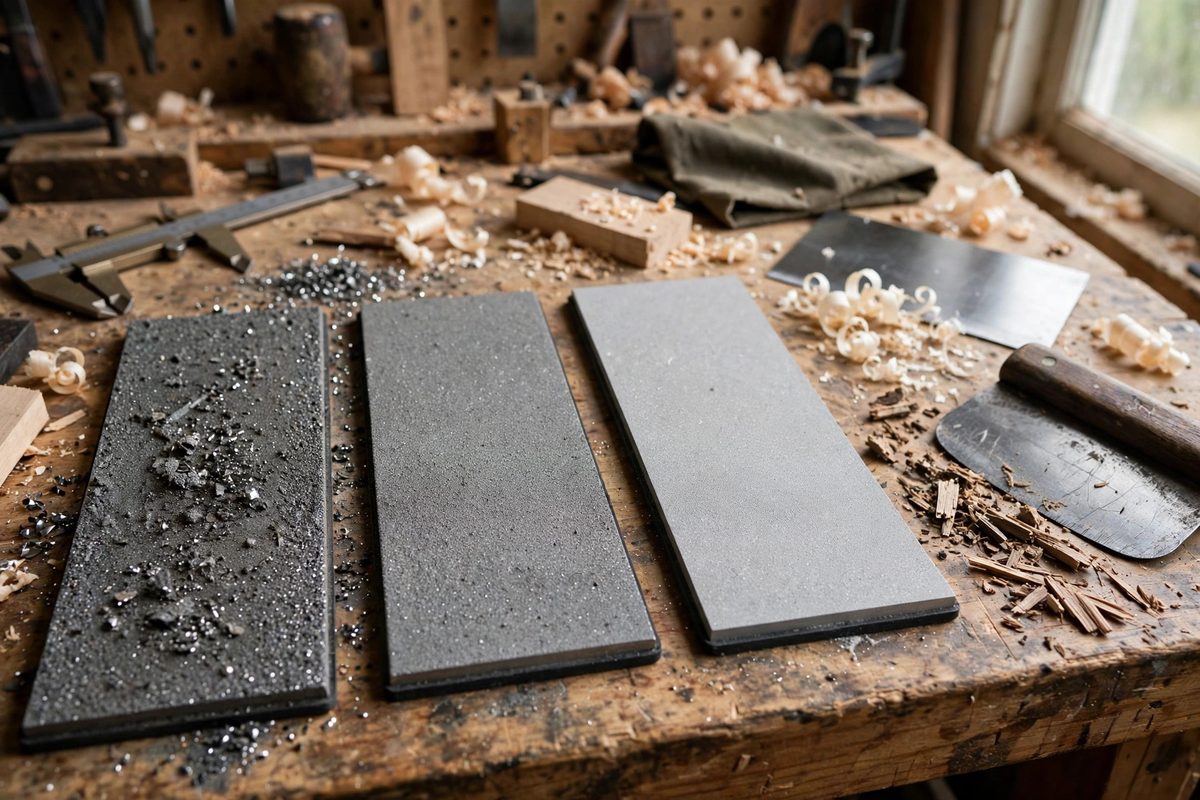
Why Flat Matters More Than Sharp
A scraper does not cut with a bevel like a chisel; it cuts with a tiny hook burnished onto a square edge. If the scraper's face is not flat, the hook forms unevenly and only parts of the edge engage the wood. Lapping the face flat on a diamond plate is therefore the foundation of the whole sharpening process, more important than the final polish. A flat face at a medium grit outperforms a wavy face at a fine grit every time, because geometry beats surface finish in scraper work.
The Plate Progression
A practical progression for scrapers runs: coarse (around 300-400 grit diamond) for establishing flatness and removing damage, medium (around 600 grit) for refining, and fine (around 1200 grit) for the working finish. Start on the coarse plate only if the scraper is new (mill scale and rough edges), damaged, or visibly out of flat; a well-maintained scraper can start at medium. Work each grit until the scratches from the previous grit are uniformly replaced, checking by wiping the face clean and looking at the scratch pattern in raking light. Skipping grits leaves deep scratches that the fine plate cannot efficiently remove, so the progression earns its time.
Lapping Technique
Hold the scraper flat on the plate with even finger pressure distributed across its face, and work it in a figure-eight or circular pattern to wear the plate evenly and avoid dishing any one area. Keep the scraper flat; rocking the edges rounds them, which is exactly what you are trying to undo. Use light pressure and let the diamonds cut; bearing down hard just wears the plate faster and risks flexing a thin scraper. A splash of water or a dedicated honing fluid keeps the swarf moving and prevents loading, and a quick rinse of the plate between grits prevents coarse particles from contaminating the fine work.
Edge Squaring
After the faces are flat, square the working edge itself: hold the scraper perpendicular to the coarse or medium plate and draw the edge straight across a few times to remove the old hook and establish a clean 90-degree corner. Check squareness with a small square and raking light; the edge should show a uniform bright line with no rounded or dubbed sections. This step feels destructive (you are removing the old cutting edge entirely), but a fresh square edge is the only reliable foundation for a new hook.
Polishing Before the Hook
Take the squared edge through the fine plate (and, if you like, a strop charged with fine compound) to polish the faces right up to the edge. The smoother the face, the cleaner the hook that the burnisher will raise, and the longer that hook lasts in use. You do not need a mirror polish; you need the coarse scratches gone from the last sixteenth of an inch near the edge, because that is where the hook lives. Inspect with magnification if you have it; the edge should look like a clean, sharp corner, not a rounded or ragged one.
Raising the Hook and Testing
With the edge square and polished, the burnisher draws the hook: a few firm strokes along the edge at a slight angle, rolling the steel into a tiny cutting lip. Test on scrap wood immediately; a good hook produces fine, continuous shavings and leaves a glassy surface, while a poor hook dusts or chatters. When the hook dulls in use, you can often refresh it with the burnisher alone several times before returning to the plates. The plates are for geometry; the burnisher is for the edge; knowing which one the scraper needs is the skill.
Diamond plates give scraper sharpening something it never had before: a reliably flat reference that never needs flattening itself. Progress through the grits without skipping, keep the scraper flat, square the edge honestly, and the hook you raise will cut like the tool was meant to.
Related Guides
- Diamond Lapping Plate Micron Grading for Cabinet Scrapers: A cabinet scraper is a deceptively simple tool: a flat piece of steel that cuts when its edge is properly prepared. That preparation starts with a
- Lapping Cast Iron Plane Soles on Monocrystalline Plates: A hand plane is only as good as its sole. Vintage planes often arrive with soles that are hollow, bellied, or twisted from a century of use and
- Hollow Ground Bevel Angles on Carbon Chisels: A hollow-ground bevel, the concave bevel left by sharpening on a grinding wheel, is the traditional fast track to a sharp chisel. Instead of honing
- Flattening Whetstone Slurry for Razor Sharp Edges: A whetstone cuts steel with its abrasive surface, but the real cutting agent in traditional sharpening is the slurry: the milky suspension of stone