
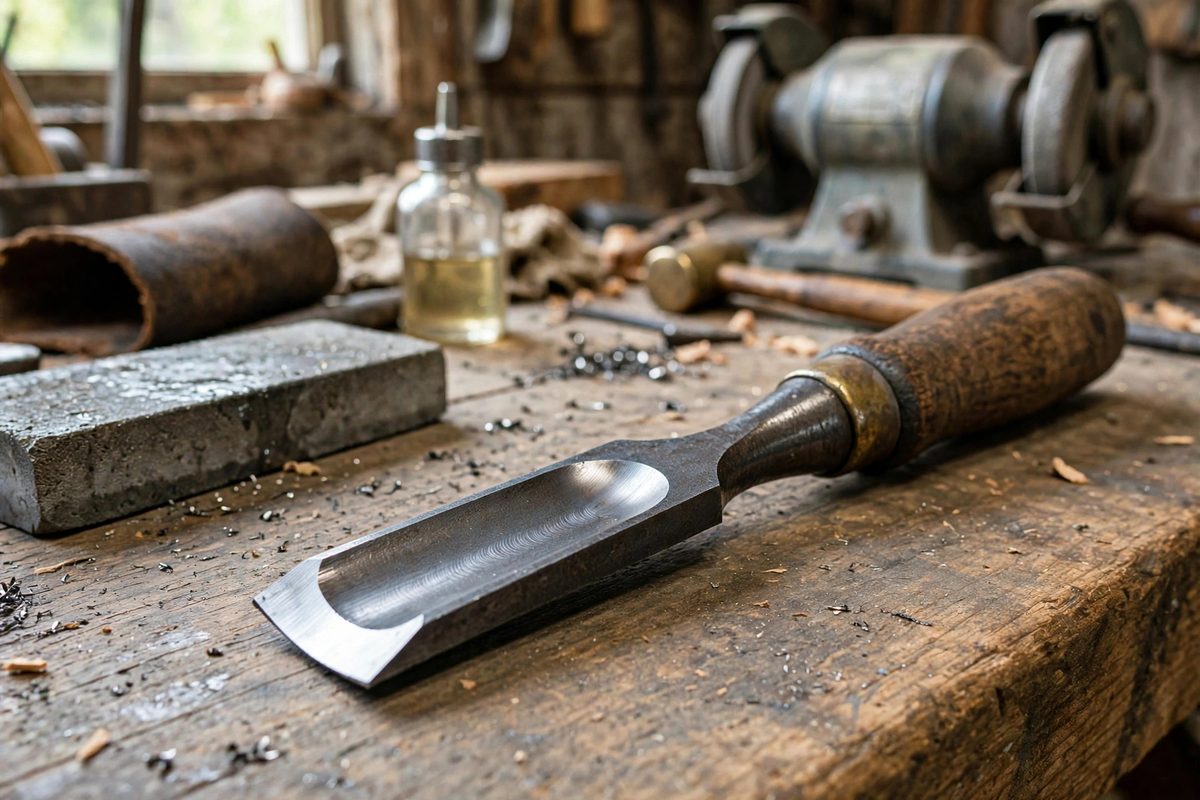
A hollow-ground bevel, the concave bevel left by sharpening on a grinding wheel, is the traditional fast track to a sharp chisel. Instead of honing the entire bevel flat on a stone, you grind a hollow into it and then hone only the two thin edges where the hollow meets the steel: the cutting edge and the heel. Those two narrow lands hone in seconds, which is why generations of woodworkers kept their chisels working with a grinder and a quick stone. Understanding the geometry, and the angles that make it work, keeps this fast system producing truly sharp edges instead of overheated, dubious ones.
What the hollow does for you
Honing a flat bevel means abrading the entire bevel face down to the edge, which is slow because the bevel face is large. A hollow grind removes most of that face on the wheel, leaving only two narrow contact lands. When you lay the bevel on the honing stone, the chisel registers stably on those two lands, and a few strokes refine the cutting edge because there is so little steel to remove. As you hone over weeks and months, the edge land grows wider and honing slows; when it gets tedious, you return to the grinder to re-establish the hollow. The system is a cycle: grind the hollow, hone the edge quickly many times, regrind when honing slows. It is efficient precisely because the slow work (grinding) is infrequent and the frequent work (honing) is fast.
Choosing the bevel angle
The bevel angle sets the edge's character: lower angles cut more easily but are more fragile, higher angles are tougher but need more force. For bench chisels in carbon steel, the traditional grinding angle is around 25 degrees, with honing raising the effective edge to about 30 degrees via a micro-bevel. Paring chisels, which are pushed by hand through fine work, often go lower, around 20 to 25 degrees at the edge, for effortless cutting. Mortise chisels and chisels destined for mallet work and tough woods go higher, 30 to 35 degrees, trading some keenness for an edge that survives levering. These are starting points, not laws: the right angle for your chisel depends on the steel, the wood, and the work. If an edge chips in normal use, the angle is too low for the task; if it crushes fibers instead of cutting, it may be too high or simply dull.
Grinding without ruining the temper
The grinder is fast and therefore dangerous to the steel's heat treatment. Carbon steel loses its hardness if it gets too hot: the first warning is a straw-yellow color at the edge, and blue means the temper is gone and the edge will never hold. Grind with a light touch, keep the tool moving across the wheel, and quench frequently in water, cooling the steel before it even approaches warm. A slow-speed grinder or a well-dressed wheel reduces heat buildup. Grind to just short of the edge, leaving a tiny flat or a wire edge to be honed away, rather than grinding the edge to a fragile foil that overheats instantly. The hollow should be even across the bevel's width; a wheel that is grooved or a rest set at the wrong angle produces a lopsided hollow that hones unevenly. Dress the wheel and set the rest carefully before grinding.
Honing the hollow-ground edge
Honing is where the sharpness actually happens. Lay the bevel on the stone so both lands of the hollow contact, and work the bevel with steady strokes, feeling the two-point registration that tells you the angle is right. A few strokes on a medium stone establish the edge, then refine on a fine stone. Finish with a micro-bevel: raise the chisel a degree or two and take a few light strokes, creating a tiny secondary bevel right at the edge. The micro-bevel concentrates the honing on the absolute edge, making the process even faster, and it slightly strengthens the edge by increasing the angle exactly where the steel is thinnest. Then remove the wire edge from the back: lay the chisel's flat back on the fine stone and take a few light strokes. The back must be flat and polished for the edge to be truly sharp; a hollow-ground bevel with a neglected back is a sharp-looking chisel that will not cut.
Maintaining the system
The rhythm of hollow grinding is: hone often, grind rarely. Hone the edge whenever it starts to need more pressure, which keeps the work pleasant and the edge keen. When honing takes noticeably longer than it used to, the hollow is gone and it is time to regrind. Keep the grinder's tool rest set to your chosen angle so regrinding reproduces the geometry instead of improvising a new one each time. And protect your eyes at the grinder and your fingers at the stone: grinding throws sparks and grit, and a truly sharp chisel deserves the same respect as any edge tool. The hollow grind is old technology, but for keeping carbon chisels working with minimum downtime, it has never been bettered.
Grind the hollow at around 25 degrees, hone the two lands quickly and often, micro-bevel the edge, and keep the back flat. The system is fast because the geometry does the work; your job is just to maintain it.
Related Guides
- Flattening Whetstone Slurry for Razor Sharp Edges: A whetstone cuts steel with its abrasive surface, but the real cutting agent in traditional sharpening is the slurry: the milky suspension of stone
- Lapping Cast Iron Plane Soles on Monocrystalline Plates: A hand plane is only as good as its sole. Vintage planes often arrive with soles that are hollow, bellied, or twisted from a century of use and
- Diamond Lapping Plate Micron Grading for Cabinet Scrapers: A cabinet scraper is a deceptively simple tool: a flat piece of steel that cuts when its edge is properly prepared. That preparation starts with a
- Diamond Lapping Plate Grit Progressions for Scrapers: Card scrapers and cabinet scrapers live on their edges: a scraper with a truly flat, square, burr-free face and a crisp hook shaves wood like a