
A hand plane is only as good as its sole. Vintage planes often arrive with soles that are hollow, bellied, or twisted from a century of use and storage, and no amount of blade sharpening fixes a sole that does not register flat on the work. Lapping the sole on a monocrystalline diamond plate is the modern, reliable way to true it, because the plate itself stays flat in a way that sandpaper on glass never quite does.
Why Sole Flatness Matters
The sole is the plane's reference surface. When it rocks on a hollow or rides on a belly, the blade's cutting edge cannot maintain consistent contact with the wood, and the plane chatters, digs, or refuses to take a fine shaving. The critical zones are the areas immediately ahead of and behind the mouth; the toe and heel matter less, and many experienced users intentionally relieve them slightly. A sole that is flat through the mouth zone will take gossamer shavings even if the far ends are a whisper high. Conversely, a sole that looks shiny all over but dips at the mouth will never perform. Flatness where it counts is the entire goal.
Why Monocrystalline Diamond Plates
Sandpaper on a flat substrate works, but the paper dishes under pressure, loads up, and needs constant replacement during a long lapping session. A monocrystalline diamond plate has diamond abrasive bonded to a flat metal substrate, so it cuts aggressively and stays flat indefinitely. Monocrystalline diamonds, as opposed to polycrystalline, are single crystals that wear slowly and cut cleanly, which keeps the plate's surface consistent over time. The plate must itself be flat; check it with a straightedge before trusting it. For sole lapping, a coarse plate does the heavy work and a finer plate refines the surface. The investment pays off across every plane in the collection.
The Lapping Process
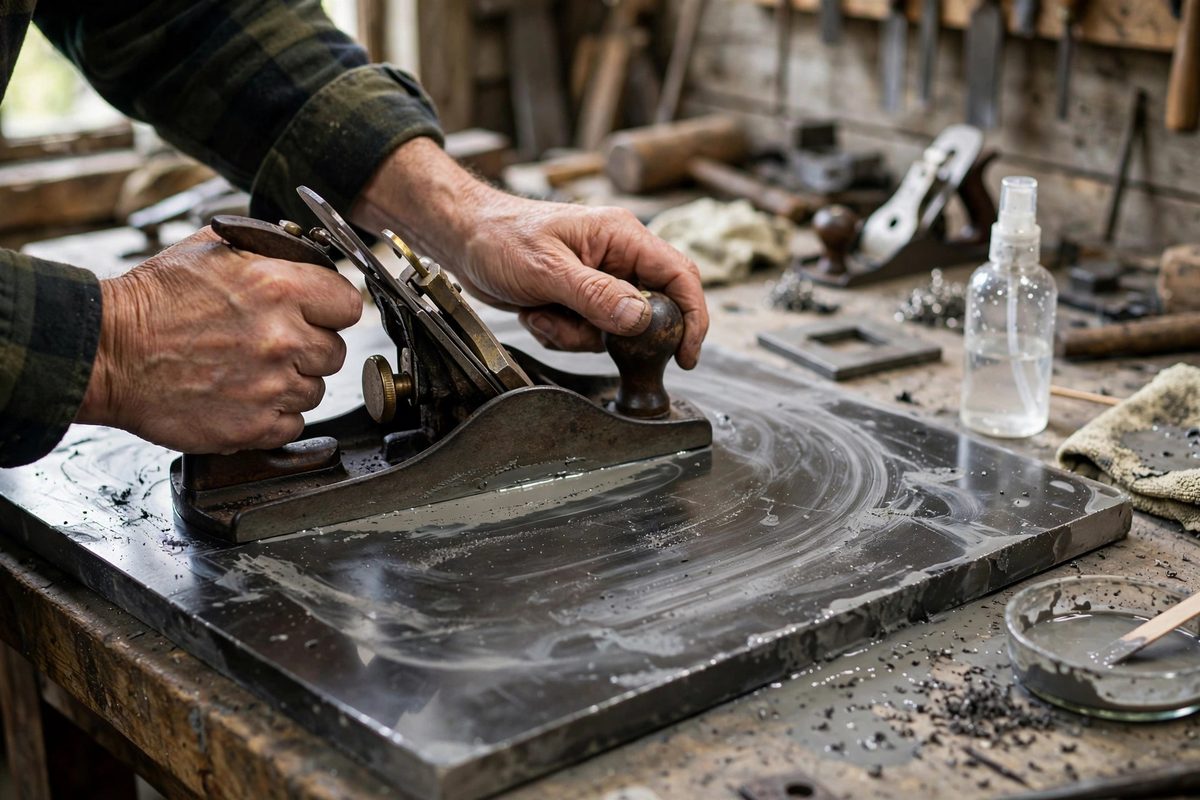
Disassemble the plane completely: remove the blade, chipbreaker, frog, and handles, because lapping with the works installed flexes the body and gives false readings. Mark the sole with a felt-tip grid or layout dye so you can see where material is being removed. Place the plate on a stable, flat bench, lubricate lightly with water or a honing fluid, and work the sole in straight passes along the plate's length, using even pressure distributed across the body. Check the marking frequently: high spots lose their marking first, and the pattern tells you whether the sole is hollow, bellied, or twisted. Work until the marking removes evenly across the critical mouth zone. This takes patience on a badly worn sole; take breaks rather than bearing down harder, since heavy pressure rocks the body and rounds the very flatness you are creating.
Reading the Sole and Knowing When to Stop
Check progress with a straightedge and feeler gauges or by sighting against a light source. A sole that shows no light under the straightedge through the mouth zone is done for practical purposes. Chasing perfection across the entire sole wastes time and metal; the toe and heel can be a few thousandths high without affecting performance. Watch for a twisted sole, where diagonal corners are high; twist requires working the high corners specifically and checking often. If the mouth has opened up excessively from wear, lapping will not fix it, and the plane may be better retired to rough work. Know the difference between a sole that needs lapping and a plane that is simply worn out.
After Lapping: Protection and Reassembly
Clean the sole thoroughly to remove all diamond swarf, which would otherwise embed in the next piece of wood you plane. A freshly lapped sole is bare cast iron and will rust quickly; coat it with paste wax or a light oil immediately. Reassemble the plane, reset the frog, and sharpen the blade before testing, since a lapped sole with a dull blade still disappoints. Test on a scrap of straight-grained wood: the plane should take a full-width, translucent shaving with moderate pressure. If it does, the lapping worked. Maintain the sole with occasional waxing and avoid storing the plane sole-down on damp surfaces.
Lapping a plane sole is slow, honest work: mark, lap, check, repeat, until the mouth zone is true. A monocrystalline plate makes the process reliable, and a flat sole transforms a wall-hanger into a working tool.
Related Guides
- Diamond Lapping Plate Grit Progressions for Scrapers: Card scrapers and cabinet scrapers live on their edges: a scraper with a truly flat, square, burr-free face and a crisp hook shaves wood like a
- Diamond Lapping Plate Micron Grading for Cabinet Scrapers: A cabinet scraper is a deceptively simple tool: a flat piece of steel that cuts when its edge is properly prepared. That preparation starts with a
- Hollow Ground Bevel Angles on Carbon Chisels: A hollow-ground bevel, the concave bevel left by sharpening on a grinding wheel, is the traditional fast track to a sharp chisel. Instead of honing
- Flattening Whetstone Slurry for Razor Sharp Edges: A whetstone cuts steel with its abrasive surface, but the real cutting agent in traditional sharpening is the slurry: the milky suspension of stone