
A cabinet scraper is a deceptively simple tool: a flat piece of steel that cuts when its edge is properly prepared. That preparation starts with a truly flat, finely finished edge, and diamond lapping plates in the right micron grades produce that edge faster and more consistently than traditional stones. The grading sequence matters because each step must remove the scratches of the last.
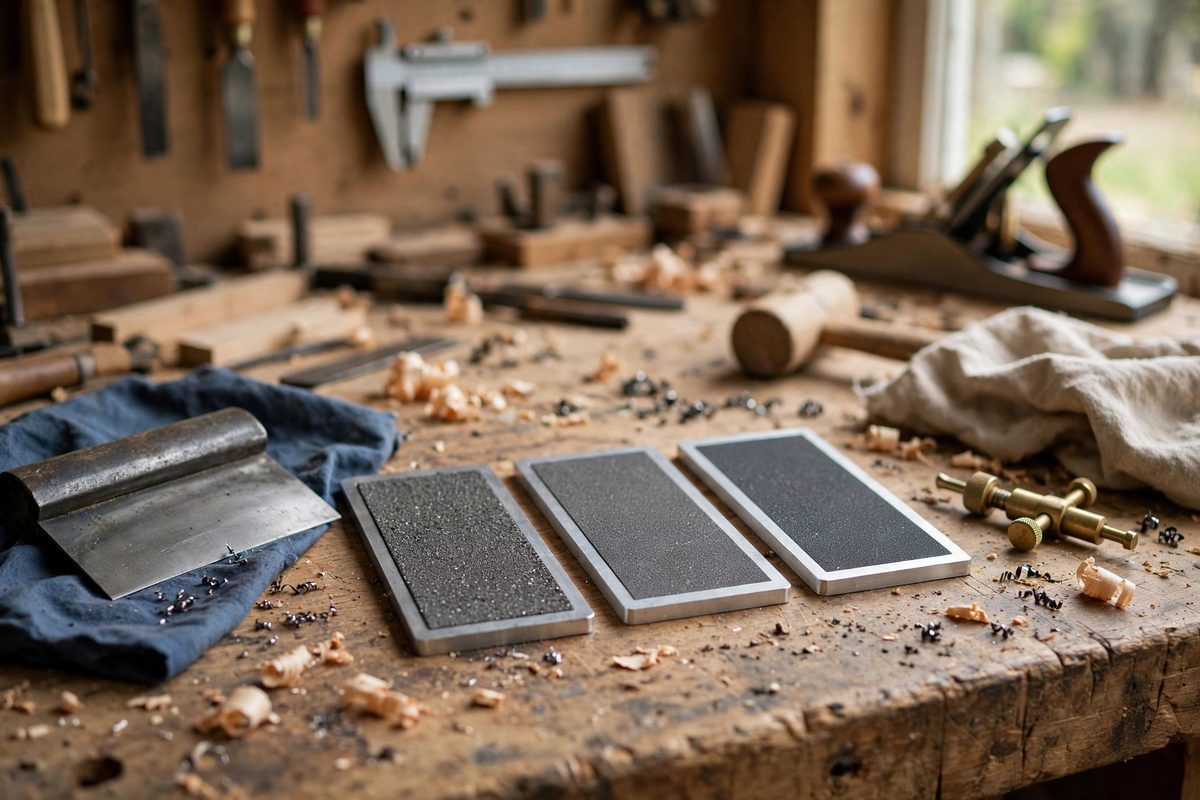
Why Diamond Plates for Scrapers
Scraper steel is hard, and hard steel eats traditional waterstones and oilstones quickly, dishing them and rounding the very edge you are trying to keep flat. Diamond plates stay flat because the abrasive is bonded to a rigid substrate, and they cut hard steel aggressively without dishing. For scraper work, where flatness of the edge is everything, a plate that stays flat is not a luxury; it is the requirement. The plates also work dry or with a splash of water, keeping the process quick and the cleanup trivial.
Understanding Micron Grades
Diamond plates are graded by the size of the diamond particles in microns. Coarse grades around forty to sixty microns remove metal fast and leave deep scratches; medium grades around twenty-five microns refine; fine grades around nine to fifteen microns produce a near-polished surface; extra-fine grades below nine microns take it further. For scraper edge preparation, you rarely need the coarsest grades unless repairing a damaged edge. The working sequence typically starts at a medium grade to establish flatness and ends at a fine grade to polish, with each step erasing the previous step's scratch pattern.
The Flattening Sequence
Start by lapping the scraper's faces flat on the medium plate, working in a figure-eight or circular pattern to distribute wear. Check flatness frequently by marking the face with a marker and watching where the plate removes the ink; high spots clean first. Once both faces are flat and the edge is square, move to the fine plate and repeat until the medium scratches are gone. The test is visual: under a good light, the surface should show a uniform fine scratch pattern with no deeper lines remaining. Rushing the sequence leaves deep scratches that the burnisher will follow, producing a ragged hook instead of a clean one.
Edge Squareness Before Burnishing
The scraper's cutting edge is the intersection of two flat faces meeting at ninety degrees, and the burnisher then turns a tiny hook on that intersection. If the faces are not flat or the edge is not square, the hook forms unevenly and the scraper cuts erratically. After the fine plate, check the edge with a square; it should be square along its full length. Any remaining burr from lapping gets stoned off flat before burnishing, because a lapping burr is ragged and a burnished hook needs a clean starting edge.
Plate Maintenance
Diamond plates last a long time but they are not immortal. Clean the plate after use with a brush and water to clear swarf from between the diamonds; loaded plates cut slowly and scratch coarsely. Store plates flat and protected so nothing gouges the diamond surface. A plate that has worn smooth in the center from years of use can be retired to rough work; using a worn plate for final finishing produces inconsistent results that masquerade as technique problems. When the fine plate stops refining the surface, it is the plate, not you.
Flat faces, square edge, medium then fine, clean plates: the diamond lapping sequence gives the burnisher a perfect foundation. The scraper that results will take whisper shavings instead of dust, which is the whole point of the tool.
Related Guides
- Diamond Lapping Plate Grit Progressions for Scrapers: Card scrapers and cabinet scrapers live on their edges: a scraper with a truly flat, square, burr-free face and a crisp hook shaves wood like a
- Lapping Cast Iron Plane Soles on Monocrystalline Plates: A hand plane is only as good as its sole. Vintage planes often arrive with soles that are hollow, bellied, or twisted from a century of use and
- Hollow Ground Bevel Angles on Carbon Chisels: A hollow-ground bevel, the concave bevel left by sharpening on a grinding wheel, is the traditional fast track to a sharp chisel. Instead of honing
- Flattening Whetstone Slurry for Razor Sharp Edges: A whetstone cuts steel with its abrasive surface, but the real cutting agent in traditional sharpening is the slurry: the milky suspension of stone