
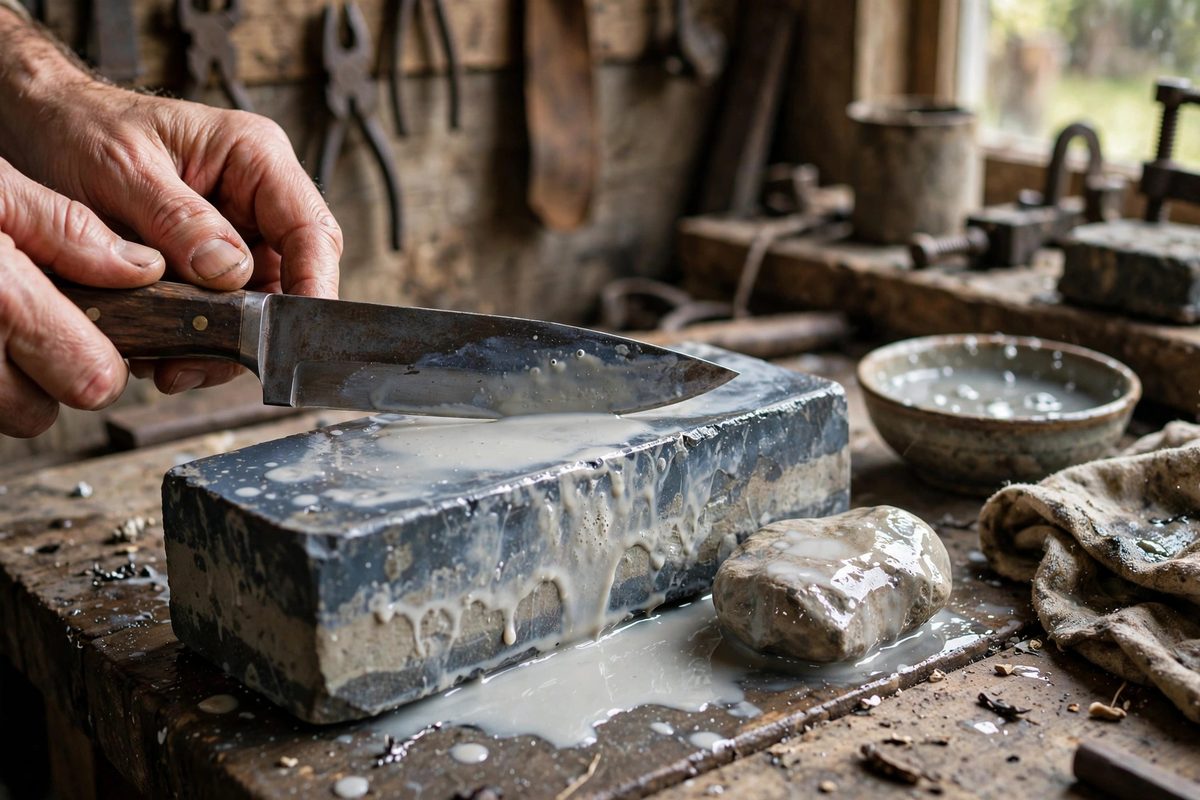
A whetstone cuts steel with its abrasive surface, but the real cutting agent in traditional sharpening is the slurry: the milky suspension of stone particles and water that forms on the stone's face. Managing that slurry, and keeping the stone flat enough for it to work evenly, is what produces a truly razor edge on antique tools. A dished stone with uncontrolled slurry gives a rounded, mediocre edge no matter how long you work.
Why flatness comes first
A hollowed stone sharpens the middle of the bevel more than the edges, rocking the tool and rounding the very apex you are trying to refine. For plane irons and chisels, where the back must also be dead flat, a dished stone is fatal: the back never fully contacts, and the edge never truly forms. Flatten the stone before every serious sharpening session, not once a year. The test is simple: draw a pencil grid on the stone's face and rub it on the flattening plate until the grid disappears evenly. Any remaining grid marks are low spots still dished.
Flattening methods
A diamond flattening plate is the modern standard: fast, reliably flat, and it works on any stone. Silicon carbide powder on a glass plate is the traditional budget method and works well, though messier. Whatever the method, flatten with water, use the whole surface of the plate, and rotate the stone periodically to wear it evenly. Coarse stones need flattening most often since they dish fastest; fine finishing stones dish slowly but still need checking. A stone that is flat to begin with stays flat longer if you use its whole face instead of grinding in one spot.
Working the slurry
On water stones, the slurry forms naturally as you sharpen; on hard Arkansas stones and similar, a nagura stone or a diamond plate rub generates it deliberately. The slurry does the fine cutting: its suspended particles roll between the tool and the stone, abrading with a gentler, more uniform action than the fixed stone surface. For the coarsest work, rinse the slurry away and let the fresh stone cut aggressively. For refining, build and keep the slurry; it is what polishes the bevel toward razor sharpness. Learn to read it: thick, dark slurry is cutting fast, thin clear water means the stone's surface is glazed and needs refreshing.
Slurry progression for razor edges
Work through the grits, and manage slurry at each stage. On the coarse stone, use fresh water and frequent rinsing to keep cutting fast and the bevel geometry true. On the medium stone, allow a moderate slurry to build; it speeds the removal of coarse scratches. On the finishing stone, cultivate a fine, consistent slurry and use light pressure; this is the polishing stage where the edge becomes truly keen. Between stones, clean the tool thoroughly; a single coarse particle carried to the finishing stone carves a scratch that undoes the polish.
Testing the edge
The classic tests: the edge should shave arm hair cleanly, catch a fingernail dragged gently across it, and pare end grain with minimal effort. For antique tools, also check the edge under magnification; a truly sharp edge shows no reflected light along the apex, while any visible bright line is a flat or a burr remaining. Strop lightly on leather after the finest stone to remove the last burr; heavy stropping rounds the edge you just perfected.
Flat stone, managed slurry, clean progression, honest testing. The razor edge is not a mystery; it is a procedure.
Related Guides
- Hollow Ground Bevel Angles on Carbon Chisels: A hollow-ground bevel, the concave bevel left by sharpening on a grinding wheel, is the traditional fast track to a sharp chisel. Instead of honing
- Lapping Cast Iron Plane Soles on Monocrystalline Plates: A hand plane is only as good as its sole. Vintage planes often arrive with soles that are hollow, bellied, or twisted from a century of use and
- Diamond Lapping Plate Micron Grading for Cabinet Scrapers: A cabinet scraper is a deceptively simple tool: a flat piece of steel that cuts when its edge is properly prepared. That preparation starts with a
- Diamond Lapping Plate Grit Progressions for Scrapers: Card scrapers and cabinet scrapers live on their edges: a scraper with a truly flat, square, burr-free face and a crisp hook shaves wood like a