
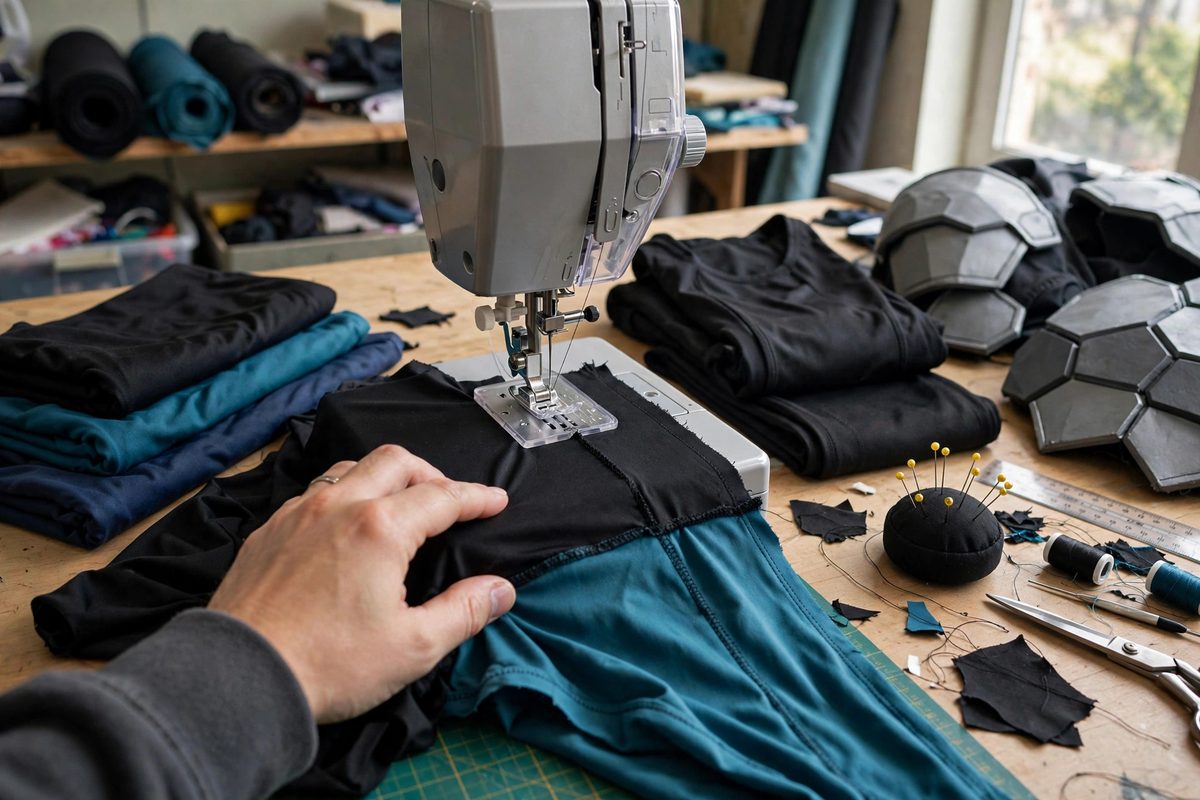
Four-way stretch fabrics, the spandex blends behind bodysuits, leggings, and fitted armor undersuits, defeat ordinary sewing machine settings: the feed dogs push the bottom layer while the presser foot drags the top, and the stretchy layers shift, ripple, and wave. Differential feed, the serger's ability to run its front and rear feed dogs at different speeds, is the purpose-built solution. Set correctly, it feeds stretch fabric without distortion; set wrong, it gathers or stretches the seam on purpose or by accident.
What differential feed does
A serger has two sets of feed dogs: the front set and the rear set. At a 1:1 differential setting, they move at the same speed and the fabric feeds normally. Set the differential above 1 (up to about 2:1), and the front dogs move faster than the rear, gathering the fabric slightly as it sews: this counteracts stretch fabrics' tendency to elongate under the presser foot. Set it below 1 (down to about 0.7:1), and the rear dogs pull faster, stretching the fabric as it feeds, which is useful for applying elastic or creating lettuce-edge ruffles. For plain seams in four-way stretch, you typically want a slight gathering bias, just above 1:1.
Dialing in the setting
Start at 1:1 and sew a test seam on a scrap of your actual fabric, doubled as it will be in the garment. Examine the seam relaxed: if it ripples or waves, the fabric stretched during sewing, so increase the differential feed in small steps until the seam lies flat. If the seam puckers or gathers when you wanted it flat, decrease toward 1:1. The correct setting is the one where the sewn seam, pressed lightly, lies exactly as flat as the unsewn fabric. Write the setting down with the fabric name; every stretch fabric has its own number, and memory is unreliable across projects.
Coordinating with other settings
Differential feed works as part of a system. Reduce presser foot pressure for stretch fabrics; heavy pressure increases the drag that differential feed is trying to counteract. Lengthen the stitch slightly; short stitches perforate stretch fabric and weaken the seam. Use a stretch or ballpoint needle so the needle pushes yarns aside instead of cutting them. And consider woolly nylon or textured thread in the loopers: it fills the seam with springy thread that stretches with the fabric instead of popping when the garment moves.
Seams that must stretch
Cosplay bodysuits and dancewear seams must elongate with the body, which means the stitch itself must stretch. A four-thread overlock with the differential set for flat feeding gives a seam that stretches with the fabric; a three-thread overlock stretches more but is weaker. For areas of extreme stress, like the crotch of a bodysuit, reinforce with a second row of stitching or a stretch straight stitch alongside the serged seam. Test every seam type by stretching the test scrap firmly: the thread should give before the fabric tears, and neither should fail in normal use.
Troubleshooting common results
Wavy seams mean too little differential feed or too much presser pressure. Puckered seams mean too much differential or tension too tight. Skipped stitches on stretch usually mean the wrong needle, not the wrong feed setting. And if the seam looks perfect flat but pops when worn, the stitch length is too short or the thread too inelastic for the fabric's stretch percentage. Fix the actual variable; guessing wastes fabric.
Test on scraps, set the differential just past flat, lighten the foot, and use stretch-friendly thread. The seams will move with the costume instead of fighting it.
Related Guides
- Differential Feed Calibration for Four-Way Spandex: Four-way spandex stretches in every direction, which is why it makes perfect bodysuits and terrible seams when the feed is wrong. A serger's
- Differential Feed Tension on Double Brushed Poly Knits: Double brushed poly knits, the buttery fabric behind countless cosplay bodysuits and leggings, stretch in every direction and punish sloppy feeding
- Reinforced Spandex Seam Stitching for Bodysuits: A bodysuit is the most demanding garment most cosplayers will ever sew: it must stretch in every direction, recover instantly, survive lunges and
- Twin Needle Tension Calibration on High-Spandex Knits: Twin needle hems give cosplay bodysuits and stretch garments that clean, professional double row of stitching, but high-spandex knits punish bad