
Differential pairs carry high-speed signals as equal-and-opposite voltages on two traces, and the receiver reads the difference between them. This scheme rejects noise beautifully, but only if the two signals arrive simultaneously. When one trace of the pair is longer than the other, its signal arrives late: the pair becomes skewed, the common-mode rejection degrades, and at high speeds the link fails. Length matching, making both traces electrically the same length, is the fundamental layout discipline for differential pairs, and KiCad provides the tools to do it properly.
Why Skew Kills Differential Signals
A differential receiver subtracts the two signals: identical-but-opposite arrivals cancel noise and double the signal. Skew breaks the symmetry. If the positive trace's edge arrives noticeably later than the negative trace's edge, there is a window where the receiver sees both signals in the same state, and during that window the differential voltage collapses toward zero while the common-mode noise no longer cancels. The result is jitter, reduced noise margin, and bit errors. How much skew is too much depends on the signal speed: the relevant metric is skew as a fraction of the bit period or rise time. Slower interfaces tolerate millimeters of mismatch; multi-gigabit serial links demand sub-millimeter matching. The rule of thumb: match tighter as speed rises, and when in doubt, match tighter than the minimum, because tighter never hurts.
Routing Pairs Together From the Start
Length matching is easiest when the pair is routed as a pair from the beginning. In KiCad, the differential pair router keeps the two traces coupled, maintaining consistent spacing and symmetric routing around obstacles. Route both traces through the same layer transitions: if one trace changes layers, the other should change layers at the same point, because a via adds length and a layer change alters the propagation environment. Keep the pair's surroundings symmetric too: a ground pour that approaches one trace but not the other creates an impedance asymmetry that behaves like a length mismatch electrically. Avoid routing one trace of the pair near a noisy aggressor, like a switching power supply trace, while the other runs through quiet territory; the noise couples asymmetrically and defeats the pair's purpose. Symmetric routing is the goal in every dimension, not just length.
Using the Length Tuner
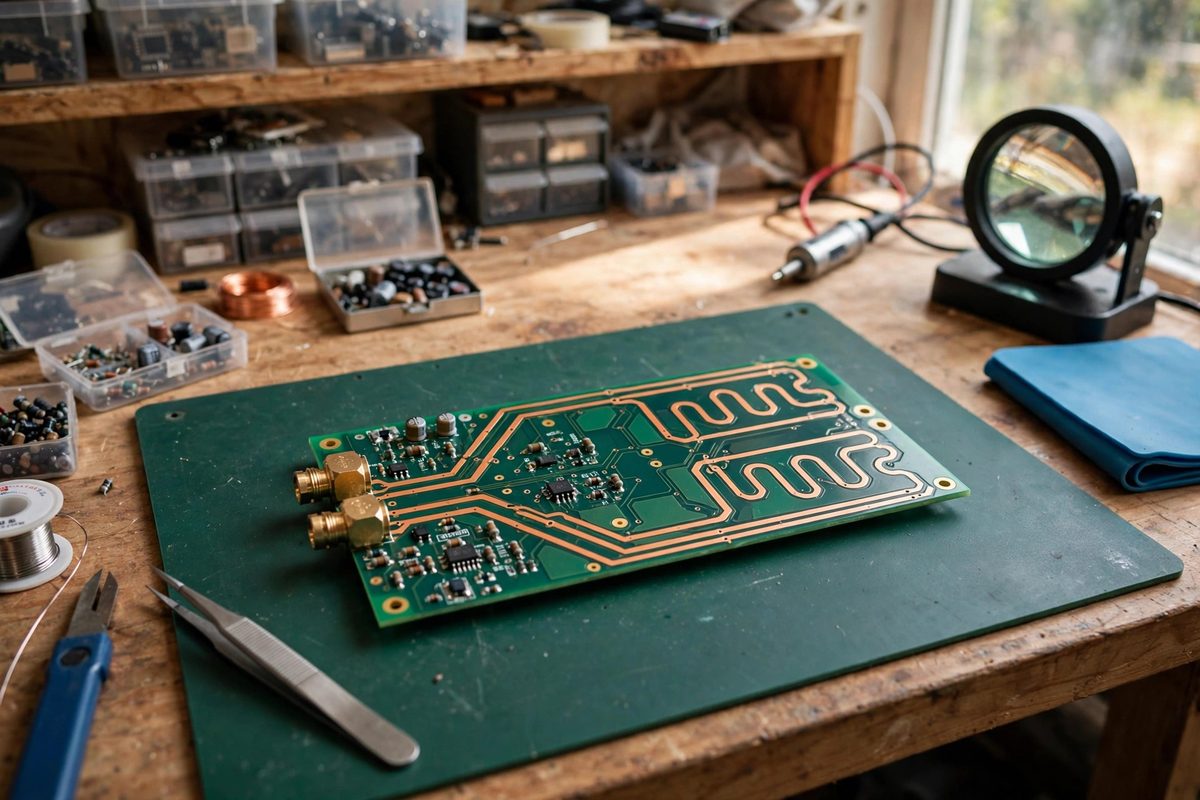
Despite best efforts, one trace usually ends up longer, often because it took the outside of a bend. KiCad's length tuning tool fixes this by adding meanders, small accordion-like wiggles, to the shorter trace. Set the target length from the longer trace, configure the meander amplitude and spacing to suit the available room, and let the tool add tuning patterns. The meander geometry matters electrically: tight, closely spaced meanders couple to themselves and change the pair's impedance, so use gentle, widely spaced wiggles, and keep the meander section's total added length only what is needed. Place tuning patterns on straight sections with room around them, not crammed against the bend that caused the mismatch. After tuning, verify with the length report: both traces should match within your target tolerance, and the tolerance should be chosen from the interface's requirements, not from habit.
Phase Matching at Bends
Bends are where intra-pair skew is born: the outer trace of a bend travels farther than the inner trace. The mitigation is to compensate within the bend itself rather than with a distant tuner. KiCad's differential router can add small length-compensation jogs at bends automatically, or you can route bends as gentle arcs where the length difference is minimal. For tight bends that cannot be avoided, add a tiny trombone jog to the inner trace right at the bend, keeping the compensation local. The principle is that skew introduced and corrected at the same location never accumulates into a timing error downstream. Also minimize the number of bends in high-speed pairs generally: every bend is a discontinuity and a skew source, so a straight-ish route with one compensated bend beats a scenic route with five.
Verifying Before Fabrication
Length matching must be verified, not assumed. KiCad's PCB calculator and the length statistics in the router give per-trace lengths; check every high-speed pair against its requirement. Inspect the 3D or Gerber view for asymmetric features you might have missed: a via on one trace without its partner, a tuning pattern that got partially deleted during cleanup, a copper pour intruding on one side. Run the design rule check with differential-pair-aware rules if your KiCad version supports them. And document the matching requirements: note the target skew tolerance on the schematic or in fabrication notes, so a future revision does not casually reroute a matched pair. A matched pair is a precision structure; treat rerouting one as deliberately as you would changing a component value.
Differential pairs work on symmetry, and length matching is symmetry in the time domain. Route as a pair, compensate bends locally, tune with gentle meanders, and verify every length before the board goes out. The link will run at speed instead of failing mysteriously at temperature.
Related Guides
- Ground Plane Stitching Via Spacing in KiCad Layouts: Stitching vias tie the ground planes of a multilayer board together into a single low-impedance reference, and their spacing decides how well that
- Copper Pour Clearance in KiCad Ground Planes: A copper pour turns empty board area into a ground plane, which lowers impedance, improves EMC, and simplifies return paths. But a pour placed with
- Zone Priority Rules for Overlapping KiCad Fills: KiCad's copper zones, the poured fills for grounds, power, and signals, overlap constantly in real designs: a ground pour covering the board with a
- Thermal Relief Spoke Angles on Fine Pitch Pads: A pad connected directly to a large copper pour acts as a heatsink during soldering: the pour wicks heat away and the joint never flows properly