
Where two colors meet in tapestry, the weaver must join them without a slit weakening the cloth. The dovetail interlock, where each color's weft turns around the same warp thread, is the strongest of the joins, and on heavy wool tapestry it is often the right choice. But its strength depends on tension discipline: interlocked wefts pulled too tight pucker the warp, and too loose they leave a visible gap. Here is how to manage dovetail tension in heavy wool.
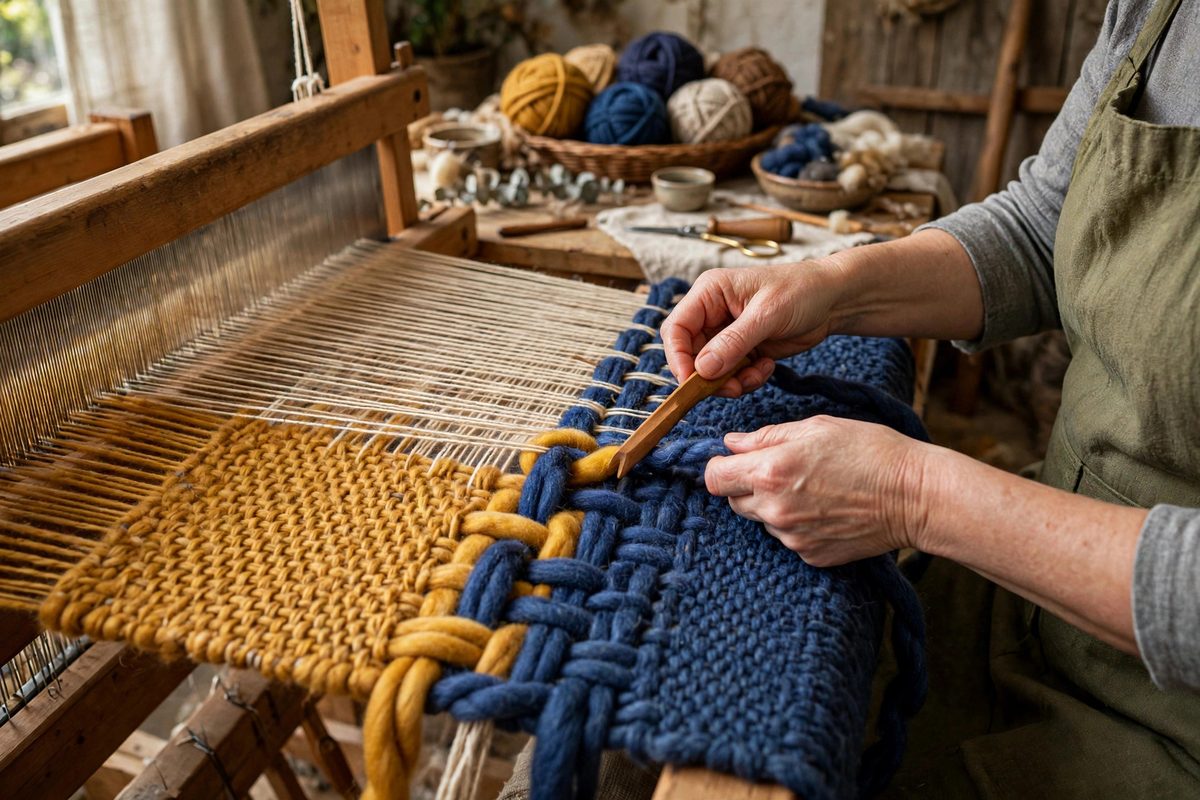
How the dovetail joins colors
In a dovetail, the two wefts meet at a shared warp thread: color A travels to that warp, turns around it, and heads back; color B does the same from the other side. The two wefts interlock around the single warp like the pins of a dovetail joint in woodworking, which is where the name comes from. Unlike a slit, where each color turns on its own warp and leaves a gap, or an interlock where wefts link between warps, the dovetail puts both turns on one warp thread. The result is a firm, slit-free join that can follow diagonal color boundaries.
Why heavy wool is demanding
Heavy wool weft is thick, springy, and grippy. Those are virtues in the finished tapestry, but at the dovetail they complicate tension: the thick weft wants to ride up over its neighbor, the springiness fights the turn, and the grippy surface locks in whatever tension you set, right or wrong. A dovetail in fine silk forgives sloppy tension; a dovetail in heavy wool displays it. The shared warp thread also carries double the weft bulk at the join, so it is under more stress than its neighbors and will show distortion first.
Setting the tension at the turn
The rule is simple to state and takes practice to feel: each weft should turn around the shared warp with exactly the same tension as a normal weft turn at the selvedge. No tighter, no looser. The common error is pulling the dovetail tighter than the surrounding weaving, "to make it secure," which draws the shared warp out of line and creates a visible vertical pucker running through the color boundary. Lay the weft in with the same hand pressure you use everywhere else, and let the interlock's geometry provide the strength. If the join looks loose, the fix is usually to beat the surrounding picks more firmly, not to yank the dovetail.
Beating around dovetails
Beat dovetail areas with attention. The doubled weft at the shared warp packs differently than single weft elsewhere, so beat these sections to the same picks-per-inch as the surrounding tapestry, checking with a pick glass or by counting. Over-beating a dovetail compresses the join and can force the wefts to overlap visibly; under-beating leaves the join open and weak. When a design has many dovetails in one area, such as a diagonal boundary, beat the whole area as a unit and check the density across the boundary, not just on one side.
Designing with dovetails
Dovetails excel on diagonal color boundaries of moderate angle; on very shallow diagonals they create a stepped, chunky edge, and on vertical boundaries a slit-and-sew approach may look cleaner. Plan your joins when you cartoon the design: mark where dovetails will fall and keep them at least a few warps apart vertically, since stacked dovetails on adjacent rows concentrate stress on the same warps. In heavy wool, that spacing matters more than in fine work.
The dovetail is strong because its geometry is sound, not because it is pulled hard. Trust the interlock, match your normal tension, and the color boundary will hold for the life of the tapestry.
Related Guides
- Dovetail Interlock Joins on Dense Tapestry Warps: Tapestry weaving builds images from discontinuous wefts: each color area is woven separately, and where two colors meet along a vertical boundary
- Managing Interlock Slit Overlaps on Fine Tapestry: Tapestry's defining technique, discontinuous weft that turns back at color boundaries, creates slits: vertical gaps where two color areas meet but
- Limiting Slit Gaps in Structural Heavy Weft Tapestry: Tapestry's color changes create slits: vertical gaps where one weft color ends and another begins, with no interlacing between them. In pictorial
- Slit Weaving Interlock Joins on High Sett Linen Warps: In tapestry, each color block is woven with its own weft, and where two colors meet along a vertical boundary, the wefts turn back on themselves