
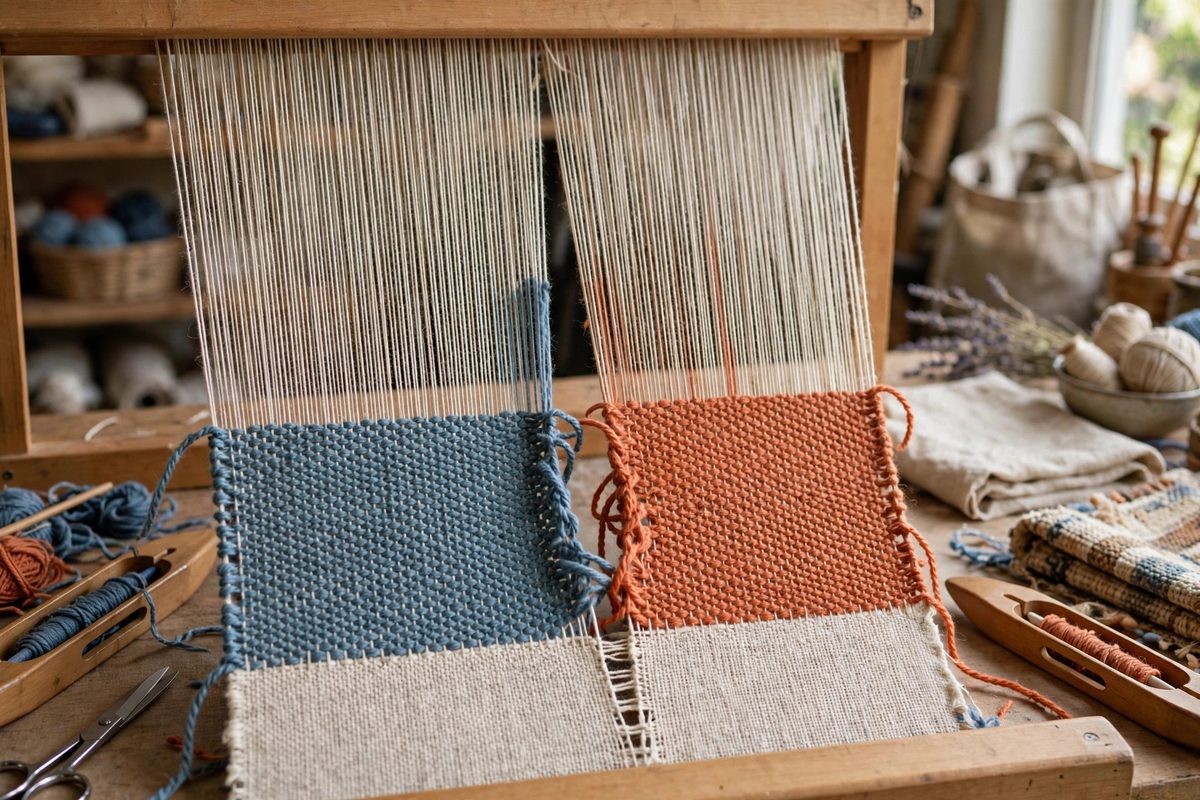
In tapestry, each color block is woven with its own weft, and where two colors meet along a vertical boundary, the wefts turn back on themselves. Left alone, those turn-backs create a slit: a literal gap in the cloth between the color areas. Slits are a legitimate design feature in many traditions, but where you need a closed, stable fabric, the wefts must be joined. Interlocking the two wefts at the boundary closes the slit during weaving, producing a strong join with no sewing afterward. On high sett linen warps, where fine threads are packed closely, the interlock technique needs care to stay invisible and secure.
How slits form and why they matter
A slit forms whenever adjacent wefts turn around different warp threads. Color A weaves up to warp thread 20 and turns; color B starts at warp thread 21 and turns. Between 20 and 21 there is no weft connecting the two areas, so the fabric separates into a slit under any lateral stress. Short slits, an inch or two, are structurally harmless and appear in historic tapestries everywhere. Long slits weaken the cloth and can gape open in the finished piece. The weaver's choice is between leaving slits deliberately (and sewing them closed later if needed), or joining the wefts as you go. Interlocking is the during-weaving solution: instead of each weft turning around its own boundary warp, the two wefts hook around each other at the boundary, linking the color blocks into one continuous fabric.
The single interlock technique
To work a single interlock, bring color A's weft to the boundary and pass it around the first warp thread of color B's territory before turning back. Then bring color B's weft to the boundary and pass it around the last warp thread of A's territory, hooking it through the loop A just made. The two wefts link like the links of a chain at the boundary warp. Each pick repeats the link, so the join runs continuously up the color boundary. The mechanics are simple; the finesse is in tension. Pull either weft too tightly at the interlock and the boundary puckers, drawing the two color areas together into a visible ridge. Leave it too loose and the join gaps. Aim for the same gentle tension you use in the body of the color block, and check the back of the tapestry periodically: the interlock should look like a neat vertical chain, not a pinched seam.
Double interlock for high-stress joins
Where a boundary will bear stress, such as a long vertical join in a wall hanging that will hang from its top edge, a double interlock adds security. Each weft passes around the boundary warp twice, or the wefts link through each other twice, before turning. The result is a firmer join that resists working loose over time. The trade-off is bulk: double interlocks build a slightly raised line at the boundary, which can show as a ridge in fine work. Reserve double interlocks for boundaries that need them and use single interlocks elsewhere. In traditional practice, weavers also combined methods, interlocking where the design allowed and leaving short slits where a crisp color edge mattered more than a closed join.
The linen challenge: slip and visibility
High sett linen warps complicate interlocking in two ways. First, linen is smooth and relatively inelastic compared to wool, so interlocked wefts can slip along the warp under tension instead of seating firmly. Counter this by keeping boundary tension snug but not strained, and by beating each pick fully into place before interlocking the next. Second, fine sett means the interlock occupies very little space, which is good for invisibility but demands precision: a sloppy link that would hide in a coarse wool tapestry shows clearly at fine sett. Work the boundary under good light and check with a magnifier if needed. Linen's crispness is an asset here too: once beaten in, a linen interlock holds its shape well and the join stays put.
Alternatives and when to use them
Interlocking is not the only answer. Dovetailing, where the two wefts share the same boundary warp thread on alternating picks, creates a serrated color edge with no slit and no added bulk; it suits diagonal or stepped boundaries better than straight vertical ones. Sewing slits closed from the back after weaving gives the crispest color separation of all, since nothing distorts the boundary during weaving, at the cost of finishing labor. Many experienced tapestry weavers mix all three in a single piece, choosing per boundary based on length, stress, and design intent. The mark of control is not using one method everywhere but matching the method to the job.
Interlocked joins disappear into the cloth when they are done well, which is exactly their virtue. Learn the chain link motion until it is automatic, mind your tension at the boundary, and your color blocks will hold together as one fabric from the loom to the wall.
Related Guides
- Dovetail Interlock Joins on Dense Tapestry Warps: Tapestry weaving builds images from discontinuous wefts: each color area is woven separately, and where two colors meet along a vertical boundary
- Managing Interlock Slit Overlaps on Fine Tapestry: Tapestry's defining technique, discontinuous weft that turns back at color boundaries, creates slits: vertical gaps where two color areas meet but
- Dovetail Interlock Tension on Heavy Wool Tapestry: Where two colors meet in tapestry, the weaver must join them without a slit weakening the cloth. The dovetail interlock, where each color's weft
- Limiting Slit Gaps in Structural Heavy Weft Tapestry: Tapestry's color changes create slits: vertical gaps where one weft color ends and another begins, with no interlacing between them. In pictorial