
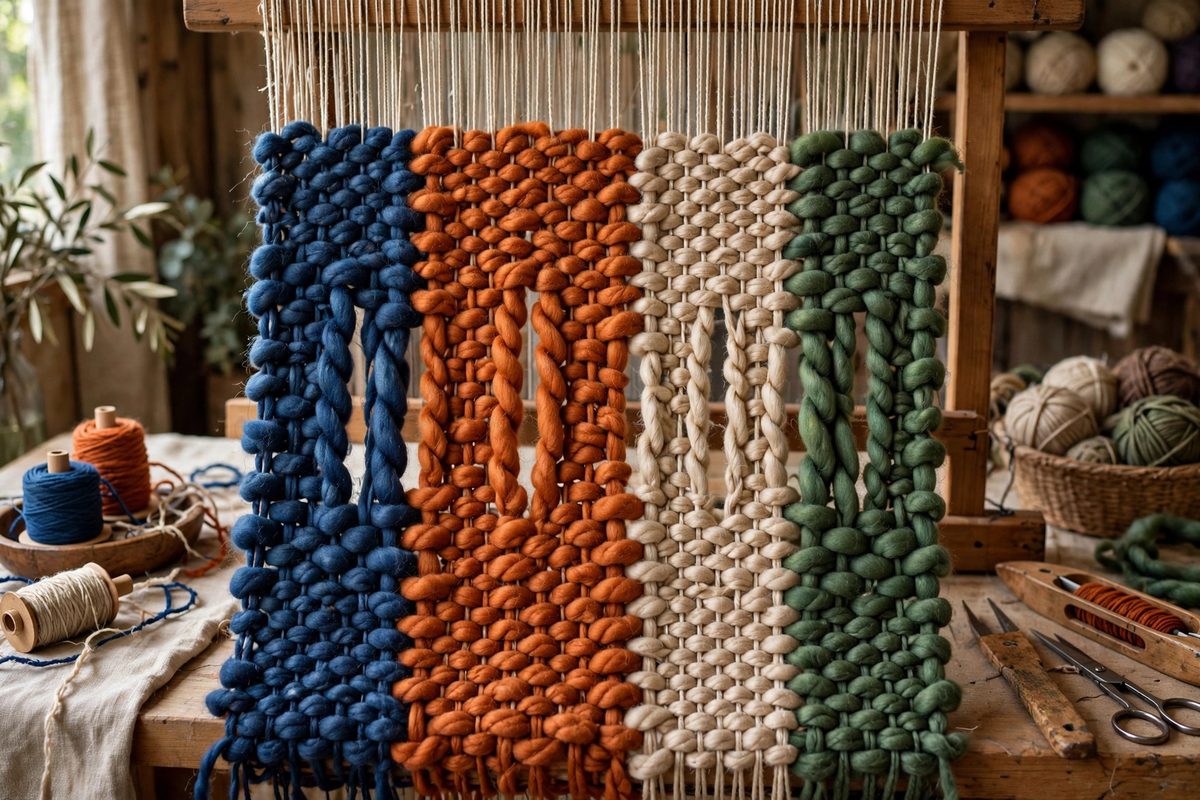
Tapestry's color changes create slits: vertical gaps where one weft color ends and another begins, with no interlacing between them. In pictorial tapestry the slits are part of the technique; in structural heavy-weft tapestry, where the weaving must hold together under load, uncontrolled slits are weak points. Limiting them is structural engineering in thread.
Why slits weaken the weaving
A slit is a discontinuity in the weft: the fabric is held together there only by the warp threads, with no weft binding one side to the other. Under tension, the slit opens; under repeated flexing, it grows. In a wall hanging the slits are harmless, but in a tapestry that bears weight, forms a bag, or serves as upholstery, the slits are the failure points. Heavy weft, which is thicker and stiffer, makes the problem worse, because the stiff weft does not ease around the slit the way fine weft does.
Planning color boundaries
The first defense is design: minimize the number and length of vertical color boundaries. Arrange the pattern so color changes happen along diagonal or stepped lines rather than long verticals; a diagonal boundary distributes the slit stress across multiple warps instead of concentrating it in one column. Where vertical boundaries are unavoidable, keep them short. A tapestry designed with its slits in mind is stronger than one designed purely pictorially and woven structurally afterward.
Interlocking the wefts
Where two colors meet, interlock their wefts instead of leaving a clean slit. The simplest interlock wraps each weft around the neighboring warp at the boundary, linking the two color areas. More thorough methods, like dovetailing the wefts through each other's territory, create a stronger join at the cost of a slightly less crisp color line. For structural work, choose the stronger join; the slight softening of the color boundary is invisible compared to a slit that opens under load.
Sewing the slits
Slits that remain after weaving can be sewn closed from the back with a matching thread. This is standard practice in fine tapestry and essential in structural pieces. Sew each slit with small, firm stitches that bridge the gap without puckering the surrounding weaving. The sewing does not just close the hole; it transfers load across the boundary, making the two color areas work together. Sew as you go or at the end, but do not skip it on any slit in a load-bearing area.
Weft density and beat
A firm, even beat packs the weft tightly and minimizes the slit's tendency to open. In heavy-weft tapestry, beat each pick fully home; the weft should completely cover the warp, with no gaps for the slit to exploit. Consistent beat also keeps the color boundaries straight, which keeps the interlocks and sewn closures effective. An under-beaten tapestry is a loose tapestry, and loose tapestry fails at its slits first.
Testing the structure
Before the tapestry goes into service, test it. Apply the expected load gradually and inspect every color boundary for opening or distortion. Flex it the way use will flex it. If a slit opens, sew it more thoroughly or reinforce it from the back with a patch of compatible fabric. The test is not pessimism; it is the final quality check on a structural textile, and it is far better to find the weakness now than in use.
Design the boundaries short and diagonal, interlock the wefts, sew every remaining slit, beat firmly, and test under load. The tapestry will hold together as a structure, not just as a picture.
Related Guides
- Managing Interlock Slit Overlaps on Fine Tapestry: Tapestry's defining technique, discontinuous weft that turns back at color boundaries, creates slits: vertical gaps where two color areas meet but
- Dovetail Interlock Tension on Heavy Wool Tapestry: Where two colors meet in tapestry, the weaver must join them without a slit weakening the cloth. The dovetail interlock, where each color's weft
- Dovetail Interlock Joins on Dense Tapestry Warps: Tapestry weaving builds images from discontinuous wefts: each color area is woven separately, and where two colors meet along a vertical boundary
- Slit Weaving Interlock Joins on High Sett Linen Warps: In tapestry, each color block is woven with its own weft, and where two colors meet along a vertical boundary, the wefts turn back on themselves