
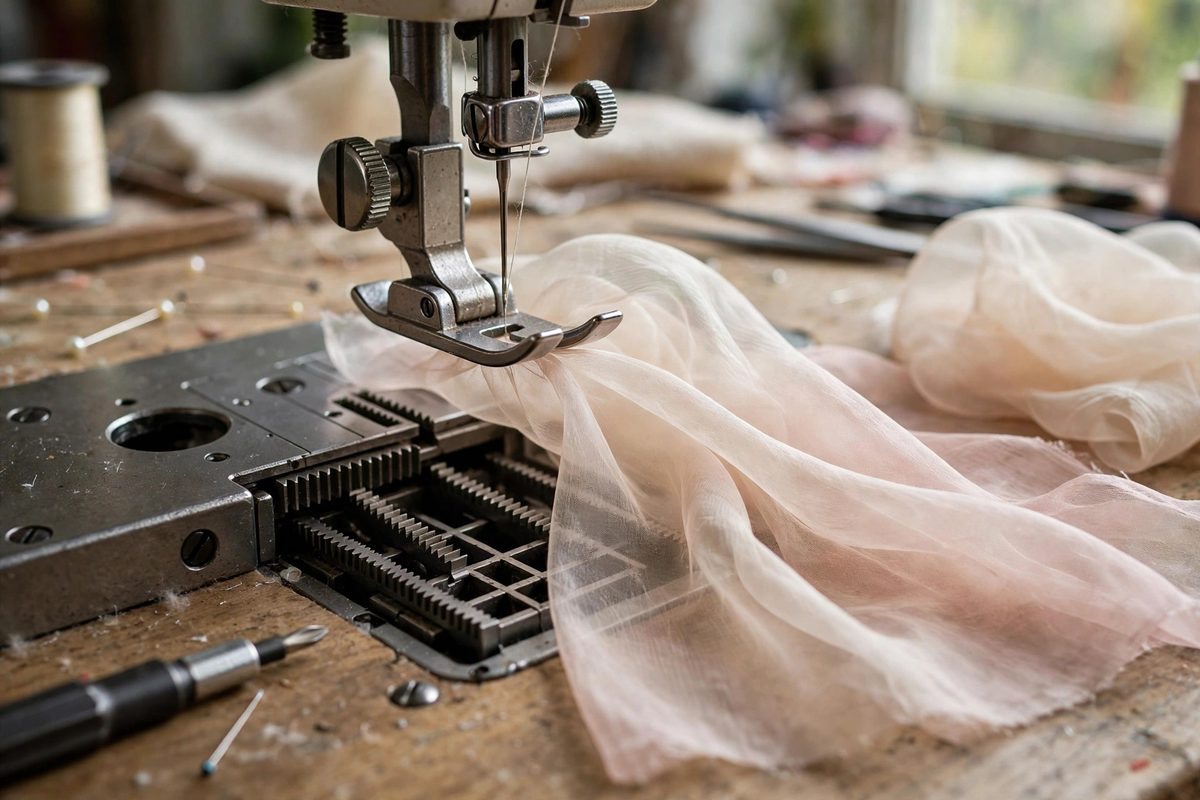
Silk chiffon is the final exam of machine sewing: sheer, slippery, and utterly intolerant of the feeding errors that other fabrics forgive. The feed dogs, the toothed mechanism that advances fabric under the needle, must be set to grip this elusive material firmly enough to feed evenly but gently enough not to chew it. Feed dog height, how far the teeth rise above the needle plate, is the adjustment that threads this needle. Too high and the teeth claw the delicate weave; too low and the chiffon slips, stretches, and sews into puckered waves. Calibrating the height for chiffon is a precise, test-driven procedure.
How feed dogs move fabric
The feed dogs rise above the needle plate, grip the fabric's underside with their teeth, carry it backward one stitch length, drop below the plate, and return forward for the next cycle, all while the presser foot holds the fabric down against them. The height of the teeth above the plate determines the grip: higher teeth bite deeper into the fabric, lower teeth barely engage. For stable fabrics, the factory height is a fine compromise. For chiffon, the compromise fails in both directions: the fabric is too slippery for a timid grip and too delicate for an aggressive one. The calibration finds the narrow band where the teeth engage the weave just enough to advance it positively without damaging the fibers or distorting the fabric's drape.
Finding the chiffon setting
Start from the factory setting and adjust in small increments, testing on chiffon scraps at each step. The test is a straight seam sewn at the intended stitch length: examine it for even stitch length along the seam, absence of puckering, and no damage to the weave visible when the seam is held to the light. If the stitches vary in length or the fabric seems to hesitate, the dogs are too low to grip; raise them slightly. If the fabric shows tooth marks, chewed spots, or the seam puckers from the fabric being forced, they are too high; lower them. The correct height usually sits slightly lower than the factory setting for medium fabrics, since chiffon needs less tooth engagement than its slipperiness suggests; the presser foot pressure, set light, does part of the holding work. Record the final setting for future chiffon projects.
The presser foot partnership
Feed dog height works in partnership with presser foot pressure, and the two must be calibrated together. Heavy foot pressure on chiffon crushes the delicate weave and forces the fabric to stretch as it feeds, causing the wavy seams chiffon is notorious for; set the pressure light, just enough to keep the fabric in contact with the dogs. A straight-stitch plate and foot, with their small needle hole and full fabric support around it, prevent the chiffon from being pushed down into the bobbin area, a common disaster with wide zigzag plates. Consider a walking foot or an even-feed foot for long chiffon seams; the auxiliary feed eliminates the differential between top and bottom layers that causes creeping. Each of these choices reduces the burden on the feed dog height adjustment, widening its workable band.
Stabilizing the chiffon itself
Sometimes the best feed dog adjustment is not enough because the fabric itself needs help. Staystitching the seam lines before construction stabilizes the chiffon's edges against stretching during handling. Tissue paper basted under the seam, torn away afterward, gives the feed dogs something to grip and prevents the chiffon from distorting; this old couture trick remains one of the most effective. Starch or fabric stabilizer spray adds temporary body that washes out later. For the seam about to be sewn, these stabilizations let the feed dogs work against a cooperative material rather than fighting the chiffon's nature. Remove or wash out temporary stabilizers as appropriate; the finished garment should drape as chiffon, not as the stabilized version.
Stitch and needle choices
Support the feeding with compatible stitch parameters. Use a short stitch length, which gives the feed dogs more engagement cycles per inch and produces a stronger seam in the delicate fabric. Choose a fine, sharp needle, a small-diameter universal or microtex, since a large or dull needle displaces the weave and creates runs; change the needle at the start of the chiffon project, because the fabric reveals needle wear immediately. Use fine thread matched to the fabric's delicacy; heavy thread in a fine fabric creates tension imbalance that mimics feeding problems. Sew at a moderate, steady speed; rushing chiffon through the machine defeats every careful adjustment. The machine sews what the setup allows, and the setup must be wholly sympathetic to the fabric.
Testing protocol for the real project
Before cutting the fashion fabric, run a complete test protocol on scraps: straight seams, curved seams, and seam intersections, all with the calibrated feed height, light foot pressure, stabilizer if used, and the chosen needle and thread. Wash a test scrap as the garment will be washed, since some feeding sins appear only after laundering. Only when the tests pass completely, cut the real fabric. Chiffon forgives nothing and conceals nothing; the discipline of testing is the price of admission, and the calibrated feed dogs are the foundation it stands on.
Calibrate feed dog height for silk chiffon by testing downward from the factory setting until the teeth grip without clawing, pair it with light presser foot pressure and full fabric support, stabilize the chiffon when needed, and prove everything on scraps before cutting. The sheerest fabric demands the most precise feeding, and precision here is entirely achievable.
Related Guides
- Walking Foot Pressure Tuning for Slippery Silk Crepe: Silk crepe is one of the most rewarding fabrics to wear and one of the most punishing to sew. Its high-twist yarns give it that pebbled texture and
- Differential Feed Tension on Fine Silk Charmeuse: Silk charmeuse is one of the most beautiful and most treacherous fabrics to sew: liquid drape, luminous surface, and a tendency to slip, pucker, and
- Rotary Blade Sizing for Multi-Layer Cottons: The rotary cutter is the garment maker's speed tool, but its blade diameter is a real engineering choice, not a fashion preference. Cut six layers of
- Tension Balance for Bias-Cut Lightweight Rayon Crepes: Bias-cut rayon crepe drapes like liquid, which is why designers love it and why sewers approach it with respect. Cut on the bias, the fabric