
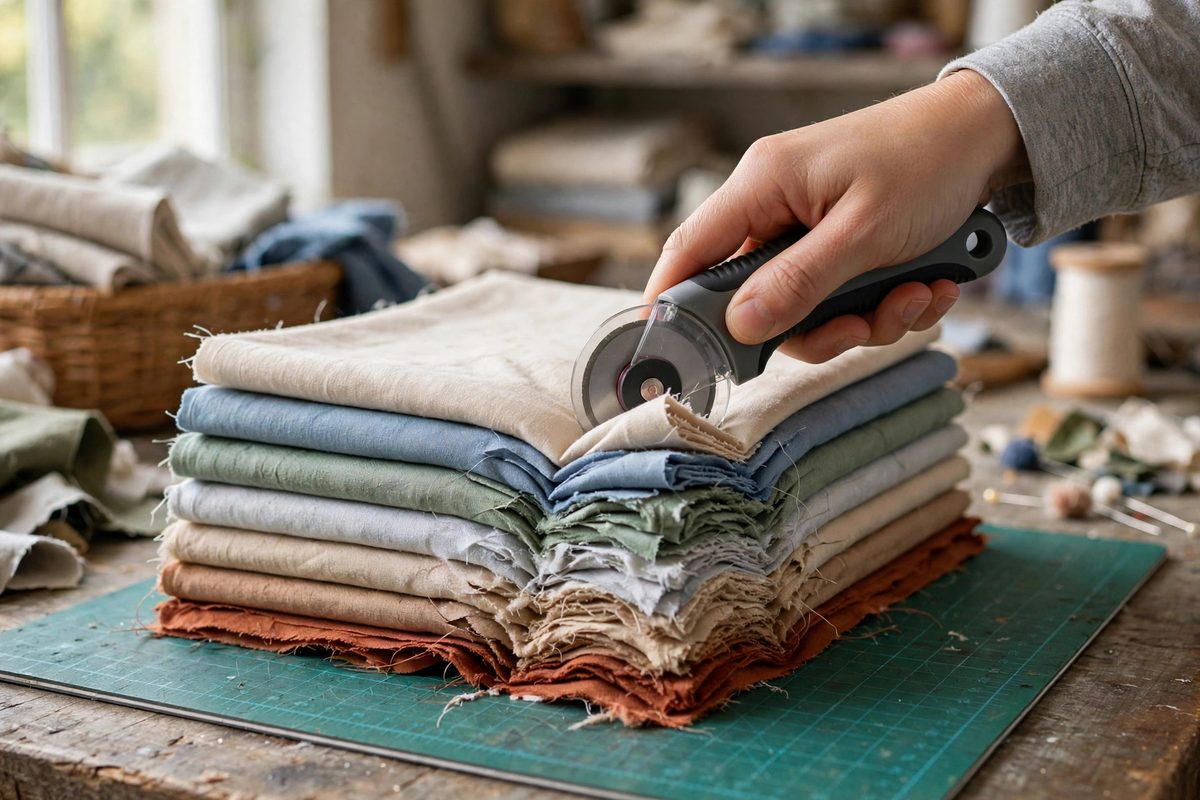
The rotary cutter is the garment maker's speed tool, but its blade diameter is a real engineering choice, not a fashion preference. Cut six layers of quilting cotton with a blade meant for single-layer precision work and you get skipped cuts, frayed edges, and a sore wrist. Match the blade to the layer count and the job gets faster, cleaner, and safer.
What blade diameter changes
A larger blade contacts more fabric per rotation and carries more momentum through the cut, which is why big blades power through stacks. A smaller blade turns tighter curves and gives finer control at pattern notches and corners. The common sizes form a clear ladder: 18mm for tight detail work, 28mm for general single-layer cutting and curves, 45mm as the all-rounder, and 60mm for thick stacks and long straight cuts. The trade-off is always power versus maneuverability; there is no size that does both jobs best.
Sizing to the layer count
For a single layer of quilting cotton, the 45mm blade is the comfortable default, with the 28mm better for small pattern pieces with tight curves. At two to four layers, the 45mm still performs well on a sharp blade, though you will feel it working harder. At five to eight layers, step up to the 60mm blade: its greater cutting edge engagement keeps the bottom layers from shifting and skipping. Beyond about eight layers of cotton, even the 60mm struggles; the stack compresses unevenly under the ruler, the bottom layer creeps, and accuracy suffers. Split the stack rather than forcing it.
Blade sharpness matters more than size
A sharp 45mm blade out-cuts a dull 60mm every time. The symptoms of a dull blade are unmistakable: skipped threads that need a second pass, frayed cut edges, and increasing hand pressure to complete cuts. That extra pressure is also a safety hazard, since a cutter that needs forcing is a cutter that can jump the ruler. Change blades at the first sign of skipping, not when they are fully dead; blades are consumables and cheap compared to ruined fabric or a cut finger. Cutting only fabric, never paper or batting with embedded debris, extends blade life enormously.
Technique for clean multi-layer cuts
Stand so your cutting arm moves straight along the ruler without reaching; body mechanics matter more as the layer count rises. Apply firm, even downward pressure and cut in one continuous pass, because stopping mid-cut lets layers shift. Keep the blade perpendicular to the mat, not tilted, since a tilted blade cuts the top layers wider than the bottom ones. Use a sharp, heavy ruler with a non-slip backing, and keep your guiding hand's fingers well behind the ruler's edge, curled or using a safety guard. Replace a scarred, grooved mat; deep cuts in the mat catch the blade and deflect it.
Safety is part of the sizing decision
Larger blades cut deeper, which means they cut fingers deeper too. Always retract or cover the blade the instant a cut is finished, even if you are about to make another cut in a few seconds; the habit is what saves you on the thousandth repetition. Cut away from your body, keep the work area clear of clutter that could nudge the ruler, and store cutters locked closed. A sharp blade used with respect is safer than a dull blade used with force.
Size the blade to the stack, keep it sharp, and let the tool do the work. Multi-layer cutting should feel smooth and controlled, never like a wrestling match.
Related Guides
- Walking Foot Pressure Tuning for Slippery Silk Crepe: Silk crepe is one of the most rewarding fabrics to wear and one of the most punishing to sew. Its high-twist yarns give it that pebbled texture and
- Tension Balance for Bias-Cut Lightweight Rayon Crepes: Bias-cut rayon crepe drapes like liquid, which is why designers love it and why sewers approach it with respect. Cut on the bias, the fabric
- Feed Dog Height Calibration for Slippery Silk Chiffon: Silk chiffon is the final exam of machine sewing: sheer, slippery, and utterly intolerant of the feeding errors that other fabrics forgive. The feed
- Differential Feed Tension on Fine Silk Charmeuse: Silk charmeuse is one of the most beautiful and most treacherous fabrics to sew: liquid drape, luminous surface, and a tendency to slip, pucker, and