
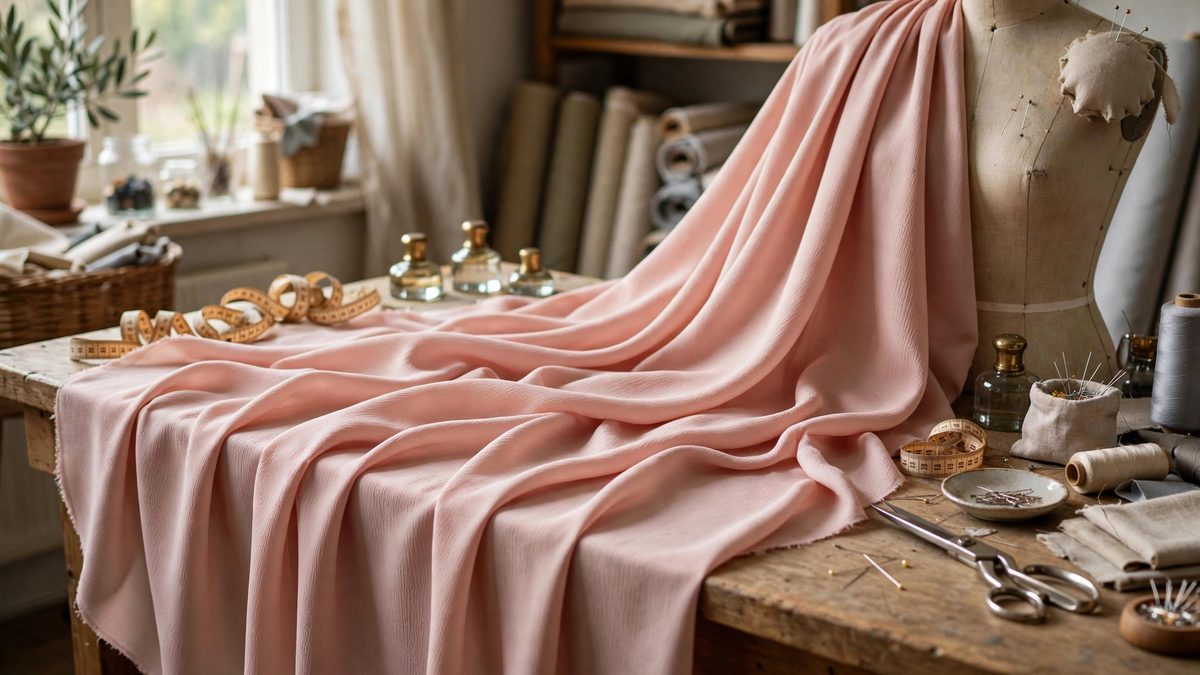
Bias-cut rayon crepe drapes like liquid, which is why designers love it and why sewers approach it with respect. Cut on the bias, the fabric stretches in every direction; made of rayon crepe, it is lightweight, fluid, and determined to grow. Tension balance, in both the sewing machine and the handling, is what keeps a bias garment true.
How bias cut changes the fabric
Cutting on the true bias, forty-five degrees to the grain, gives woven fabric its maximum stretch and drape. The fabric no longer has a stable direction; it gives along every seam and edge. Rayon crepe adds its own character: the creped texture means the yarns are highly twisted, giving the fabric a lively, slightly springy hand. Together, bias and crepe produce a fabric that moves beautifully on the body and moves inconveniently everywhere else, including on the cutting table and under the presser foot.
Machine tension for the fabric
The sewing machine's tension must suit a fabric that stretches as it sews. Too much upper tension puckers the seam; too little leaves loops. Test on bias-cut scraps of the actual fabric, sewn in the actual seam direction, because straight-grain scraps behave differently. A slightly looser-than-normal tension often works best, letting the seam relax with the fabric. Use a fine needle and a short stitch length; the short stitches distribute the seam's stress and resist the grin-through that bias seams are prone to.
Handling without stretching
Every touch stretches bias-cut rayon. Support the fabric's weight when cutting, never let it hang off the table; hang the cut pieces for a day before hemming, because bias pieces grow, sometimes dramatically, and hemming before the growing is done guarantees a wavy hem. When sewing, guide the fabric without pulling; let the feed dogs do the work. Pin within the seam allowances, and consider basting long seams by hand first. The fabric rewards a light touch and punishes a heavy one.
Seam choices for bias
Choose seams that accommodate stretch. French seams enclose the raw edges beautifully and suit the fabric's drape, but they must be sewn without stretching the first pass. Narrow hems work for edges, rolled or hand-finished. Staystitch curved edges immediately after cutting, before they can stretch out of shape; the staystitching is the edge's memory of its intended shape. Interface only where structure is truly needed, with a fusible light enough not to fight the drape.
Pressing with restraint
Rayon crepe presses easily and distorts easily. Use a press cloth, moderate heat, and a lifting motion rather than sliding the iron; sliding stretches the bias. Steam can shrink or grow rayon unpredictably, so test on a scrap first. Press seams as sewn, gently, and let each section cool before moving it. The iron is a shaping tool here, not just a flattening one; use it to coax, never to force.
Fitting on the body
Fit bias garments on the body, not on the dress form, because the fabric behaves differently under the body's warmth and movement. Allow the garment to hang on the wearer for a while before marking the hem; the bias will settle and the hemline will move. Mark the hem with the wearer standing naturally, and cut it with the garment hanging. The final fitting is where the liquid drape either happens or does not, and patience at this stage is what produces it.
Balance the machine tension to the stretch, handle the fabric like it is always about to grow, choose seams that move with it, and fit on the living body. The bias-cut rayon will do what it does best: drape beautifully, exactly as designed.
Related Guides
- Differential Feed Tension on Fine Silk Charmeuse: Silk charmeuse is one of the most beautiful and most treacherous fabrics to sew: liquid drape, luminous surface, and a tendency to slip, pucker, and
- Walking Foot Pressure Tuning for Slippery Silk Crepe: Silk crepe is one of the most rewarding fabrics to wear and one of the most punishing to sew. Its high-twist yarns give it that pebbled texture and
- Rotary Blade Sizing for Multi-Layer Cottons: The rotary cutter is the garment maker's speed tool, but its blade diameter is a real engineering choice, not a fashion preference. Cut six layers of
- Feed Dog Height Calibration for Slippery Silk Chiffon: Silk chiffon is the final exam of machine sewing: sheer, slippery, and utterly intolerant of the feeding errors that other fabrics forgive. The feed