
Macro photography of small mechanisms, watch movements, lock internals, tiny gear trains, hits a hard wall called depth of field. At high magnification, the in-focus slice can be thinner than a hair, so no single frame shows the whole mechanism sharp. Focus stacking solves this by shooting a sequence of frames, each focused a fraction deeper, and blending them into one image that is sharp front to back. The technique only works if the rig moves the camera or the focus with micron-level repeatability.
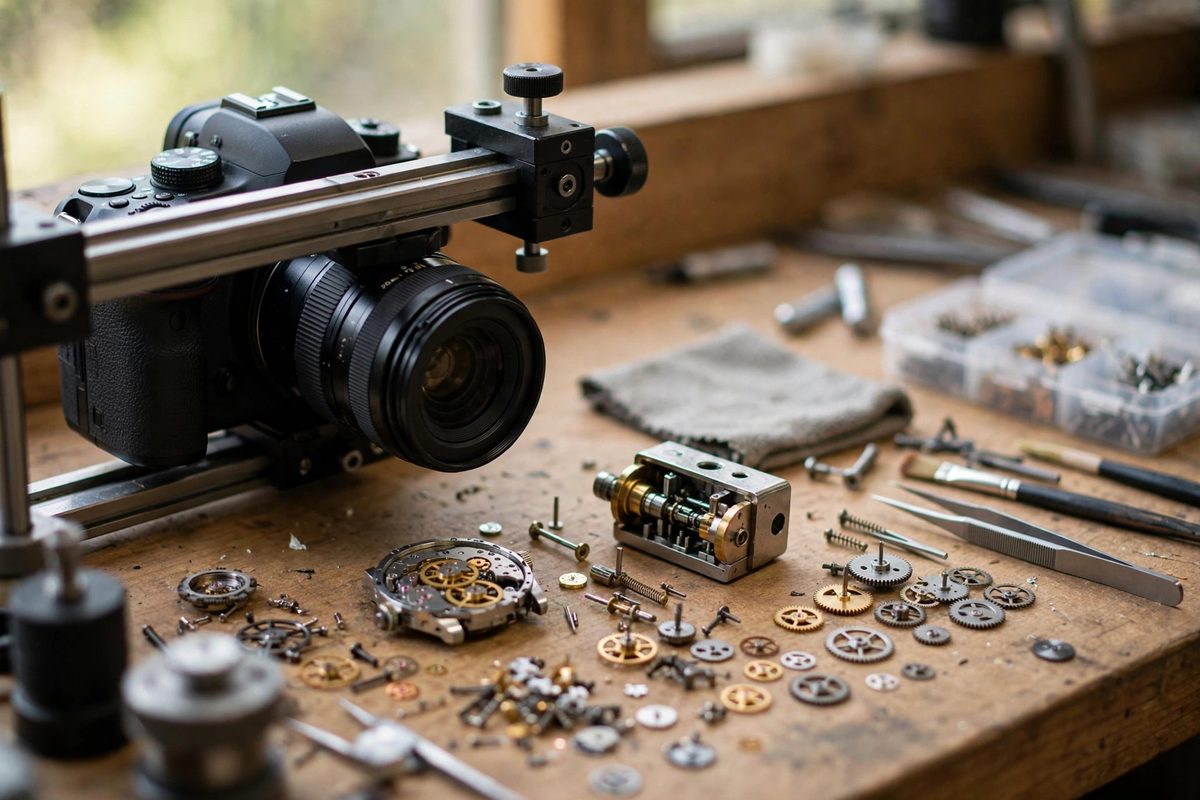
Why the Rig Matters More Than the Camera
Stacking software aligns frames, but it cannot fix a stack where the step sizes wandered. If the focus moves 50 microns between frames one through ten and 200 microns between frames ten and twenty, there will be soft bands in the final blend that no amount of processing hides. The rig's job is simple: advance focus (or the subject) in perfectly even increments, without lateral drift. Every design decision flows from that requirement.
Manual Rails: Cheap, Capable, Honest
A manual macro focusing rail with a micrometer-style drive is the entry point. You mount the camera, frame the subject, and advance the rail by hand between shots, typically in increments of 0.1 to 0.5 mm depending on magnification. Manual rails work well for static subjects and modest stacks (20 to 50 frames), because you can feel the drive and keep the rhythm. Their weakness is operator fatigue: past 50 frames, your hand introduces lateral wobble, and the stack degrades. Mark your start and end points with tape so you can re-shoot a stack that ran short.
Motorized Stacking: Consistency at Scale
For stacks of hundreds of frames, a motorized rail with a stepper-driven lead screw is the standard tool. The controller moves a set distance, triggers the shutter, waits for vibration to settle, and repeats. Step sizes down to a few microns are achievable with a fine lead screw and microstepping, and the consistency across the whole stack is what makes deep blends possible. The critical build detail is the settle delay: after each move, the rig must pause long enough for all vibration to die before the shutter fires, or every frame carries motion blur that stacking cannot remove.
Moving the Subject vs. Moving the Camera
You can stack by moving the camera toward a fixed subject or by moving the subject toward a fixed camera. Moving the subject stage is often easier to build rigidly, since a small platform on a lead screw wobbles less than a camera hanging off a long rail. But moving the subject changes the lighting relationship frame to frame, which can cause brightness banding in the blend. Moving the camera keeps lighting constant at the cost of a longer, flex-prone arm. For mechanism guides where lighting is built around the subject, the camera-moving rail is usually the better choice.
Focus Stepping by Lens: An Alternative
Some lenses can be driven by electronic focus stepping, where the camera's autofocus motor advances focus in fine increments while the rig stays still. This eliminates mechanical motion entirely, which is wonderful for vibration, but it changes the lens's magnification slightly between frames (focus breathing). Stacking software handles mild breathing well, but at extreme macro magnifications the frame-to-frame scale shift gets large. Test your lens at your working magnification before committing to a 300-frame electronic stack.
Building the Rig for Mechanism Work
Whatever drive you choose, the mechanical rules are the same. Use a solid base plate, keep the cantilever as short as possible, and mount the camera with two points of contact rather than one. Isolate the rig from the table with a heavy mass (a steel plate or a bag of sand) to damp ambient vibration, and trigger the shutter with a remote or tether so your hand never touches the rig during a stack. Light the subject with continuous LED panels rather than flash for stacking, because flash recycle timing fights the rhythm of the sequence. Then shoot the stack, blend it, and enjoy mechanism photos that show every tooth of every gear, sharp.
A precision focus stacking rig is a patience machine: it trades your time for images that a single frame could never produce. Build it rigid, step it evenly, settle between frames, and your mechanism guides will look like engineering illustrations instead of blurry guesses.
Related Guides
- Focus Stacking Setup for Macro Tool Walkthroughs: Macro photography of tools, showing the grind of a chisel edge or the teeth of a saw at life size and beyond, runs into a physics problem: at high
- Micro Photography Rigging for Fine Mechanism Bench Guides: A bench guide for a fine mechanism, a watch movement, a lock, a small engine, lives or dies on its photographs. The reader needs to see exactly which
- Multi-Angle Workbench Macro Rigging for Fine Lathes: Photographing small lathe work at macro range is a battle against vibration, shadow, and depth of field, and the rig holding the camera matters as
- Diffused High-CRI Overhead Lighting for Assembly Guides: Assembly guide photos and videos are only as good as the light they are shot in. Harsh overhead shop lights create blown highlights, black shadows