
Raw edge appliqué bonds fabric shapes to a background with fusible web, then secures the edges with stitching, leaving the cut edges exposed as a design feature. The fusible web's weight, how much adhesive it carries, determines whether the appliqué bonds permanently, stays soft, and survives washing. Choosing the right weight for the fabrics involved is the technical decision beneath the technique's casual charm, and it is worth making deliberately rather than grabbing whatever web is in the drawer.
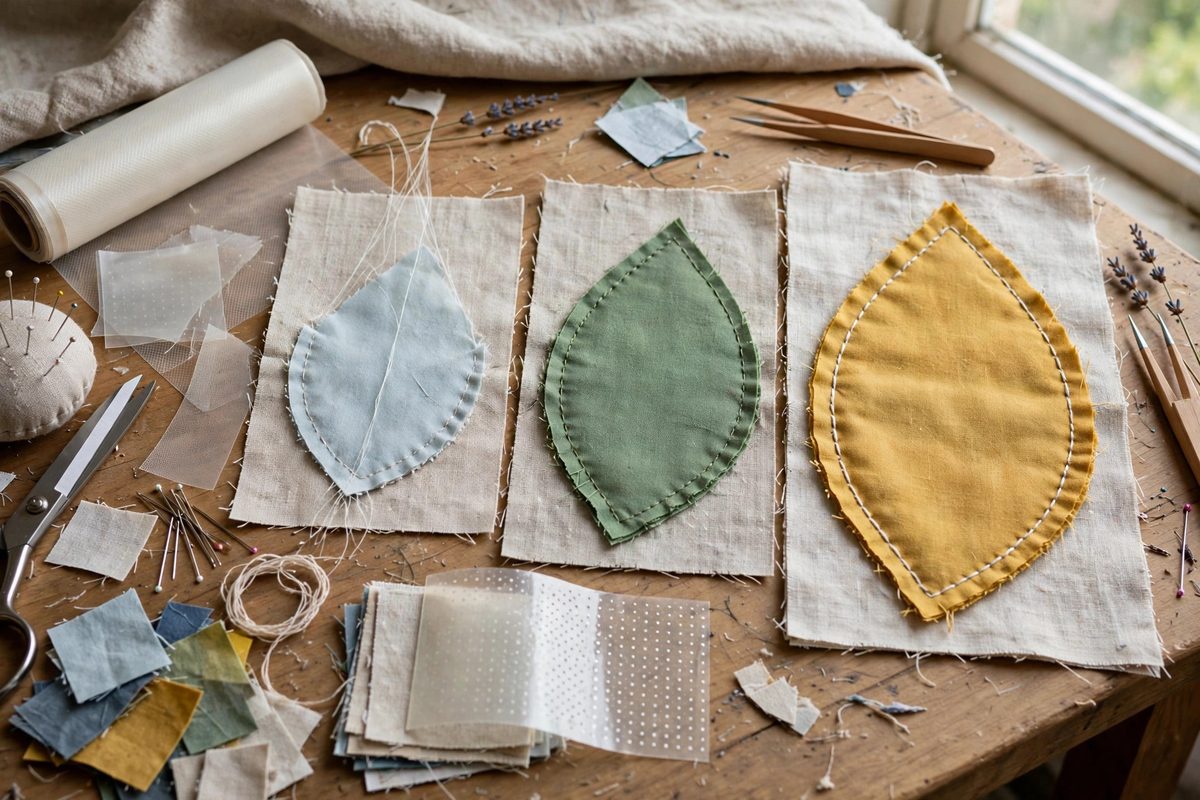
What fusible web weight means
Fusible web is a sheet of heat-activated adhesive, and its weight describes the adhesive density: lightweight webs carry a sparse adhesive layer, heavyweight webs a dense one. More adhesive means a stronger bond and a stiffer result; less adhesive means a softer hand but a bond that may fail under stress or washing. The choice balances hold against drape, and the right balance depends on the fabrics and the project's life.
Web also comes paper-backed or paperless. Paper-backed web lets you trace shapes onto the paper, cut precisely, and peel before fusing, which is ideal for intricate appliqué pieces. Paperless web suits large background pieces where tracing is unnecessary. The weight choice is independent of the backing style; select each for its own reasons.
Matching web weight to fabric
Lightweight fabrics, quilting cottons, lawn, voile, want lightweight web. Heavy web's dense adhesive bleeds through light fabrics, showing as stiff spots or discoloration, and its stiffness overwhelms the fabric's drape. The bond only needs to hold the piece through stitching and washing; lightweight web does this without changing the fabric's character.
Medium and heavy fabrics, denim, canvas, home-dec weight, need medium to heavy web to bond reliably, since their texture and weight resist light adhesive. The stiffness penalty matters less on fabrics that are already substantial. For mixed-fabric appliqué, choose the web for the heaviest fabric in the piece, or fuse different weights to different pieces, matching each fabric individually for the best result.
The fusing process
Fuse in two stages: first bond the web to the appliqué fabric's wrong side, then cut the shapes and fuse them to the background. Use the temperature and time the web manufacturer specifies, with a press cloth to protect both the iron and the fabrics. Press firmly with an up-and-down motion rather than sliding the iron, which can shift small pieces; hold for the full recommended time at each position.
Test the bond after cooling: the piece should resist gentle peeling. A bond that lifts easily was under-fused, under-heated, under-timed, or under-pressed; re-fuse with corrected parameters before stitching. Fusing is the foundation; stitching secures the raw edges but should not be compensating for a failed bond.
Raw edge considerations
The exposed cut edges will fray slightly with washing, which is part of raw edge appliqué's aesthetic, but the web choice controls how much. Heavier web stabilizes edges more, producing minimal fraying; lighter web lets edges soften and fray more freely. Decide the desired edge character and choose the web accordingly, testing on scraps washed the way the finished piece will be washed.
Cut edges cleanly with sharp scissors or a rotary cutter; ragged cutting frays unevenly regardless of web weight. For pieces that will see hard use, consider a narrow zigzag or blanket stitch that catches the edge, securing it while preserving the raw-edge look.
Washing, wear, and longevity
Wash the finished piece as the most delicate fabric in it demands, and expect the appliqué bond to be tested by every cycle. Quality fusible web survives normal laundering indefinitely when properly fused; bonds fail from under-fusing, wrong weight selection, or incompatible fabrics, not from age alone. If an edge lifts after washing, re-fuse with heat and pressure, often through a press cloth, before restitching.
For heirloom or art pieces that will be washed rarely, the web choice leans toward preserving fabric character; for children's quilts and everyday items, it leans toward maximum bond strength. Match the engineering to the project's life, as with every other material choice in quilting.
Fusible web selection is hold versus hand: lightweight web for light fabrics and soft drape, heavier web for substantial fabrics and hard use, fused in two careful stages with manufacturer-correct heat and pressure. The appliqué stays put, the edges behave as designed, and the technique's easy charm rests on a properly engineered bond.
Related Guides
- Paper Backed Fusible Web Sizing for Clean Appliqué: Fusible web is the applique artist's shortcut: an adhesive film that bonds fabric shapes to a background with heat, no pinning, no basting, no
- Stiletto Piercing Precision for Turned Needle Appliqué: Needle-turn appliqué asks you to fold a raw fabric edge under itself, a sixteenth of an inch at a time, and stitch it down invisibly while the shape
- Freezer Paper Stabilizing for Micro Needle Turn Curves: Needle-turn applique on tiny curves, the petals of a miniature flower, the tight arcs of a small motif, asks the fabric to do something it resists
- Basting Tissue Underlay for Machine Applique Bounds: Machine applique lives or dies at the edges: the satin stitch or blanket stitch that binds the applique piece to the background must land precisely