
The chest of a structured overcoat holds its shape because of what is inside it, not because of the outer fabric. Haircloth chest canvas, the stiff, resilient interfacing of traditional tailoring, is molded to the body so the coat's front rolls and shapes rather than collapsing. It is the invisible architecture of a good coat.
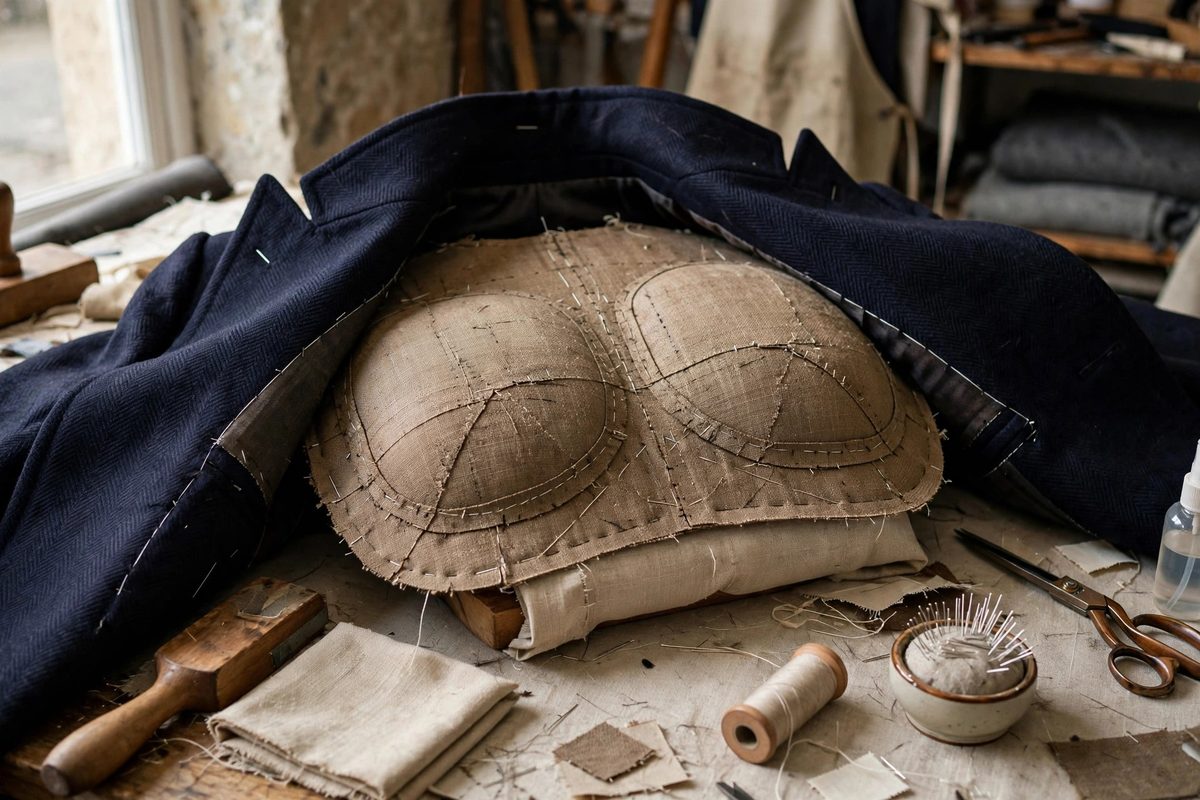
What haircloth canvas is
Haircloth is a woven interfacing traditionally made with horsehair weft, prized for its combination of stiffness and resilience: it holds a shape but springs back when flexed. Modern versions use synthetic substitutes, but the principle is the same. The canvas is cut to the coat's front, shaped with steam and pressure, and pad-stitched to hold the mold. Unlike fusible interfacing, which glues flat, hair canvas is sculpted in three dimensions, which is why a tailored chest looks alive rather than pressed.
Cutting the canvas
Cut the chest canvas from the coat's front pattern, typically extending from the shoulder through the chest and tapering toward the waist. The canvas is cut slightly smaller than the fashion fabric at the edges so it does not show through or create bulk at the seams. Mark the roll line, the break line where the lapel folds, because the canvas is shaped around it. Cut with care; the canvas is the coat's skeleton, and a misshapen skeleton misshapes everything.
Molding with steam and pressure
Molding is the heart of the technique. Dampen the canvas, shape it over a tailor's ham or a pressing form to match the chest's curve, and press it with steam until it holds. The canvas should cup gently where the chest curves and lie flat where the coat lies flat. Work gradually, checking the shape against the body or the form; over-molding creates a rigid shell, under-molding leaves the coat lifeless. The molded canvas should feel like a firm, shaped hand, not a board.
Pad stitching the layers
Pad stitching attaches the canvas to the coat front and locks in the mold. The stitches are small, diagonal, and worked through the canvas and the fabric's underlayer without showing on the face. Rows of pad stitching follow the chest's contours, denser where more control is needed, such as along the roll line. The stitching is slow handwork, and it is what makes the canvas and fabric behave as one shaped piece rather than two flat ones. Skimping here shows in the finished coat.
Fitting the canvas to the wearer
The molded canvas must match the wearer's chest, not an idealized form. Fit the canvas on the body before the coat is assembled: it should follow the chest without gaping or pulling, with the roll line sitting where the lapel will break. Adjust by re-steaming and reshaping; the canvas is forgiving until it is stitched in. A canvas fitted to the actual body is what makes a bespoke-feeling coat; one fitted to a standard form makes a standard coat.
Assembling over the canvas
Once the canvas is molded, pad-stitched, and fitted, the coat is assembled over it. The fashion fabric is basted to the canvas, the lapels are formed over the roll line, and the whole front is pressed into its final shape. Handle the assembly gently; the canvas's mold is set but not indestructible. The finished coat should show a chest that rolls naturally, lapels that lie correctly, and a front that keeps its shape through wearing. That is the canvas doing its invisible work.
Cut the haircloth true, mold it with steam to the chest's shape, pad-stitch it thoroughly, and fit it to the body. The overcoat will have the structure that separates tailoring from mere sewing.
Related Guides
- Canvas Chest Piece Pad Stitching for Structured Lapels: Pad stitching is the handwork that gives a tailored lapel its roll, its shape, and its quiet refusal to lie flat or bubble. It joins the canvas chest
- Horsehair Canvas Pad Stitching for Tailored Lapels: The difference between a jacket that looks expensive and one that looks homemade is often invisible: it is the interlining inside the lapel
- Steam Shaping Wool Canvas for Suit Collars: A suit collar does not get its elegant roll from cutting alone; it is shaped. Wool canvas, the traditional chest interfacing, can be shrunk and
- Pad Stitching Density for Tailored Collar Rolled Laps: The rolled lapel of a tailored jacket, curving smoothly from the collar to the button, holds its shape because of pad stitching: rows of small