
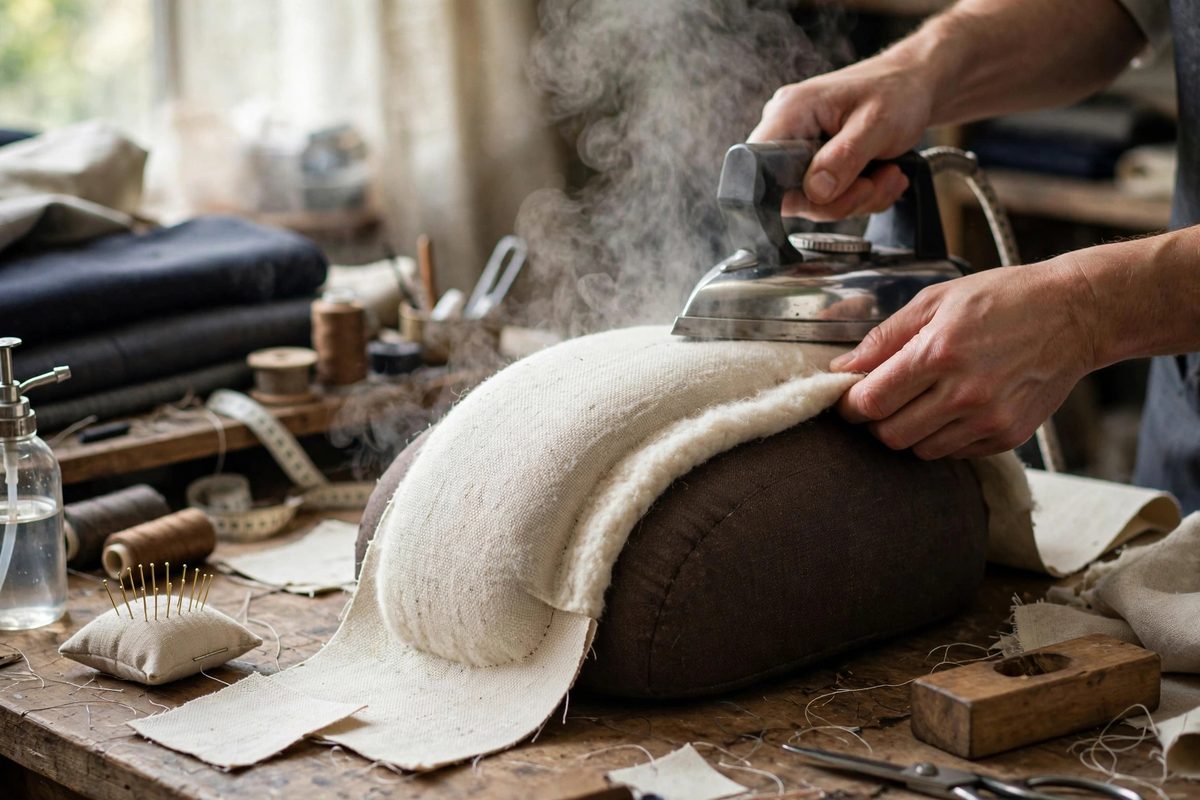
A suit collar does not get its elegant roll from cutting alone; it is shaped. Wool canvas, the traditional chest interfacing, can be shrunk and stretched with steam and pressure into a three-dimensional curve that holds the collar's roll permanently. This steam shaping, called "working the canvas" in tailoring tradition, is what separates a collar that lies correctly from one that fights the neckline. Here is how it works.
Why wool canvas takes a shape
Wool fibers respond to heat, moisture, and pressure by relaxing and re-setting their internal bonds. When you steam a section of wool canvas and press it, the fibers in the steamed zone contract slightly and lock into their new arrangement as they cool and dry. This is the same property that lets a tailor shrink fullness out of a sleeve cap or stretch a lapel. Canvas woven specifically for tailoring, with a firm plain weave, holds a shaped curve far better than fusible interfacing, which is why the traditional method survives: no glue can do what reshaped wool does.
Preparing the collar canvas
Cut the collar canvas on the same grain as the collar pattern pieces, usually with the warp running the length of the collar. Stay-stitch or mark the roll line clearly; the shaping happens relative to that line. You will shape the canvas before attaching it to the collar cloth, working on a pressing ham or a tailor's board that supports the curve you want. Have a clapper or a heavy wooden block ready: pressing the steamed canvas under the clapper sets the shape crisply as it cools.
The shaping sequence
Work in zones. To create the collar's roll, you need the canvas shorter along the roll line's inner curve and eased along the outer edge. Steam the section you want to shrink, holding the iron just above the canvas so steam penetrates without scorching, then press firmly and shrink the fibers by easing the canvas together under the iron. For areas that need stretching, steam and pull the canvas gently over the ham's curve, pressing as you go. Build the shape gradually across the whole piece, checking against the collar pattern frequently. The goal is a canvas that already holds the collar's three-dimensional curve before a single stitch joins it to the cloth.
Steam discipline and safety
Steam shaping uses real heat and real moisture near your hands. Keep fingers clear of the steam path, use the point of the iron rather than your fingertips to manipulate the canvas, and let the clapper do the holding while things cool. Too much water weakens the canvas temporarily and can leave water marks; use bursts of steam, not a soaking. Too much heat scorches wool, which smells terrible and weakens the fibers permanently; if you smell hot wool, back off. Work in a ventilated space, since steaming wool releases lanolin-scented vapor.
Attaching the shaped canvas
Once shaped and fully cooled and dried, baste the canvas to the collar's undercollar, matching the roll lines. The canvas should lie against the cloth without forcing; if you have to stretch the cloth to meet the canvas, the shaping is wrong and needs adjusting. Pad-stitch the canvas to the undercollar through the shaped zones, which locks the curve permanently. From here the collar is constructed normally, but it will roll and lie correctly because the structure was built into the canvas, not hoped for in the sewing.
Steam shaping is slow, physical, old-school tailoring, and it is the reason bespoke collars behave. Shape the canvas first, and the collar follows.
Related Guides
- Horsehair Canvas Pad Stitching for Tailored Lapels: The difference between a jacket that looks expensive and one that looks homemade is often invisible: it is the interlining inside the lapel
- Haircloth Chest Canvas Molding for Structured Overcoats: The chest of a structured overcoat holds its shape because of what is inside it, not because of the outer fabric. Haircloth chest canvas, the stiff
- Canvas Chest Piece Pad Stitching for Structured Lapels: Pad stitching is the handwork that gives a tailored lapel its roll, its shape, and its quiet refusal to lie flat or bubble. It joins the canvas chest
- Pad Stitching Density for Tailored Collar Rolled Laps: The rolled lapel of a tailored jacket, curving smoothly from the collar to the button, holds its shape because of pad stitching: rows of small