
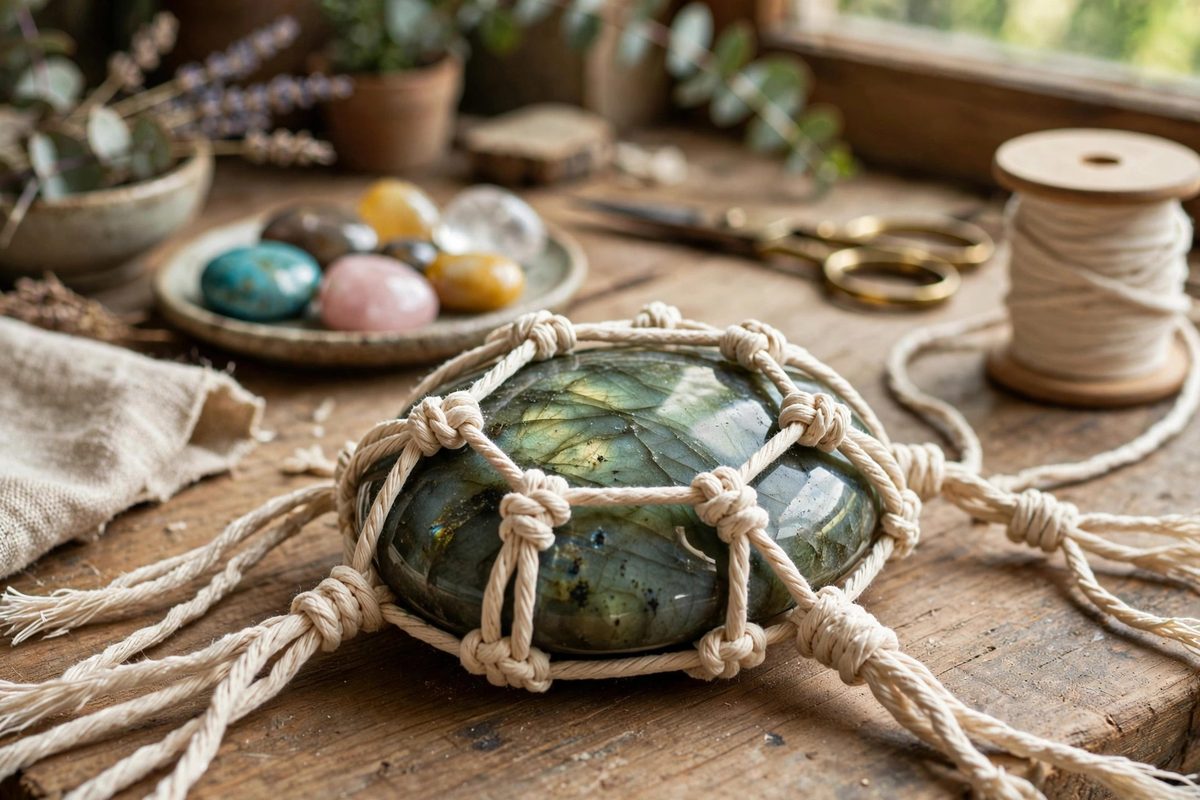
Setting a polished stone in macrame jewelry without metal findings comes down to one humble knot: the half hitch. Wrapped in series around the stone, half hitches form a net that grips the gem's curves, and because each hitch locks against the last, the net tightens under load instead of loosening. It is an ancient, tool-free setting technique, and it works on any smooth stone. Here is how to make the lock reliable.
Why half hitches grip instead of slipping
A half hitch is a single turn of working cord around a holding cord, pulled snug. On its own it can slide, but a series of them behaves differently: each hitch cinches against its neighbor, and friction between the stacked hitches multiplies. Around a stone, the holding cords radiate from a gathered point above the gem, and the hitches spiral downward over the stone's shoulder. The spiral converts the stone's tendency to slip out into tightening force; the heavier the stone pulls, the harder the net grips. That self-tightening behavior is why the technique survives centuries of use.
Choosing and preparing the stone
Polished stones are slippery by design, which is both the challenge and the point. Cabochons with a gently domed top and a defined girdle, the widest edge line, set most securely, because the net can seat into the girdle like a bezel. Very flat discs and perfect spheres are harder: discs give the net nothing to catch, spheres want to roll. For either, add a round of hitches below the widest point so the net closes under the stone's equator. Clean the stone with a dry cloth before wrapping; skin oils and polishing compounds reduce the friction the knots depend on.
Building the net
Start with four to eight holding cords, depending on stone size, knotted together above the stone with enough length to become the pendant bail or necklace. Drape them evenly around the stone and begin hitching: take one cord as the working cord and tie half hitches with each neighboring cord around it, spiraling down over the stone's shoulder. Keep the hitches snug and evenly spaced; gaps become weak points where the stone can shift. Work at least two full spiral rounds past the girdle, closing the net underneath. Finish by gathering all cords below the stone into a secure knot, or transition them into the necklace design.
Cord choice and tension
Waxed cord is the traditional choice for stone setting: the wax adds grip between hitches and against the stone, and it resists moisture. Unwaxed cotton or hemp works but needs tighter hitching to compensate for the lower friction. Keep tension firm and consistent throughout; a net that is tight in one quadrant and loose in another will let the stone migrate toward the loose side over time. If a hitch slips while you work, undo back to the last solid one rather than trying to tighten over it. Patience here pays off in a setting that lasts years.
Testing and finishing the setting
Before committing to the final knot, test the setting: hold the piece by the top cords and shake it gently, then press the stone from below with a fingertip. A good net will not shift or rotate. If the stone turns, the net is too loose or too shallow; add another spiral round. Trim cord ends only after the test, and seal cut ends according to the cord type: melt synthetic ends carefully, whip natural fiber ends. The finished piece should feel like the stone grew there.
Half hitch stone setting asks for nothing but cord, a stone, and attention. Master the spiral, respect the friction, and you can set any polished gem without a single tool.
Related Guides
- Clove Hitch Tension Locking for Miniature Micro Macrame: Micro macrame works at jewelry scale: fine cords, tiny knots, and pieces that must hold their shape under daily wear. The clove hitch, the workhorse
- Half-Hitch Micro Knots on Miniature Beaded Chords: Macrame jewelry lives at a scale where a millimeter matters: a bracelet cord barely thicker than thread, beads the size of seed pearls, knots that
- Micro Macrame Lark Head Knots on Beaded Cording: Micro macrame jewelry works at a scale where every knot is visible and every millimeter matters. The lark's head knot, the foundational mounting knot
- Micro Macrame Spiral Knots With 0.4mm Cordage: Micro macrame shrinks the ancient art of knotted cord down to jewelry scale, and the spiral knot, the half-knot repeated until it twists into a