
Micro macrame jewelry works at a scale where every knot is visible and every millimeter matters. The lark's head knot, the foundational mounting knot that attaches cords to a ring, dowel, or bead, must be tiny, tight, and perfectly seated when worked on fine beaded cording. Getting it right at micro scale is a distinct skill from tying it in chunky craft cord: the materials behave differently and the tolerances shrink.
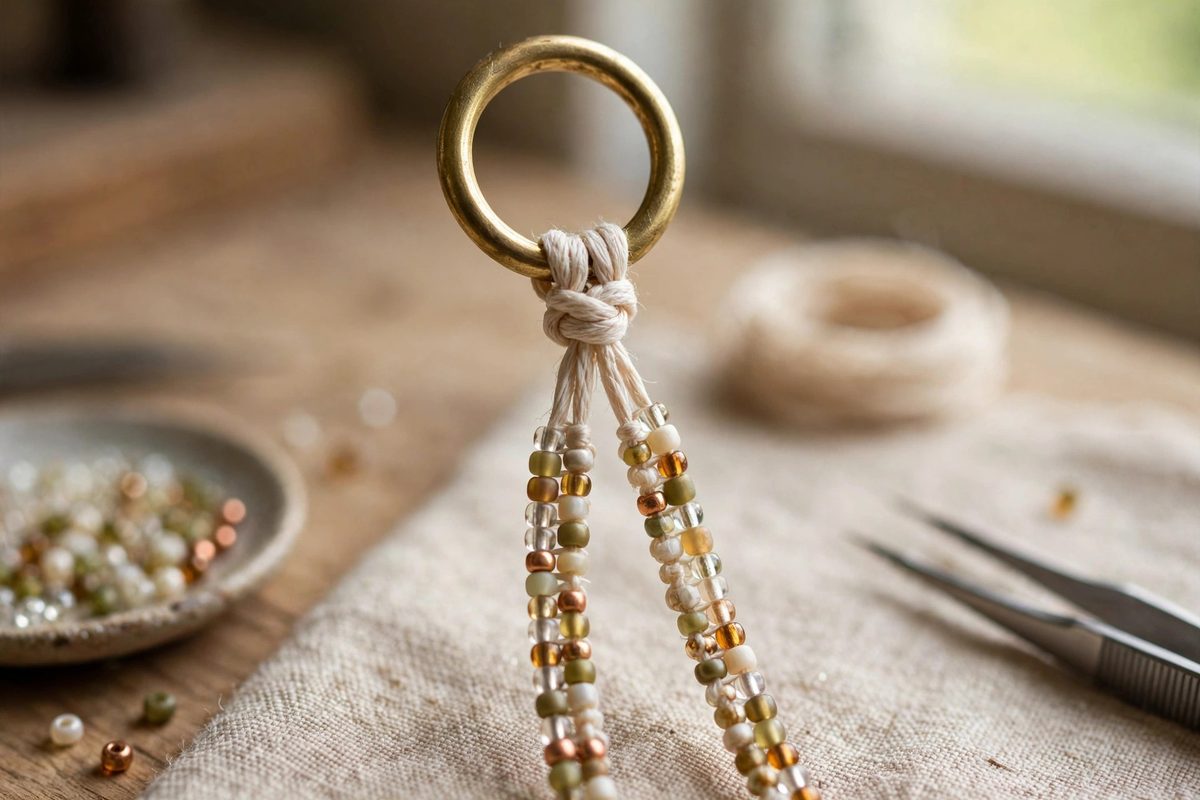
The knot at micro scale
A lark's head forms by folding a cord in half, passing the loop behind the anchor, and pulling the cord ends through the loop, cinching a girth hitch around the anchor. At jewelry scale, the anchor might be a 2mm bead, a jump ring, or a fine metal frame, and the cord might be under a millimeter in diameter. The mechanics are identical to large-scale macrame; the handling is entirely different.
The challenge is control: fine cords slip, tiny anchors roll, and fingers that manage chunky cord easily fumble at this scale. Work on a stable surface with good light and magnification; micro macrame is close work and pretending otherwise produces sloppy knots. A bead board or a piece of foam with pins gives tiny anchors somewhere to sit instead of rolling away mid-knot.
Cord selection for beaded work
Choose cords engineered for fine knotting: braided nylon, waxed polyester, or fine Chinese knotting cord in the sub-millimeter range. The cord must hold a knot without slipping, resist fraying at cut ends, and slide smoothly during tightening. Test the knot security with your actual cord and beads before committing to a piece; some slick cords creep under tension and need an extra half-hitch to lock.
Cut cords with sharp scissors or a thread burner for sealed ends; frayed ends at micro scale jam in the knot and ruin the seating. Slightly singe synthetic cord ends to prevent unraveling, being careful not to blob the end into a lump that will not pass through beads.
Seating the knot cleanly
Form the knot loosely first, position it exactly where it should sit on the anchor, then tighten progressively: snug the loop around the anchor, then draw the working ends through evenly, keeping the two legs of the knot symmetric. At micro scale, uneven tightening twists the knot visibly; slow, even tension is the technique.
When mounting on beads, the knot should cinch into the bead's hole or against its surface without distorting the bead's position. If the bead has a large hole relative to the cord, the knot can slip inside; size the cord to the bead or add a stopper knot. Test the assembly's movement: the mounted cords should hang evenly and the bead should sit straight.
Spacing and consistency
Jewelry pieces often mount many lark's heads in a row along a frame or ring. Consistency is everything: each knot must seat at the same depth, with legs of equal length, spaced evenly. Mark the anchor with tiny reference points or use a jig, a pinned board that holds the anchor while you work, to maintain spacing. Work all the knots in one session so your hand's rhythm stays consistent.
Count and measure rather than eyeballing at this scale. A millimeter of variance invisible in craft macrame screams in a necklace. Calipers or a marked gauge card help verify leg lengths and spacing until your eye is trained.
Locking and finishing
At jewelry scale, knots experience constant movement and need locking. After seating the lark's head, secure it according to the design: the subsequent knotting pattern often locks it naturally, but standalone mounts benefit from a tiny drop of jewelry glue wicked into the knot, or a discreet half-hitch. The lock must be invisible and must not stiffen the surrounding cords into a clump.
Trim working ends cleanly and finish them per the cord type: singed, glued, or tucked into subsequent knots. Every end in micro macrame is a visible detail; finish them as carefully as you tied the knots. Step back and view the finished mounting at arm's length before calling it done; flaws invisible under magnification sometimes show in the overall drape, and vice versa.
Micro macrame lark's heads are precision work: fine knotting cord, sharp tools, magnification, even progressive tightening, measured spacing, and invisible locking. Master the mounting knot at this scale and every micro macrame piece starts from a foundation of clean, consistent craftsmanship.
Related Guides
- Half-Hitch Micro Knots on Miniature Beaded Chords: Macrame jewelry lives at a scale where a millimeter matters: a bracelet cord barely thicker than thread, beads the size of seed pearls, knots that
- Micro Macrame Spiral Knots With 0.4mm Cordage: Micro macrame shrinks the ancient art of knotted cord down to jewelry scale, and the spiral knot, the half-knot repeated until it twists into a
- Clove Hitch Tension Locking for Miniature Micro Macrame: Micro macrame works at jewelry scale: fine cords, tiny knots, and pieces that must hold their shape under daily wear. The clove hitch, the workhorse
- Half Hitch Knot Locking Around Polished Stones: Setting a polished stone in macrame jewelry without metal findings comes down to one humble knot: the half hitch. Wrapped in series around the stone