
Macrame jewelry lives at a scale where a millimeter matters: a bracelet cord barely thicker than thread, beads the size of seed pearls, knots that must be both tiny and secure. The half-hitch is the fundamental knot of macrame, and at miniature scale it becomes a micro knot demanding a different touch than its full-size cousin. Getting crisp, even, reliable half-hitches on miniature beaded cords is a skill of tension and consistency more than strength.
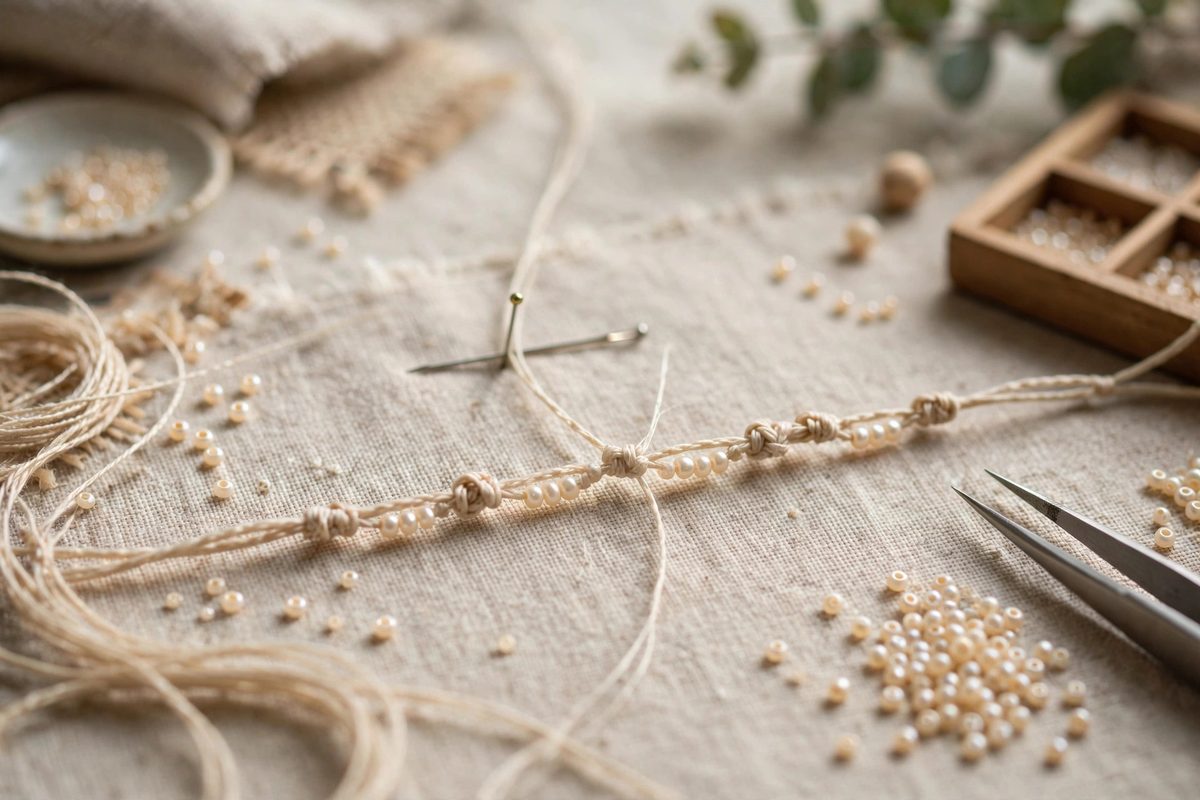
The Half-Hitch at Micro Scale
A half-hitch is one cord looped around another and drawn tight: the working cord wraps the anchor cord, passes through its own loop, and cinches. In macrame it is almost always worked as a double half-hitch (two hitches in sequence) for security, and in jewelry the anchor is often the bracelet's core cord with beads threaded on it. At miniature scale, everything about the knot shrinks except its importance: the hitch must grip the fine cord firmly enough to hold beads in place and survive daily wear, while remaining small enough not to overwhelm the design. A sloppy micro hitch is not a minor flaw; at this scale it is the most visible thing in the piece.
Cord Choice for Micro Work
Not every cord works at miniature scale. You need a cord fine enough for the design but with enough texture and body to hold a knot: slick, wiry cords slip, while soft, slightly textured cords grip. Waxed cords are popular in micro macrame because the wax adds grip and the knots seat firmly, but too much wax makes the cord stiff and hard to work tightly. Test the knot on your actual cord before committing: tie a series of double half-hitches, tug them firmly, and check that they hold without sliding. If the cord is too slippery for the design, consider a different cord rather than fighting it: no technique fully compensates for a cord that will not hold a knot.
Tension: The Whole Game
At micro scale, tension is everything. Each half-hitch must be tightened with the same firm, even pull: too loose and the knots slide and the bead spacing drifts; too tight and the cord distorts, the anchor cord kinks, and the work becomes rigid and lumpy. Develop a consistent tightening motion: after forming each hitch, pull the working cord smoothly until the knot seats, then give it a final snug tug. Keep the anchor cord taut while you work: a slack anchor lets the hitches wander and produces an uneven line. Many micro macrame artists work with the piece pinned to a board or held in a clip, because stabilizing the anchor cord frees both hands for the precise, repeatable motions the knots demand.
Placing Knots Around Beads
Beads complicate the knotting: each bead must sit exactly where intended, flanked by knots that hold it without crushing it against its neighbors. Thread the bead onto the anchor cord, slide it to position, and work the hitches snugly against it: the knot should touch the bead firmly enough to lock it, but the bead should not be under compression that could crack it. For very small beads, even the knot's bulk matters: plan the design so the hitch size and bead size are proportional. Count hitches between beads rather than measuring: consistent hitch counts produce consistent spacing, while measuring invites the tiny variations that accumulate visibly over a bracelet's length.
Finishing and Securing
Micro knots need secure endings because there is so little material to work with. Finish with several tight hitches, then trim the working cord close and seal the end: a tiny drop of clear-drying glue, carefully melted synthetic cord ends, or a whipped finish, depending on the cord. The seal must be minimal: a blob of glue is as visible at this scale as a bad knot. Test the finished piece with firm tugs before calling it done: jewelry gets pulled, caught, and stressed in daily wear, and a bracelet that fails in the first week is worse than one never finished.
Practice at Scale
Micro knotting is a motor skill, and motor skills need repetition. Before starting a piece, warm up on scrap cord: tie a few inches of even double half-hitches until the motion is automatic and the tension consistent. Work in good light with magnification if needed: eye strain causes tension inconsistency as surely as inexperience does. And take breaks: hand fatigue at micro scale shows up first as uneven knots, and pushing through it just means unpicking later.
Half-hitch micro knots reward patience with jewelry that looks impossibly precise: even knots, locked beads, clean finishes. Choose a grippy cord, stabilize the anchor, keep the tension metronome-steady, and finish securely. At miniature scale, consistency is the design.
Related Guides
- Clove Hitch Tension Locking for Miniature Micro Macrame: Micro macrame works at jewelry scale: fine cords, tiny knots, and pieces that must hold their shape under daily wear. The clove hitch, the workhorse
- Micro Macrame Lark Head Knots on Beaded Cording: Micro macrame jewelry works at a scale where every knot is visible and every millimeter matters. The lark's head knot, the foundational mounting knot
- Half Hitch Knot Locking Around Polished Stones: Setting a polished stone in macrame jewelry without metal findings comes down to one humble knot: the half hitch. Wrapped in series around the stone
- Micro Macrame Spiral Knots With 0.4mm Cordage: Micro macrame shrinks the ancient art of knotted cord down to jewelry scale, and the spiral knot, the half-knot repeated until it twists into a