
Micro macrame shrinks the ancient art of knotted cord down to jewelry scale, and the spiral knot, the half-knot repeated until it twists into a helix, is its signature texture. Worked in 0.4mm cordage, the spiral becomes a fine, rope-like column suitable for delicate bracelets, pendants, and earrings. The thin cord magnifies every inconsistency: uneven tension shows as lumps, miscounted knots break the rhythm, and frayed ends ruin the finish. Working at this scale demands good light, the right tools, and a disciplined technique, but the results have a precision that heavier cord cannot touch.
Why 0.4mm changes everything
At 0.4mm, the cord is closer to thread than rope, and the physics of knotting shift. Friction between the fine cords is high relative to their stiffness, which means knots lock readily but also means uneven tension locks in permanently; there is no loosening and redoing a knot tied three rows back. The knots themselves are tiny, so a tension variation invisible in 3mm cord becomes a visible irregularity here. On the positive side, the fine scale produces jewel-like detail: a spiral column in 0.4mm cord has the refined texture of a machined part, and color changes read as crisp stripes rather than muddy blends. The scale also means projects consume little material and work up into truly wearable, lightweight jewelry rather than chunky statement pieces.
Tools and setup for fine work
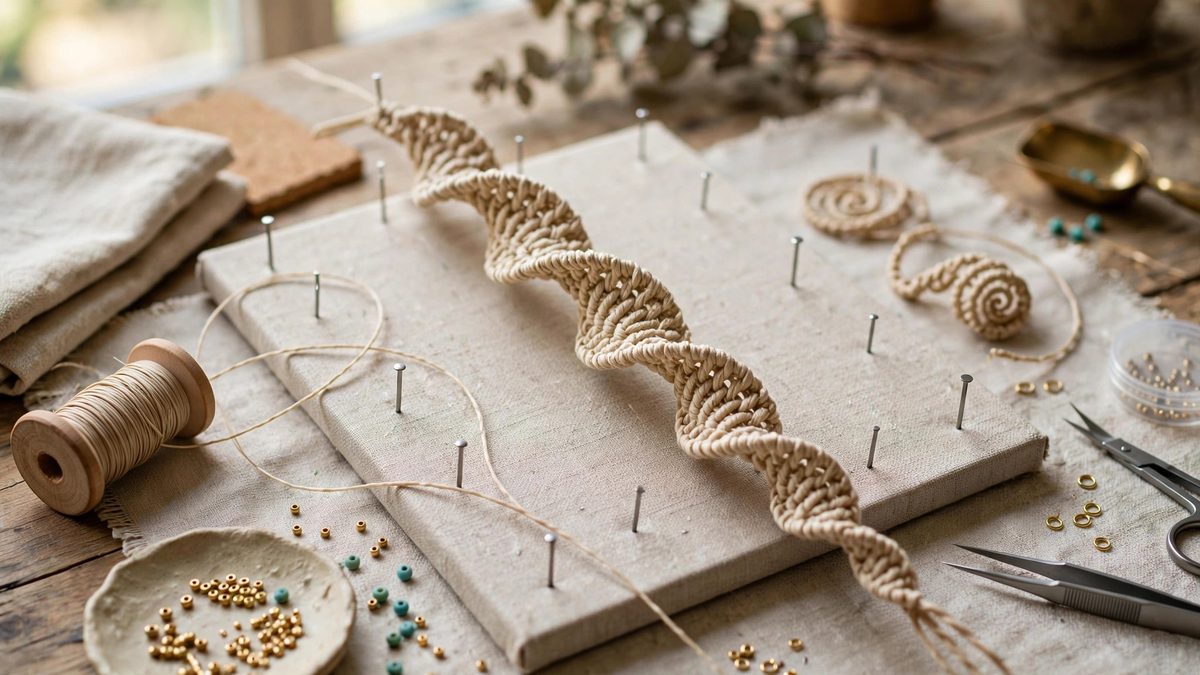
Set up for precision before knotting. Good magnification, whether a headband loupe or a desk magnifier lamp, is not optional at this scale; you cannot tension what you cannot see. Pin the work to a macrame board or a foam pad with fine pins, keeping the core cords taut and straight, since a wandering core produces a wandering spiral. Use sharp, fine scissors or a thread burner for cutting; frayed ends on 0.4mm cord are disproportionately messy. Keep the working cords organized and untangled, because fine cord knots itself if left to its own devices, and a tangle in 0.4mm is a project-ending event. Work in good light with a neutral background so the knot structure is clearly visible.
Tying the spiral knot at micro scale
The spiral knot is a half-knot repeated: the same half-knot tied over and over, each one rotating slightly relative to the last, building the helix naturally. At micro scale, the critical discipline is consistency of the half-knot itself: same cord over, same cord under, every time, since alternating the half-knot produces a flat sinnet instead of a spiral. Tension each knot firmly and identically; the spiral's regularity comes from uniform knots, and the twist rate, how tightly the helix winds, is set by the knot spacing, which is set by tension. Count knots rather than measuring length, because the spiral's pitch is more reliably controlled by knot count. If the spiral starts to flatten or reverse, a half-knot went the wrong way; back up to the error and fix it immediately, since the helix cannot be corrected from above.
Managing cord and joins
Fine cord comes in limited lengths per working end, so joins are inevitable in longer pieces. Plan joins at design points: behind a bead, at a color change, or at the clasp, where they hide naturally. Join by overlapping the old and new cords for several knots, trimming the tails close and securing with a tiny drop of jewelry glue wicked into the knot; at 0.4mm, a well-made join is nearly invisible. Keep the core cords continuous wherever possible, since the core carries the structural load and core joins are the weak points. Estimate cord needs generously before starting; running out mid-spiral with no matching dye lot is a familiar heartbreak. The standard estimate of four to six times the finished length per working cord holds at micro scale, erring toward more.
Finishing micro macrame jewelry
Finishing is where micro work succeeds or fails visibly. Trim tails with the thread burner for sealed, tiny ends, or with sharp scissors followed by a touch of glue to prevent fraying. Attach findings, clasps, jump rings, ear wires, with the same care as the knotting; a beautiful spiral with a sloppy clasp is a failed piece. Test the finished jewelry's strength with a firm tug before wearing or gifting; micro knots are strong in aggregate but a single missed knot in a structural spot can let go. Consider the wearer's skin: fine cord is comfortable, but glue residue and rough-cut ends irritate, so finish every end as if it will rest against skin, because it will.
Designing at the small scale
Micro scale invites design thinking that heavy cord does not support. Combine the spiral column with tiny beads threaded on the core cords, letting the knots trap them at intervals; the bead-to-knot scale relationship that looks clumsy in heavy cord looks intentional here. Vary the spiral's pitch deliberately for texture zones, or interrupt the spiral with bands of square knots for contrast. Color changes in 0.4mm cord produce fine striping that reads as sophisticated rather than busy. Sketch the design at actual size, since a pattern that looks balanced in a diagram can feel entirely different at true scale. The constraint of fineness becomes a creative engine once the technique is solid.
Micro macrame spiral knots in 0.4mm cord demand magnification, consistent half-knots, even tension, and meticulous finishing, and they repay the discipline with jewelry of exceptional refinement. Set up for precision, count the knots, hide the joins, and finish every end. Small cord, exacting standards, beautiful results.
Related Guides
- Micro Macrame Lark Head Knots on Beaded Cording: Micro macrame jewelry works at a scale where every knot is visible and every millimeter matters. The lark's head knot, the foundational mounting knot
- Clove Hitch Tension Locking for Miniature Micro Macrame: Micro macrame works at jewelry scale: fine cords, tiny knots, and pieces that must hold their shape under daily wear. The clove hitch, the workhorse
- Half-Hitch Micro Knots on Miniature Beaded Chords: Macrame jewelry lives at a scale where a millimeter matters: a bracelet cord barely thicker than thread, beads the size of seed pearls, knots that
- Half Hitch Knot Locking Around Polished Stones: Setting a polished stone in macrame jewelry without metal findings comes down to one humble knot: the half hitch. Wrapped in series around the stone