
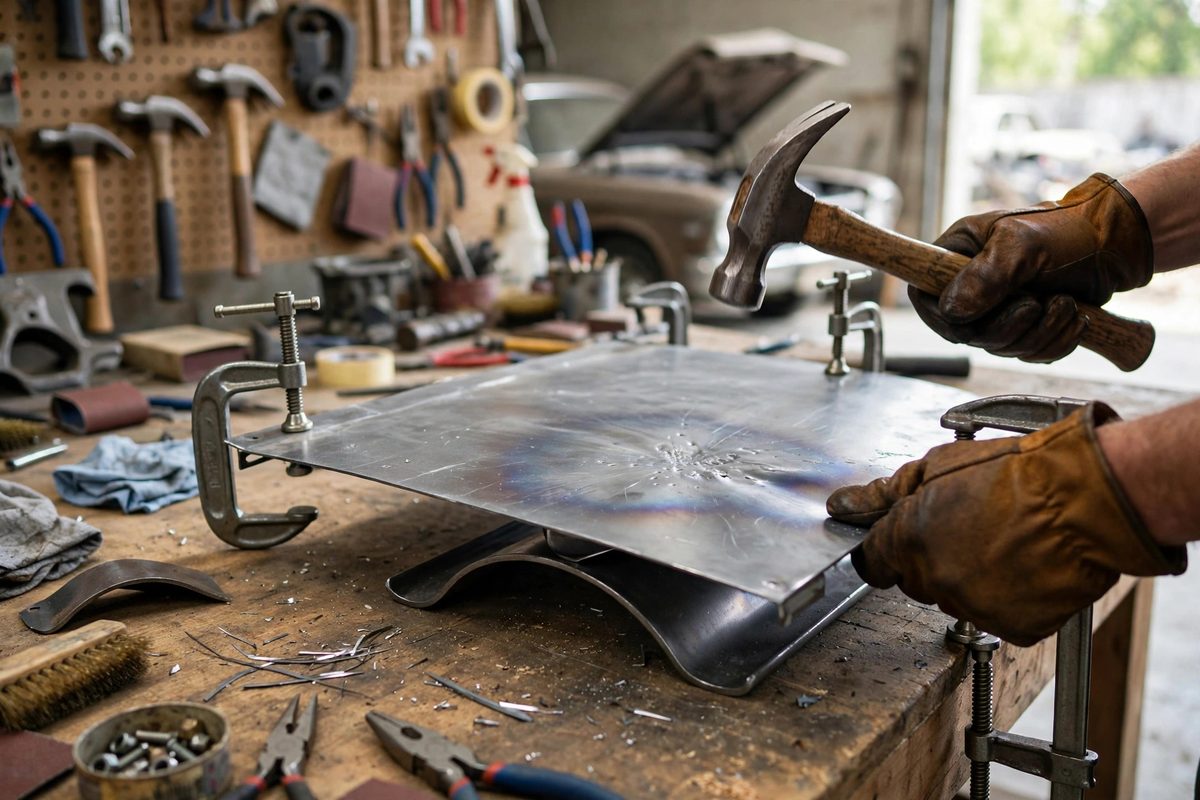
Thin automotive sheet metal stretches when it is dented, welded, or overheated, and stretched metal will not sit flat no matter how much filler you apply. Shrinking puts the metal back: hammer and dolly work compresses the stretched area, gathering the excess material until the panel lies true again. On thin modern panels, the technique demands a light touch and an understanding of what the metal is doing, because heavy-handed work stretches it further instead of shrinking it.
How Stretching Happens
When a panel dents, the metal in the dent gets longer; when it is welded, the heat-affected zone expands and then contracts unevenly, leaving the area oil-canning. Filler can hide the shape but not the instability: a stretched panel flexes, pops, and eventually cracks its filler. Shrinking addresses the cause by thickening the metal back up in the stretched zone. The hammer and dolly do this mechanically, squeezing the metal between the hammer face and the dolly's shaped surface so the excess length has nowhere to go but into thickness.
Reading the Panel
Before striking anything, read the damage. Push on the panel with your palm: a stretched area oil-cans (pops in and out with a click), while a simple low spot just sits low. Mark the stretched zone's boundaries with a marker; shrinking outside the stretched area creates new problems. Thin panels (modern sheet is often under a millimeter) show their stress clearly: the oil-can is your map. Work from the outside of the stretched area inward, shrinking the perimeter first so the excess metal gets herded toward the center rather than pushed outward.
Hammer and Dolly Selection
Use a flat-faced or slightly crowned hammer with a smooth, polished face; any ding in the hammer face prints itself into the panel. Match the dolly to the panel's contour: a flat dolly for flat areas, a curved dolly for crowned panels, a toe dolly for tight spots. The dolly goes behind the panel as the anvil, the hammer works from the front, and the two must meet squarely; glancing blows stretch, direct blows shrink. On thin metal, a lighter hammer (around a pound) gives better control than a heavy body hammer, because the goal is many small compressions, not few large ones.
The Shrinking Stroke
Hold the dolly firmly against the back of the panel, directly under where the hammer will land. Strike with light, rapid taps, on-dolly (hammer landing exactly over the dolly), moving in a tight spiral or grid pattern across the stretched zone. Each tap squeezes a tiny area of metal; hundreds of taps across the zone accumulate into real shrinkage. Check progress constantly with the palm test: when the oil-canning stops and the panel feels rigid, stop hammering. Over-shrinking creates a high spot that is harder to fix than the original stretch was.
Heat Shrinking as a Companion
For severely stretched areas, mechanical shrinking pairs with heat shrinking: a small spot heated with a torch (or a shrinking disc on a grinder) and then quenched contracts as it cools, pulling the surrounding metal in. Heat shrinking is powerful and easy to overdo on thin panels, so use small spots (dime-sized), quench promptly, and follow with light hammer-and-dolly to level the spot. Never heat-shrink a panel with filler or paint on it; strip to bare metal first, because trapped coatings contaminate the work and the heat.
Finishing the Panel
A properly shrunk panel needs minimal filler: a thin skim coat to perfect the surface, not a quarter inch to fake the shape. Prime bare metal promptly, since shrunk and stripped steel flash-rusts. Block-sand the filler with a long board to verify the panel's fairness; the eye forgives a lot, but a straightedge does not. The real test comes at paint time: a panel that was shrunk correctly stays stable through temperature cycles, while a panel that was merely filled will eventually telegraph its sins through the paint.
Hammer and dolly shrinking is metalworking's answer to stretched panels: read the oil-can, work light and on-dolly from the outside in, stop when the panel goes rigid, and finish with minimal filler. Learn it on scrap first, because the touch takes practice, but once it clicks, no dented panel will ever intimidate you again.
Safety note: wear eye protection whenever hammering on metal; chips and scale fly unpredictably. If heat shrinking, keep a fire extinguisher within reach, remove flammables from the area, and let the panel cool before handling bare-handed.
Related Guides
- Hammer and Dolly Shrinking on Stretched Metal: Sheet metal stretches when it is damaged: a dent pushed outward, a panel worked with a hammer, a crease pulled straight, all leave the metal with
- Slapping Spoon Contouring on Reverse Curve Auto Panels: Reverse curves, the S-shaped transitions where a fender crown rolls into a body line or a door skin sweeps into a wheel arch, are the hardest panels
- English Wheel Anvil Selection for Crown Curves: The English wheel shapes sheet metal by rolling it between a flat upper wheel and a curved lower anvil wheel, stretching the metal into compound
- Linear Stretching Mechanics on Curved Aluminum Fenders: An aluminum fender curves in ways that flat sheet cannot follow without changing its surface area. Linear stretching, elongating the metal along one