
Reverse curves, the S-shaped transitions where a fender crown rolls into a body line or a door skin sweeps into a wheel arch, are the hardest panels to shape. The slapping spoon, a heavy spoon-shaped dolly, is the traditional tool for contouring these areas, because it spreads hammer blows over a broad area and lets the metal move without the sharp dents that a flat dolly leaves. Used well, it coaxes complex curves into shape; used carelessly, it stretches the panel into an oil can.
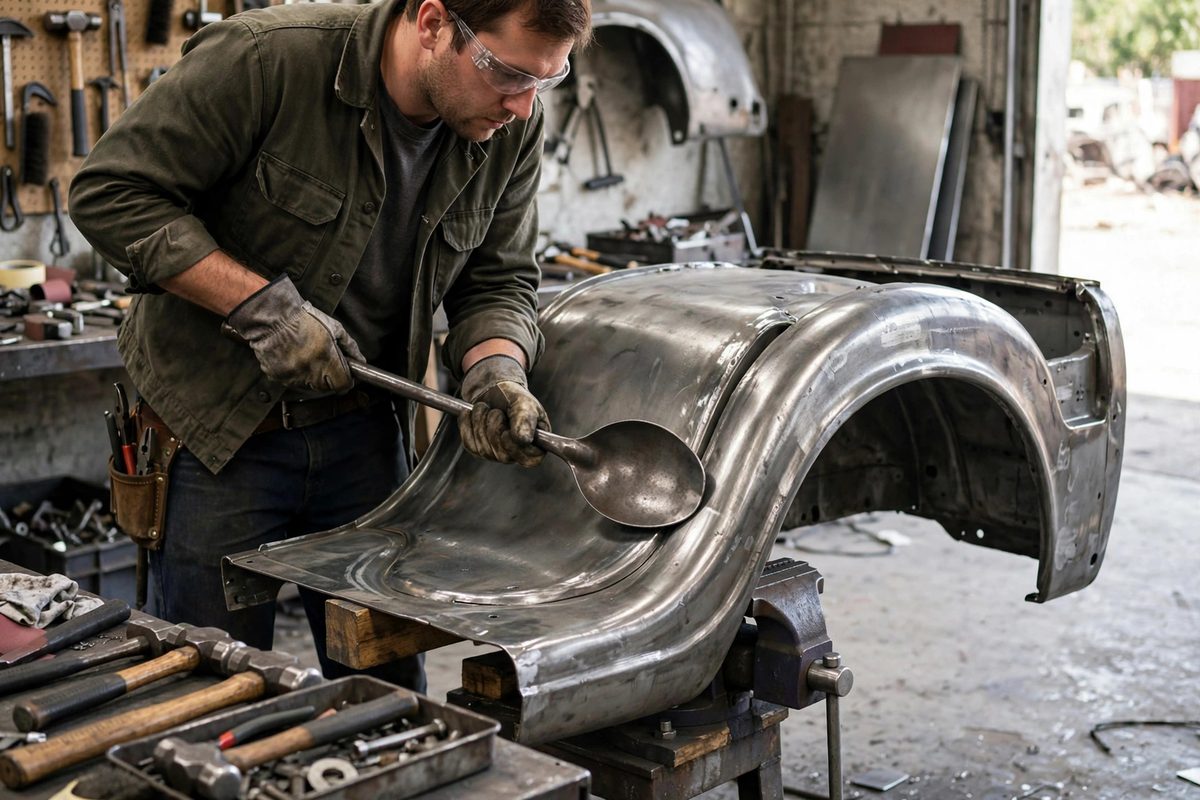
What the Slapping Spoon Does
A slapping spoon is essentially a large, smooth, slightly crowned striking face on a handle. Working it against a dolly held behind the panel, the restorer slaps the high spots down while the dolly supports the surrounding metal. The broad face distributes each blow so the metal moves as a zone rather than denting at a point. On reverse curves, where the panel changes from convex to concave, the spoon's shape lets it follow the transition without bridging across the low spots. The technique is more about persuasion than force: many light, overlapping slaps move metal controllably, while a few heavy blows stretch it. Stretch is the enemy in contour work, because stretched metal has to be shrunk back, which is far harder than moving it correctly the first time.
Reading the Panel Before You Strike
Before picking up the spoon, read the panel with your hand and your eye. Run your palm over the area to feel highs and lows; sight along the panel from a low angle to see distortions in the reflections. Mark the high spots lightly with a marker. On a reverse curve, identify the inflection line where convex becomes concave, because that line is your reference: work should blend across it, never flatten it. Check the panel's tension by pressing gently; an area that oil-cans, popping in and out, is already stretched and needs shrinking, not more slapping. Slapping a stretched panel makes it worse. Diagnose first, strike second.
Working the Reverse Curve
Hold the dolly behind the panel, positioned under the area adjacent to the high spot rather than directly under it; this is the off-dolly technique, where the blow lands beside the dolly's support and the metal between them moves. Slap the high spot with the spoon using light, rapid blows, working from the edges of the high area toward its center. Keep the spoon face flat to the panel's local surface so the blow lands evenly. On the concave side of the reverse curve, switch to a dolly with a matching concave face or use the spoon itself as the dolly from behind while tapping from the front with a pick hammer. Work slowly and check constantly; the panel changes shape gradually, and overworking one spot creates a new low that then needs raising.
Managing Stretch and When to Shrink
Every hammer blow stretches the metal slightly. On a reverse curve, uncontrolled stretching shows up as the panel growing loose and wavy, or as the inflection line wandering from its original position. If the panel starts to oil-can, stop slapping and shrink the stretched area. A shrinking disc on a grinder, used with care and followed by quenching, gathers stretched metal back; a torch with a small tip does the same in skilled hands. The rule is to shrink early and shrink small: a tiny shrink in the right place beats a large one after the panel has gone wild. Keep a body file handy to reveal highs; the file cuts the high spots bright and shows exactly where the metal still needs work.
Finishing the Contour
When the panel reads true to hand and eye, finish with a body file to level the surface, then a skim of filler only where needed. A well-worked panel needs minimal filler; filler is for perfection, not for structure. Prime the bare metal promptly to prevent flash rust, especially in humid shops. Stand back and sight the panel from multiple angles under raking light before calling it done, because the final judgment is always visual. A reverse curve shaped with a slapping spoon and finished by hand has a quality that machine-shaped panels rarely match: it looks like the car, not like a repair.
The slapping spoon moves metal in zones, which is exactly what reverse curves need. Read the panel, work off-dolly with light blows, watch for stretch, shrink early, and finish by eye. Patience with the spoon beats aggression every time.
Related Guides
- Hammer and Dolly Shrinking on Thin Automotive Panels: Thin automotive sheet metal stretches when it is dented, welded, or overheated, and stretched metal will not sit flat no matter how much filler you
- Hammer and Dolly Shrinking on Stretched Metal: Sheet metal stretches when it is damaged: a dent pushed outward, a panel worked with a hammer, a crease pulled straight, all leave the metal with
- English Wheel Anvil Selection for Crown Curves: The English wheel shapes sheet metal by rolling it between a flat upper wheel and a curved lower anvil wheel, stretching the metal into compound
- Linear Stretching Mechanics on Curved Aluminum Fenders: An aluminum fender curves in ways that flat sheet cannot follow without changing its surface area. Linear stretching, elongating the metal along one