
Needlepoint canvas is a grid, and the stitcher's contract with it is simple: the grid stays square, the stitches follow, and the finished piece matches the painted design. Interlock mono canvas, with its two threads locked at each intersection, resists distortion better than plain mono canvas, but it still distorts under the cumulative tension of thousands of stitches. Understanding how and why the mesh moves lets you stitch a piece that blocks back to true, instead of discovering the problem when the finishing begins and the deadline is near.
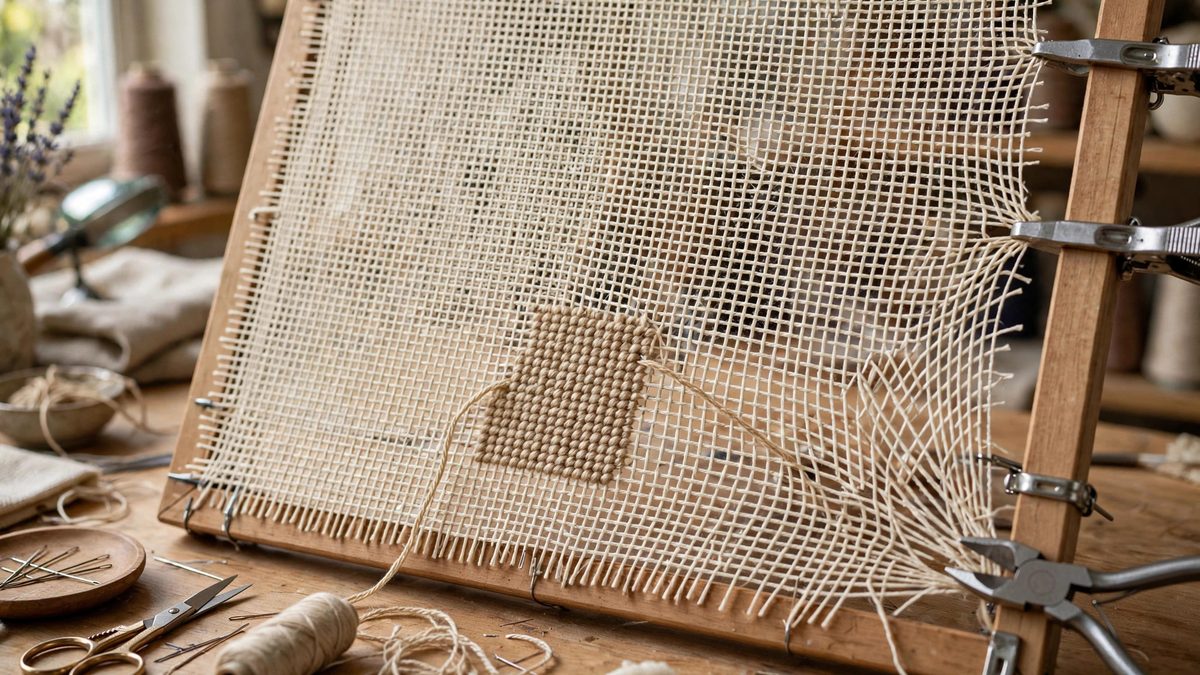
How canvas distorts
Every stitch pulls the canvas threads slightly, and the pulls accumulate in the direction of the stitching. Basketweave and continental stitches, worked diagonally, pull the canvas on the diagonal, gradually racking the grid into a parallelogram. The distortion is slow and invisible row by row, then suddenly obvious when the piece comes off the frame and will not lie square.
Interlock mono canvas resists this better than single-thread mono because the paired locked threads hold each intersection more firmly, but the improvement is relative, not absolute. Heavy stitching, tight tension, and large unframed areas still distort interlock canvas; the weave helps, it does not immunize.
Stitching techniques that minimize distortion
Alternate stitch directions to balance the pulls: work basketweave in the traditional alternating diagonal pattern rather than all rows in the same direction, so each row's distortion partially cancels the last. Keep tension even and moderate; strangled stitches distort far more than relaxed ones, and the difference compounds over a large piece.
Choose stitches with distortion in mind for large background areas. Basketweave, worked correctly in alternating directions, is the low-distortion workhorse for backgrounds; long diagonal stitches like the continental row after row are the worst offenders. The background is usually the largest stitched area, so its stitch choice dominates the piece's total distortion.
The frame: non-negotiable for large pieces
Stitch on a frame that holds the canvas taut and square: stretcher bars or a scroll frame, with the canvas mounted drum-tight and checked for squareness before the first stitch. The frame does not prevent stitch tension from pulling, but it prevents the pulls from accumulating into permanent set by holding the grid square while the stitches form around it.
Keep the frame tension consistent throughout the project. Canvas that is re-tensioned repeatedly or left slack for weeks develops uneven distortion that blocking struggles to correct. Mount it once, keep it taut, and rotate the frame rather than the canvas when working different areas. If you must remove the canvas mid-project, mark its mounted position so it goes back exactly as it was.
Monitoring squareness as you stitch
Check the canvas against square periodically: measure diagonals, sight along the grid lines, compare against the frame's right angles. Catching distortion early lets you compensate with stitch direction or tension before it sets permanently. A piece that has drifted a quarter inch over six inches needs attention now, not at blocking.
If distortion appears, the remedies are stitch-level: switch to alternating basketweave, ease tension slightly, and ensure the frame is still square and taut. Do not try to pull the canvas back square by stitching tighter in the opposite direction; that adds distortion rather than removing it.
Blocking back to true
Even well-stitched pieces need blocking: dampen the finished piece, pin it to a blocking board at the correct dimensions and square, and let it dry completely. Interlock canvas blocks well, returning to square when the distortion was kept within reason during stitching. The blocking board's grid lines are the reference; pin to them, not to the eye.
Know the limits: blocking corrects moderate distortion, not severe racking. A piece stitched wildly off-square without a frame may never block true, because the stitches themselves have set the threads in their distorted positions. Prevention during stitching beats correction at blocking every time, which is why the frame, the stitch choice, and the tension discipline matter more than the blocking board.
Canvas distortion is cumulative stitch tension against the grid: interlock weave resists it, alternating basketweave balances it, frames contain it, monitoring catches it, and blocking corrects what remains. Stitch square from the first row and the finished needlepoint will be square at the last.
Related Guides
- Mono Canvas Mesh Distortion Under Continental Stitches: Mono canvas, the single-thread needlepoint ground with its open, even weave, is a pleasure to stitch on until you notice the finished piece is no
- Mono Canvas Weft Distortion Under Continental Stitches: Every needlepointer meets the same disappointment: a canvas that started square and true comes off the frame pulled into a parallelogram, the design
- Preventing Tramming Warp Skewing on Duo Canvas Mesh: Tramming, laying a thread along the canvas before stitching over it, gives needlepoint its smooth, padded coverage. But on duo canvas, with its
- Preventing Diagonal Warp Skewing on Penelope Canvas: Penelope canvas, with its paired warp and weft threads, is the workhorse ground for needlepoint, but it has a known weakness: under the tension of