
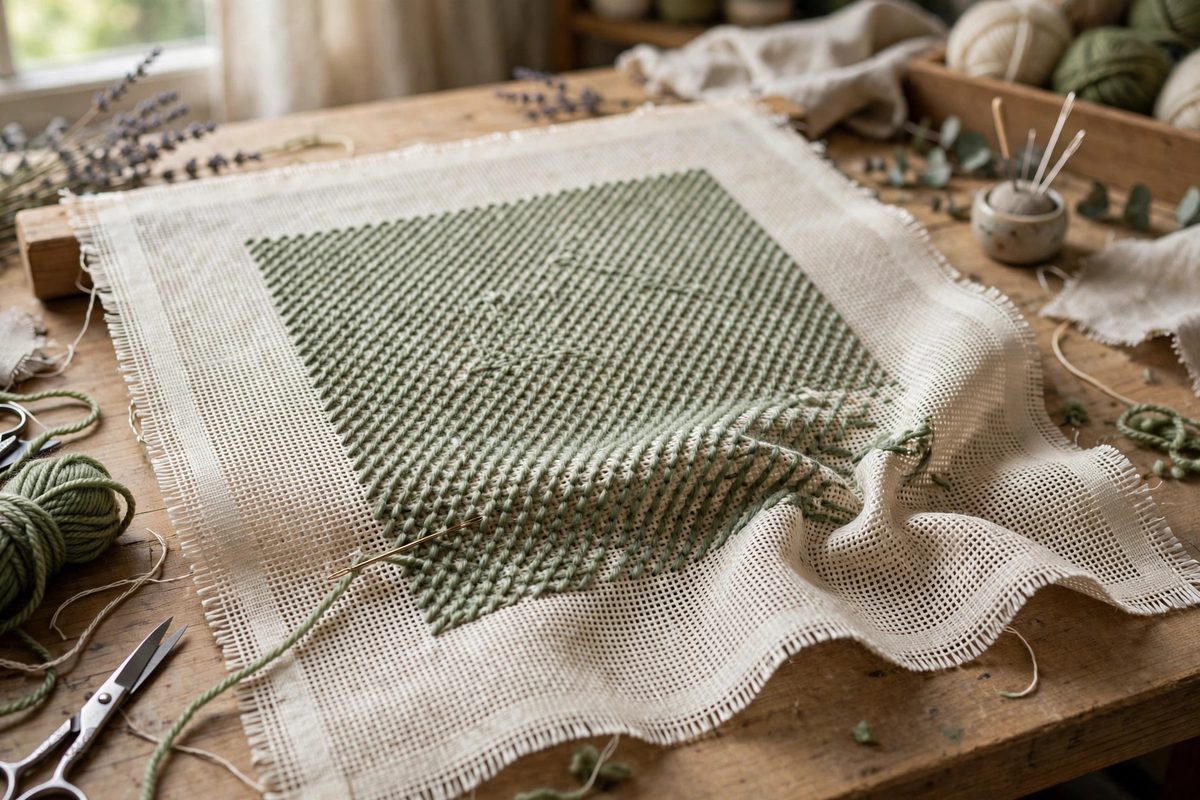
Mono canvas, the single-thread needlepoint ground with its open, even weave, is a pleasure to stitch on until you notice the finished piece is no longer square. The continental stitch, the workhorse stitch of needlepoint, pulls the canvas diagonally with every stitch, and over a large area those tiny diagonal pulls accumulate into visible distortion: the canvas skews into a parallelogram and refuses to lie flat. Understanding this distortion, and how to prevent and correct it, is essential needlepoint knowledge.
Why the Continental Stitch Distorts
Each continental stitch is a diagonal: the needle goes down through one hole and comes up through the hole diagonally adjacent, pulling the thread across the canvas intersection at an angle. That diagonal pull has a sideways component, and while one stitch's pull is negligible, thousands of stitches all pulling in the same diagonal direction add up. The canvas threads get dragged progressively off square, and because mono canvas is a single-thread weave with relatively little structural resistance to shear, it distorts more readily than stiffer grounds. The distortion is worst in large areas stitched entirely in continental stitch in the same direction: the bigger the area, the greater the accumulated pull.
Recognizing Distortion Early
Check for distortion long before the piece is finished. Lay the work flat periodically and check the edges against a right angle: if the corners are no longer square, distortion is underway. Another tell is the design itself: straight vertical or horizontal lines in the pattern start to slant. Catching it early matters because mild distortion blocks out easily while severe distortion may never fully correct. Do not assume it will block out no matter what: blocking can fix a surprising amount, but it cannot perform miracles on a badly skewed canvas, and overstretching to force squareness distorts the stitching itself.
Stitching Strategies That Minimize Pull
Several approaches reduce the accumulated diagonal pull. Alternating the stitch direction, working some rows or sections in the reverse continental (sometimes called the reverse tent stitch), balances the pulls against each other instead of letting them accumulate. Using the basketweave stitch for large background areas is the traditional professional solution: basketweave alternates the diagonal direction in a woven pattern that is inherently balanced, producing almost no distortion while giving the same surface appearance as continental. For small areas and details, continental is fine; the distortion problem is proportional to area, so reserve the balanced stitches for the big fields where it matters.
Frame and Tension Discipline
How the canvas is held during stitching affects distortion significantly. Stitching in hand, with the canvas loose, lets the fabric move freely under the stitch pulls and maximizes distortion. Mounting the canvas on a frame, stretcher bars or a scroll frame, held taut, resists the diagonal pull mechanically: the frame holds the canvas square while the stitches go in, and the distortion never accumulates. Keep the frame tension even and re-tension as needed, because a slack frame is little better than no frame. Also watch your personal stitching tension: stitching very tightly amplifies every stitch's pull, while a relaxed, even tension minimizes it. The goal is stitches that lie flat on the canvas, not stitches that strangle it.
Blocking Out Distortion
Some distortion is inevitable, and blocking corrects it. Dampen the finished piece (or steam it, depending on the fibers), then pin it to a blocking board, pulling it back to square: measure the diagonals to confirm squareness rather than trusting your eye. Pin at close intervals along all edges to distribute the correction evenly, and let the piece dry completely before unpinning: removing pins early lets the distortion spring back. For stubborn cases, blocking may need to be repeated, or the piece may need to be blocked under slightly more tension in stages. Professional finishers block needlepoint routinely, and there is no shame in sending a valuable piece out: they have the boards, the pins, and the experience.
Designing With Distortion in Mind
When planning a piece on mono canvas, design defensively. Break large background areas into sections stitched in alternating directions, or specify basketweave for backgrounds from the start. Avoid designs that require huge unbroken fields of continental stitch in one direction: the distortion is predictable, so the design should not invite it. And choose the canvas mesh appropriate to the design scale: finer meshes distort less visibly than coarse ones for the same stitch area, though they demand more stitching.
Mono canvas distortion under continental stitch is physics, not failure: diagonal pulls accumulate, and the canvas skews. Prevent it with balanced stitches and frame tension, catch it early by checking squareness, and correct what remains with careful blocking. Stitch with the distortion in mind and the finished piece will be as square as the day the canvas was cut.
Related Guides
- Mono Canvas Weft Distortion Under Continental Stitches: Every needlepointer meets the same disappointment: a canvas that started square and true comes off the frame pulled into a parallelogram, the design
- Interlock Mono Canvas Mesh Distortion Under Tension: Needlepoint canvas is a grid, and the stitcher's contract with it is simple: the grid stays square, the stitches follow, and the finished piece
- Preventing Tramming Warp Skewing on Duo Canvas Mesh: Tramming, laying a thread along the canvas before stitching over it, gives needlepoint its smooth, padded coverage. But on duo canvas, with its
- Preventing Diagonal Warp Skewing on Penelope Canvas: Penelope canvas, with its paired warp and weft threads, is the workhorse ground for needlepoint, but it has a known weakness: under the tension of