
Every needlepointer meets the same disappointment: a canvas that started square and true comes off the frame pulled into a parallelogram, the design skewed and the edges wavy. The culprit is usually the continental stitch, the workhorse tent stitch, pulling the canvas threads diagonally with every stitch. On mono canvas, where single threads cross in a plain weave, that diagonal pull distorts the weft progressively across the piece. Understanding the mechanism points to the preventions: stitch choices, frame discipline, and blocking that actually correct the problem rather than merely hiding it.
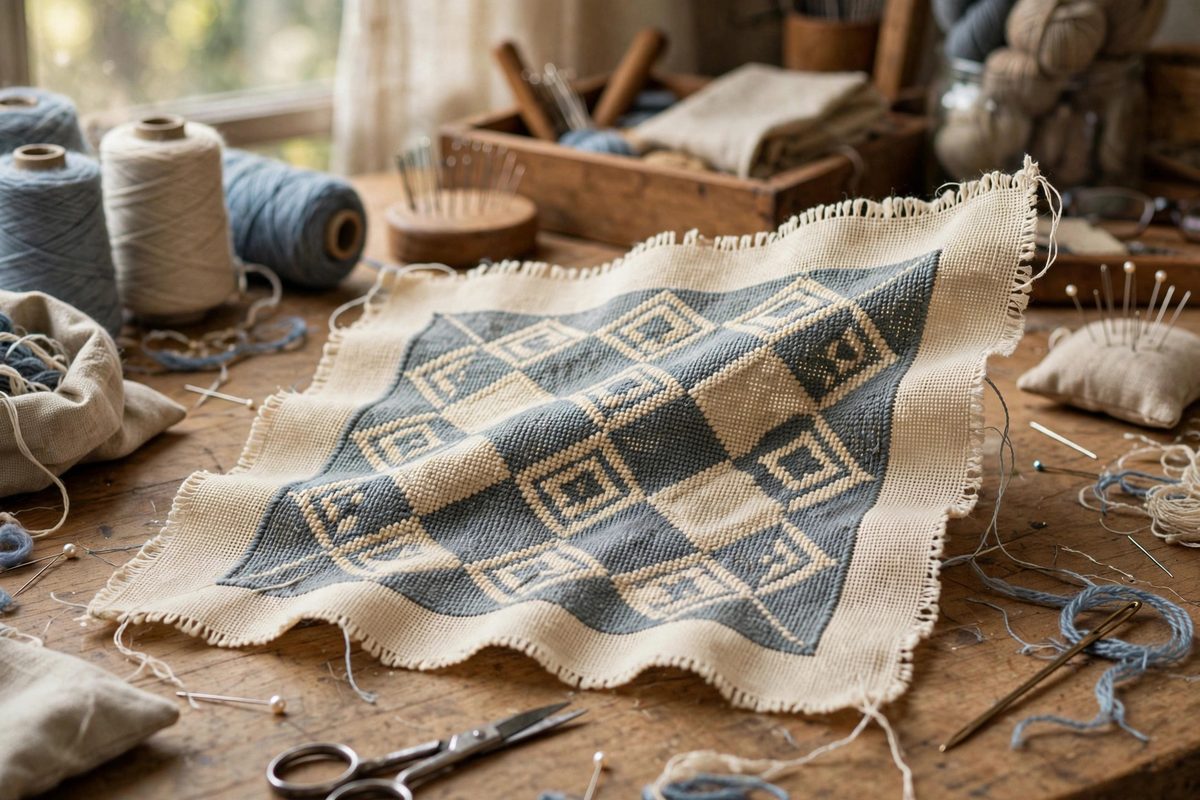
How the continental stitch pulls
The continental stitch crosses each canvas intersection diagonally, and each stitch exerts its tension along that diagonal. One stitch's pull is negligible; thousands of stitches' pulls accumulate in the same diagonal direction, shearing the canvas weave so the warp and weft threads scissor away from square. Mono canvas is particularly vulnerable because its single-thread weave has less structural resistance to shear than interlocked or double-thread canvases; the threads slide against each other relatively freely. The distortion is directional and predictable: the canvas biases toward the diagonal of the stitching, which is why experienced stitchers can often tell which stitch was used just by looking at the distorted canvas. The stitch is not wrong, but its mechanical consequence must be managed.
Why it matters beyond appearance
A distorted canvas is not merely an aesthetic problem. Pieces stitched for finishing, pillows, framed pieces, upholstery, must be square to fit their mounts; a skewed canvas either gets forced into shape, stressing the stitching, or finishes crookedly. The distortion also affects the design itself: motifs shear along with the canvas, circles become ellipses, and straight lines develop a lean. In pieces combining multiple stitch types, differential distortion between areas stitched continentally and areas stitched with balanced stitches creates internal stress that puckers the boundaries. Managing distortion is therefore part of the stitching plan from the first stitch, not a rescue operation at the end.
Prevention at the frame
The first line of defense is the frame. Stitch on a frame that holds the canvas taut and square, and check the squareness periodically during stitching; a frame that allows the canvas to relax lets the distortion accumulate unchecked. Some stitchers rotate the canvas or alternate stitch directions to balance the diagonal pulls, though this changes the stitch's appearance and must be done consistently to avoid a patchwork look. Maintaining even, moderate tension is more effective than most stitchers expect: much distortion comes not from the stitch's geometry but from overtight stitches compounding the diagonal pull. The continental stitch worked with a light, even hand distorts far less than the same stitch yanked tight.
Stitch alternatives and combinations
When distortion must be minimized, consider stitches with balanced pulls. The basketweave tent stitch, worked in diagonal rows that alternate direction, distributes its pull symmetrically and is the traditional solution for large background areas; it distorts dramatically less than continental while covering identically. For areas where the continental stitch's specific look is wanted, confine it to small regions where the accumulated pull stays manageable. Plan the stitch map with distortion in mind: large fields in basketweave, details in continental, and an awareness of how each region's pull affects its neighbors. The stitch choice is a structural decision wearing an aesthetic disguise.
Blocking: correction with limits
Blocking can correct distortion, but only within limits, and it cannot fix what the stitching made structural. To block, dampen the finished piece, pin it square to a blocking board, aligning the canvas threads to true horizontal and vertical, and let it dry fully. Mild distortion responds well; the canvas threads resettle into square and the piece finishes true. Severe distortion resists: the threads have been sheared so far that forcing them square stresses the stitching, and the piece springs back toward skew with handling. Worse, aggressive blocking of a badly distorted piece can pop stitches or break threads. The honest rule is that blocking finishes the job prevention started; it squares the last few degrees, it does not reverse a parallelogram. Stitch to minimize distortion, then block to perfect it.
Designing with the weave
The deepest solution is to design with the canvas's mechanical nature in mind. Orient the design so its critical straight lines and symmetries align with the canvas threads, making any residual distortion less visible. Avoid large unbroken fields of continental stitch where basketweave serves equally well. And accept that mono canvas plus continental stitch plus no frame equals distortion as a certainty, not a risk; the only variable is severity. The experienced needlepointer's calm about this topic comes from having internalized the physics: the stitch pulls diagonally, the canvas shears, and the stitcher plans accordingly from the first thread.
Mono canvas distorts under continental stitching because thousands of diagonal pulls shear the plain weave. Prevent it with a taut square frame, even moderate tension, and basketweave for large areas; correct the remainder with blocking, which perfects but does not rescue. Plan the stitching as structure, and the canvas stays true.
Related Guides
- Mono Canvas Mesh Distortion Under Continental Stitches: Mono canvas, the single-thread needlepoint ground with its open, even weave, is a pleasure to stitch on until you notice the finished piece is no
- Interlock Mono Canvas Mesh Distortion Under Tension: Needlepoint canvas is a grid, and the stitcher's contract with it is simple: the grid stays square, the stitches follow, and the finished piece
- Preventing Diagonal Warp Skewing on Penelope Canvas: Penelope canvas, with its paired warp and weft threads, is the workhorse ground for needlepoint, but it has a known weakness: under the tension of
- Preventing Tramming Warp Skewing on Duo Canvas Mesh: Tramming, laying a thread along the canvas before stitching over it, gives needlepoint its smooth, padded coverage. But on duo canvas, with its