
The Langstroth hive works because of a single measurement: bee space, the gap that bees treat as a passageway rather than as space to fill. Get the gaps right and bees build comb exactly where you want it, on the frames, leaving the hive inspectable. Get them wrong and bees do what bees do: they fill too-small gaps with propolis and bridge too-large gaps with burr comb, gluing your hive into a solid, uninspectable mass. Holding bee space tolerances is the core discipline of hive construction.
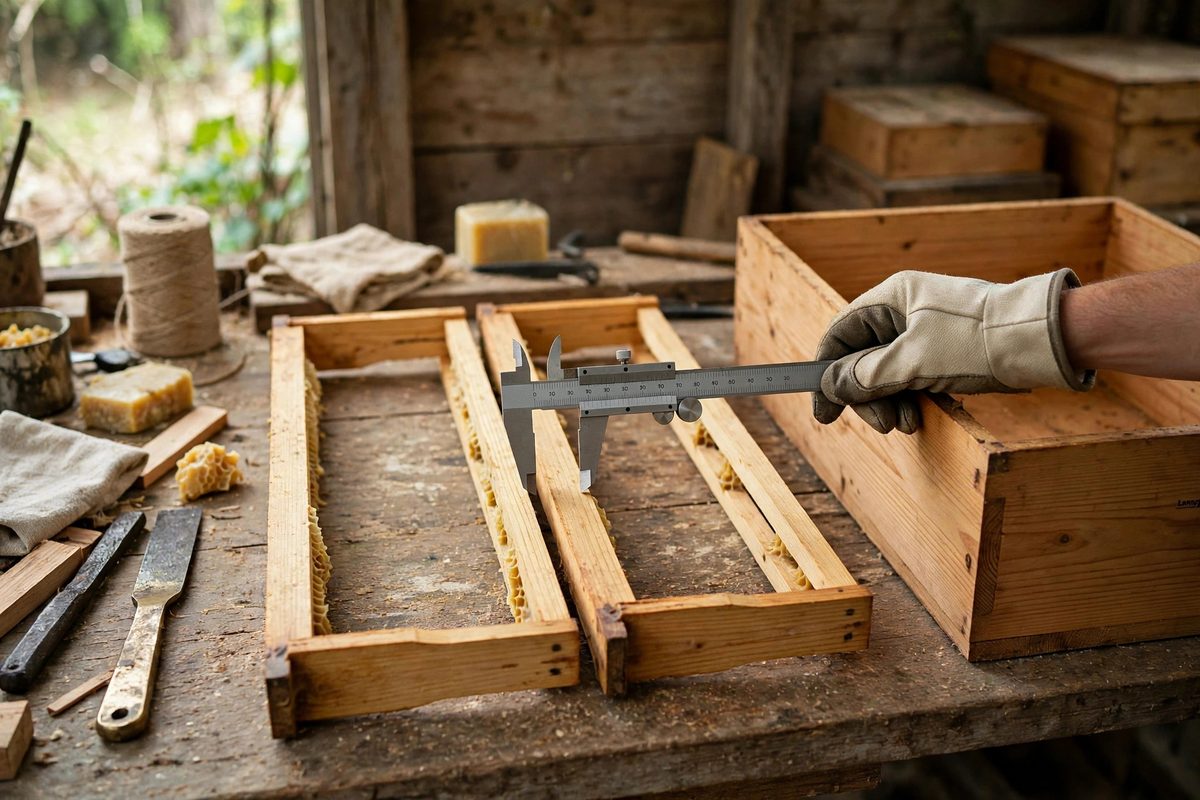
What bee space is and why it is fixed
Bee space is the gap between roughly a quarter inch and three-eighths of an inch, about 6 to 9 millimeters, with the classic figure often given as five-sixteenths of an inch. This is not a design choice; it is a biological constant. Gaps smaller than bee space get sealed with propolis, the bees' resinous caulk. Gaps larger than bee space get filled with comb, because to a bee, a big empty void is unfinished architecture. Between those limits, bees leave the space open as a walkway. The entire Langstroth system, removable frames in a box, depends on every internal gap falling inside this window: frame to frame, frame to box wall, box to box, and the space above the frames under the cover. The bees do not read your plans; they measure with their bodies.
Where tolerances matter most
The critical gaps are the ones the beekeeper disturbs most often. Frame spacing within the box must hold so that the gap between adjacent combs stays in bee space; this is why frames are built to standard widths and why frame rests and spacers exist. The gap between the end bars and the box walls matters equally, and it is where homemade boxes most often fail, since a box built a quarter inch too wide creates a propolis-and-comb mess along the walls. The space between stacked boxes, where the top bars of the lower box meet the bottom bars of the upper, must also hold; this is why box dimensions are standardized and why warped or swollen boxes cause trouble. Measure twice here: a box that is right in dry winter air may swell past tolerance in humid summer, so build to the tight side of the window where you can.
Building boxes to hold the window
Standard Langstroth dimensions exist precisely to encode bee space, so the first rule is to build to published plans rather than improvising. Cut box joints or rabbets accurately, because a sloppy corner that racks the box throws every internal gap off. Check the finished box with actual frames: drop frames in and measure the gaps at the walls and between top bars. Remember that wood moves; allow for seasonal swelling by keeping gaps toward the middle of the bee space window rather than at its edges, so a little swelling still leaves a passageway instead of a propolis joint. Seal exterior surfaces with paint or another weatherproof finish to slow moisture cycling, but leave interior surfaces bare: bees manage the interior climate themselves, and coatings inside the hive interfere with that.
Frames, foundation, and the beekeeper's habits
Even perfect boxes fail if frames are mishandled. Push frames tightly together in the center of the box after inspections, because a frame left ajar creates an oversized gap that invites burr comb. Replace frames with blown-out or warped end bars; a bowed frame narrows one gap and widens the next, violating tolerance in both directions at once. When installing foundation, make sure it hangs straight and centered so the drawn comb stays within the frame's envelope. During inspections, scrape burr comb and propolis buildup from frame rests and top bars, because accumulated deposits gradually close gaps below bee space and the bees respond by gluing things tighter. The hive is a precision instrument that the bees constantly try to recalibrate; your job is to keep resetting it to spec.
Reading the bees' corrections
The bees themselves are your tolerance gauge. Brace comb between frames means a gap was too wide; propolis gluing frames to walls means a gap was too narrow. When you find either, measure the offending gap and correct the cause rather than just scraping the symptom. A box that chronically grows burr comb along one wall has a dimensional problem, not a bee problem. Over time, reading these corrections trains your eye for the tolerances that matter, and hive construction stops being a matter of faith in the plans and becomes a matter of verified measurement.
Bee space is one of those rare cases where nature gives you an exact specification. Hold every gap between a quarter and three-eighths of an inch, verify with frames and a ruler rather than hope, and the bees will build where you ask them to, leaving you a hive you can actually work.
Related Guides
- Top Bar Hive Comb Width Spacing for Brood Frame Health: In a top bar hive, the width you give each bar decides the shape of the comb the bees draw, and comb shape decides brood health. Too wide and the
- Screened Bottom Board Airflow Ratios for Hives: The screened bottom board replaces the hive's solid floor with mesh, and the question every beekeeper asks is how much screening is right: full open
- Horizontal Frame Spacing for Top Bar Natural Beekeeping: Top bar hives do away with frames and foundation, letting bees build natural comb hanging from wooden bars. The spacing of those bars is the
- Screened Hive Base Airflow Ratios for Varroa Drops: A screened bottom board does two jobs for a hive: it ventilates the colony, and it gives falling varroa mites a one-way trip out of the hive. Mites